
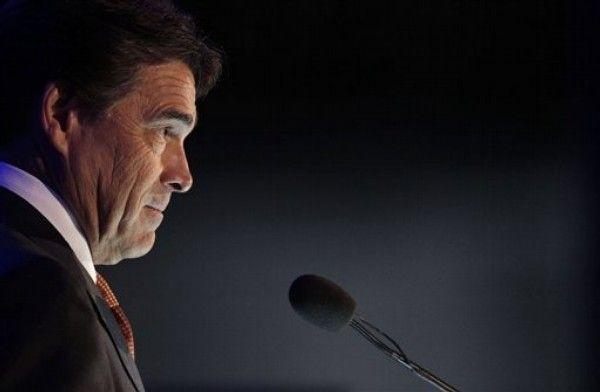
Perry, Conservatives and Gay Marriage: An Evolving View?
Published July 26, 2011 • Read time: 7m
The Republican Party may be recalibrating its approach to gay marriage at the highest level since embracing the spirit of the tea party, with its deep mistrust of the federal government and support for states' rights.
Two of the most prominent social conservatives looking toward the 2012 presidential election -- Texas Gov. Rick Perry and Minnesota Rep. Michele Bachmann -- now have suggested deferring to the states on marriage laws. That stance meshes somewhat with former Utah Gov. Jon Huntsman's view, and he is perceived to be the most socially moderate candidate in the GOP field. For a party that has in the past remained adamantly opposed to gay marriage, the coming presidential race may be the forum where that position gets a fresh look.
But it was Perry's comments Friday in Colorado that have made social conservatives uneasy, and they expect him to explain himself upon entering the presidential race.
At an event in Aspen, Perry said, "Our friends in New York six weeks ago passed a statute that said marriage can be between two people of the same sex. And you know what? That's New York, and that's their business, and that's fine with me." He continued, "That is their call. If you believe in the 10th Amendment, stay out of their business."
The 10th Amendment reads: "The powers not delegated to the United States by the Constitution, nor prohibited by it to the states, are reserved to the states respectively, or to the people." Perry has been an avid protector of the amendment in his rhetoric over the last few years, which has helped to make him something of a darling to the tea party faithful.
Cruz's Path to Nomination
Trump Stands by His Manager
With Tweets on Heidi Cruz, Trump Sinks to New Depths
A Vote for Kasich Is a Vote for Trump
Although Republicans are quick to say "leave it to the states" on any number of issues, the socially conservative wing of the GOP favors a Federal Marriage Amendment that would restrict marriage to one man and one woman. Such an amendment failed to pass the House in 2006 and likely would never pass the Senate.
And so now there are the makings of an uncomfortable clash between the federalists and the social conservatives within the party about how the issue should be addressed going forward, and potential candidate Perry has found himself right in the middle of it.
Enter Oran Smith, the president of the Palmetto Family Council, a conservative, family-values organization in South Carolina, which carries weight among conservatives who vote in the early Republican primary there. Smith said he has been bombarded with emails from activists over the past 48 hours about Perry's comments -- with mixed responses.
"I've gotten everything from people saying how horrible it was to how it was the right thing to do," he said.
Smith said he believes that Perry's comments will give conservative voters pause about the Texas governor's possible candidacy, and if he doesn't explain himself, those comments may make them hesitant to support him.
"It's the way he said it," Smith said, noting that Perry said he was "fine" with New York's new law. He explained that if by "fine" he means he's happy about it, that won't sit well with evangelical voters, but if he's approaching it as a constitutional lawyer would, it may not be so bad.
At the same time, Smith said he's concerned that Perry's comments suggest he could be "slippery" on other issues. "And he may be perceived as stumbling out of the gate because of a poor choice of words," he said, indicating that such a stumble could hurt Perry in the early voting states of Iowa and South Carolina, where he would need to do well.
Gary Bauer, president of the conservative advocacy group American Values, expounded on those sentiments in an interview.
"His comments were inartful and disappointing. The 10th Amendment and states' rights is very important to conservatives, but it's not our highest value," Bauer said. "There are some things so fundamentally wrong that we have not left those things up to the states."
Bauer added, "The governor also seemed unaware that the threat we are facing is the same-sex laws of New York and Massachusetts being forced on the whole country. So I think he still has great potential, but I think it's a sign that even if you are a governor, the transition to the presidential sweepstakes requires a lot of study and understanding the nuances of these issues."
Bob Vander Plaats, president of the Iowa Family Leader, another conservative advocacy group, was slightly less critical but figured that Perry will want to clear up his comments.
"I hope it's more of an education issue to understand this is going to a federal level," he said, adding, "Many of us advocated for states' rights and were big 10th Amendment people, but when it comes to things like whether its slavery, and abortion, or marriage, we're not saying, ‘Well it's OK to have slavery in Alabama but not Iowa.' And our group wouldn't say, ‘It's OK to have abortion in the state of Washington but not in Iowa.' Some things are right and some things are wrong, and especially when it comes to marriage, it's a foundation block and a building block for society."
Vander Plaats warned, "I think there's a lot of excitement about his potential energy, but as the excitement heightens, the scrutiny will also heighten. So the remarks in Aspen no longer stay in Aspen. Some people are going to ask, ‘Where do you stand?' "
And as leading conservative activist Ralph Reed -- the founder of the Faith and Freedom Coalition -- said in an interview Monday, Perry will have to say upon becoming a candidate whether he would support a Federal Marriage Amendment to the Constitution.
"My expectation is that he is for it," Reed said. "If he is, end of story."
Nevertheless, as Smith put it, "Perry was sounding a lot like Jon Huntsman, who was supposed to be the liberal in the race."
For his part, Huntsman has said he does not believe traditional marriage should be redefined, but he also led the charge to legalize civil unions in his home state. He told the Christian Broadcasting Network's David Brody recently, "Subordinate to traditional marriage -- one man, one woman -- I think we sometimes don't do an adequate job in talking about equality and in addressing fairness: hospital visitations, reciprocal beneficiary rights, insurance. There are a lot of these issues that I think we can do better with as people in the name of fairness and in the name of equality."
In a CNN debate in New Hampshire in June, Bachmann said, "I don't see that it's the role of a president to go into states and interfere with their state law." She spoke of her personal support for traditional marriage and said that a federal amendment would require state ratification, so that would be acceptable to her -- leaving herself some wiggle room and leaving some debate watchers confused about her position.
Still, Bauer intimated that socially conservative voters might be more comfortable with her stance than Perry's given her caveat.
"She didn't say anything like ‘that's fine with me.' I have no doubt what Michele Bachmann would do if [the Defense of Marriage Act] comes back up for a vote in Congress, nor do I have any doubt what she would do in Minnesota when the state addresses the issue there," he said. "And I don't have any doubt that Perry would oppose same-sex marriage in Texas. What I would not want to see is a trend where states' rights becomes the knee-jerk answer, even on matters that fundamentally oppose other parts of the Republican platform."
Of course, the battle in the Republican primary over the issue is just a warm-up before the general election, where President Obama has begun to modulate his own position. What's more, eight Republican senators favored the repeal of "Don't ask, don't tell" late last year.
"It's going to be an issue because Obama has said his views ‘are evolving on this,' whatever that means" Reed said. "It's going to be an issue in 2012, but there isn't going to be a huge change in the Republican Party, and our nominee will support traditional marriage."
Added Bauer, "I have no doubt that by the time of the presidential election next year, it'll be clear that the president wants to maneuver to have nationwide same-sex marriage and that the Republican presidential candidate is diametrically opposed."

Jon Finer’s Old and Dangerous ‘New Approach’ to Israel
Peter Berkowitz • RealClearPolitics
The President Deserves Better
John Ullyot • RealClearPolitics
Congress Doesn’t Need Another Blame Game. It Needs To Find What’s Broken
Jarrod Bernstein • RealClearPolitics
Democrats Won the Midterms. Common Sense Won, Too
Jordanne Kemper • RealClearPolitics
The 120th Congress Shapes Up
Carolina Lumetta • RealClearPolitics
Flooding GOP Primaries With Democrats
Robert Natelson • RealClearPolitics
RCP Today
Top stories on RealClearPolitics
The Takeaway
Polling intelligence and analysis delivered to your inbox
World News
Featuring the latest world news
Policy
Featuring the latest policy news
Support Our Mission
As part of RealClearPolitics, authors aim to provide balanced, non-partisan analysis by presenting top reporting and commentary from all sides of the political spectrum.
Trusted by policymakers and citizens alike since 2000