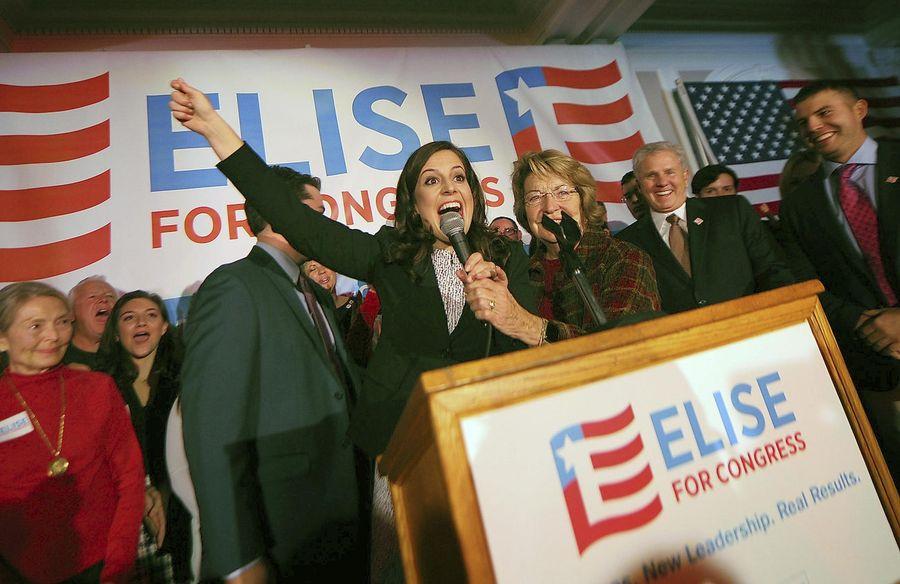
Rep. Elise Stefanik, R-N.Y., celebrates her campaign victory on election night in Glens Falls, N.Y., on Tuesday, Nov. 8, 2016. (Steve Jacobs /The Post-Star via AP)
If the Future Is Female, the GOP Needs Women Candidates
COMMENTARY
Published Jan. 24, 2019 • Read time: 5m
We’re less than a month into the New Year, and four Democratic women have stepped into the 2020 presidential election – Sens. Elizabeth Warren, Kirsten Gillibrand and Kamala Harris and Rep. Tulsi Gabbard. President Trump, the defeat of Hillary Clinton, and the identity politics of progressives all act as a magnet, pulling women candidates into Democratic primaries. Being female is an asset in Democratic Party circles.
Among Republicans, however, gender isn’t viewed as an obvious benefit. It’s certainly not a recruitment draw for candidates. But ignoring gender and failing to invest in more female lawmakers has set Republicans way back politically and limited important policy debates. If they’re willing to do the work, Republicans could benefit from changing this dynamic.
Democrats increasingly view their party’s future as the intersectionality of race, ethnicity, gender, and sexual orientation. Boston Globe columnist Renée Graham described the 2018 midterms as a “defiant mandate that Democrats want diverse and progressive representation, not just the same revolving door of old white guys.” Some Democrats might be more circumspect in their descriptions, but the sentiment is widespread. The Pew Research Center found that among Democrats strong majorities – 75 percent of men and 83 percent of women – viewed the recent surge of women candidates as a good thing.
The same cannot be said for Republicans. In response to identity politics, they often dig in their heels, rejecting any suggestion that they need to increase the diversity of their ranks. When Rep. Elise Stefanik – head of recruitment for the National Republican Congressional Committee last year – complained that the 100 female candidates she helped recruit needed more institutional support, she received scorn from NRCC Chairman Tom Emmer, who publicly called her strategy “a mistake.” As Perry Bacon wrote over at FiveThirtyEight last summer, Republicans simply don’t think electing more women to office “should be a goal.”
Cruz's Path to Nomination
Trump Stands by His Manager
With Tweets on Heidi Cruz, Trump Sinks to New Depths
A Vote for Kasich Is a Vote for Trump
Two professors from Harvard University and the University of Houston found equally concerning results from a randomized controlled trial in which they exposed respondents to a female Republican or a male Republican candidate. While Democrats and independents were more likely “to trust, think qualified, view as a leader, and vote for the female Republican,” the opposite was the case among Republicans. GOP women candidates suffered within their own party.
And so, despite the efforts of many outside groups like Winning for Women, RightNow Women, View PAC and now E-PAC, there is still a dearth of strong female Republican candidates in the pipeline, and those who emerge experience difficulty raising money, and ultimately problems with retention. This indifference on the right toward gender isn’t just affecting the party at the national level. As Bacon points out, “Republican women are getting elected at lower numbers than Democratic women to state legislatures, a key stepping stone for people who eventually get to Capitol Hill.”
In some respects the problem is confusing. Conservatives believe in biological gender differences. Many female conservatives like myself point to natural sex differences to explain varying outcomes in life: women generally prefer the humanities, while men favor hard sciences; female doctors tend to be pediatricians, while male doctors more often become surgeons; women prefer veterinary school, while men prefer business school. When it comes to politics, however, conservatives brush gender differences aside. In the political sphere, gender disappears and it’s just the policies that matter.
Certainly, women should not be defined solely by their gender – but it is part of our identity. And our shared experiences as women – as wives, mothers, caretakers – give us unique perspective about our families, communities, and the nation. And, just as important, voters perceive female candidates differently. Consider if Republicans had more women to talk about educational freedom and competition. Or more female candidates who could empathize with working moms, but also caution against a paid leave entitlement program that could jeopardize women’s progress. What if there were more women lawmakers who could speak about women as health care consumers and introduce market-based reforms such as giving individuals who purchase insurance the same tax benefits as businesses? What’s more, because voters perceive female candidates as less conservative, all else being equal, conservative women are more likely to win in swing districts than conservative men.
Without more women, Republicans are going to continue to lose elections they could otherwise win. In the 2018 midterms, Democrats gained 41 seats in Congress; 13 female Democrats unseated male Republicans. That is a third of the seats Democrats won. Nearly one-fourth of the new Congress is female. Out of 127 female members, 106 are Democrats.
In the age of Donald Trump’s populism, Republicans already have a big barrier to overcome with many women. (At an event I spoke at recently, nearly every right-of-center participant worked to distance herself from the current administration.) But these women – and many more – are still committed to sensible, limited-government policies in which Americans of all races and creeds will have more freedom and opportunity.
Making women candidates a priority doesn’t mean that we have to embrace identity politics or ignore important principles that guide our policy perspectives. Rather, taking gender seriously aligns with the conservative viewpoint that gender differences matter. Effective politics – and ultimately policymaking –requires diversity, so that it’s clear we stand for universal principles and policies that are good for all Americans.

A RealClear Thanksgiving: Investing in a Better Future
David DesRosiers • RealClearPolitics
Trump’s Newsom Problem: Antagonist-in-Chief
Carolina Lumetta • RealClearPolitics
America’s Free Spirit
John Maxwell Hamilton • RealClearPolitics
The GOP Majority Should Go Out in Glory
Daniel McCarthy • RealClearPolitics
Republican Majorities Could Return Sooner Than Expected
J.T. Young • RealClearPolitics
The Danger Before the Attack
Leslie J. Sullivan • RealClearPolitics
RCP Today
Top stories on RealClearPolitics
The Takeaway
Polling intelligence and analysis delivered to your inbox
World News
Featuring the latest world news
Policy
Featuring the latest policy news
Support Our Mission
As part of RealClearPolitics, authors aim to provide balanced, non-partisan analysis by presenting top reporting and commentary from all sides of the political spectrum.
Trusted by policymakers and citizens alike since 2000