Challenging Trump: Republicans' 2020 Question
Published Oct. 27, 2017 • Read time: 7m
Join the Conversation
0After Sen. Jeff Flake delivered a remarkable indictment of his own party’s president Tuesday, speculation quickly arose about whether he might challenge Donald Trump in 2020.
The mere mention of the next election likely agitated Americans still trying to recover from last year's all-consuming and contentious campaign, and reflected the perpetual horse-race mindset of modern U.S. politics. But even three years out, the question of whether a Republican would challenge Trump for re-election isn't all that surprising given how tensions within the party bubbled over this week.
In announcing his impending departure from the upper chamber, Flake articulated why the president may be ripe for a serious challenge for the nomination — and why Republicans may not be up for it.
On paper, Trump looks like an embattled incumbent. His approval ratings are low; GOP lawmakers are constantly fending off questions about his behavior and approach to governing; and he has little to show legislatively for his time in office. Flake's diatribe, combined with other high-profile criticisms of the commander-in-chief this week, highlighted seemingly irreconcilable differences within the party at a time when unity is critical.
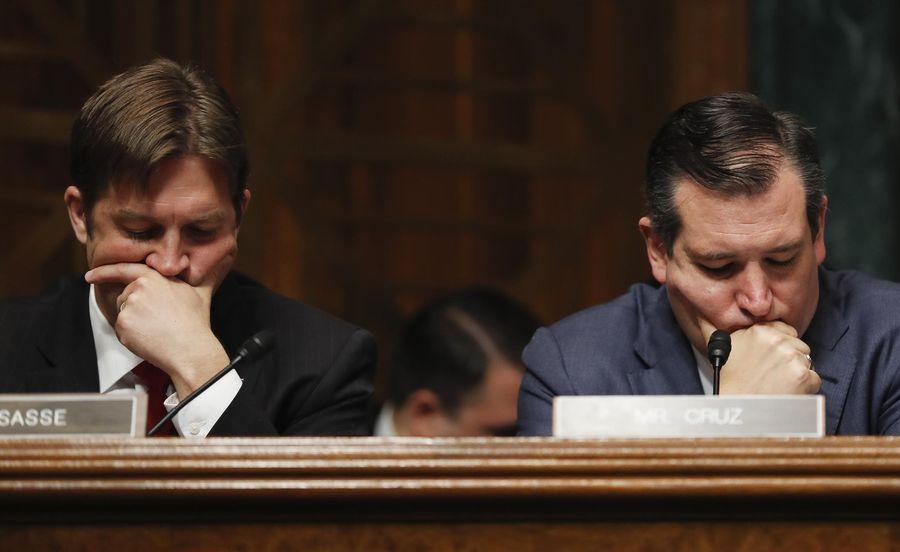
And though Trump defeated more than a dozen fellow contenders in the 2016 primary and defied orthodoxy on his way to taking down Hillary Clinton in the general election, some Republicans argue he could be vulnerable one-on-one. A few potential challengers, such as Nebraska Sen. Ben Sasse, have been seen in Iowa. And Democrats have reportedly begun prepping opposition research on possible Republican rivals.
Cruz's Path to Nomination
Trump Stands by His Manager
With Tweets on Heidi Cruz, Trump Sinks to New Depths
A Vote for Kasich Is a Vote for Trump
Yet the events of this week found Trump's base of support to be durable. While excoriating comments by Flake and fellow retiring Sen. Bob Corker seemed to put pressure on fellow party members to do likewise, their congressional colleagues did not follow suit. Some dismissed the clashes as insignificant, even bothersome to the legislative tasks at hand. Ted Cruz, who just last year told Republicans to vote their conscience, said lawmakers should "shut up and do your job."
Flake's decision not to take his case to Arizona voters in 2018 underscored Trump's hold on the GOP. The senator acknowledged he would not likely survive a Republican primary in his state, after having been openly and repeatedly critical of the president. Polling shows a vast majority of Republicans still support the president. And one recent CNN survey found that more GOP voters support Trump's direction for the party than that of congressional leadership. A Pew poll released this week found deep fissures and multiple constituencies within both parties, but support among Republican-aligned voters remained solid.
The news surrounding Flake also suggested that the divisions between Republicans of his ilk and supporters of Trump is more political than policy-oriented. Save for a couple of agenda items, including immigration reform, Flake has been a top supporter of the president's priorities, voting in favor of big ticket issues like Obamacare repeal, executive appointments, and the budget. Some party strategists argue that rhetorical differences aren't enough to break up the party.
The results of the upcoming battle over tax reform legislation could mark a key point in the relationship between congressional Republicans and the president. Success would show an ability to govern and could restore GOP voters’ faith in party lawmakers and Trump. But failure could deepen divisions. The president and voters would likely blame Congress, and lawmakers might be more inclined to turn on the president and argue for a change at the top. The results of the midterm elections will also shape the path to 2020.
"The wind is at the back of Donald Trump and Steve Bannon and the nationalist-populist movement, and the establishment Republican Party faction is at their mercy," says GOP strategist Alice Stewart. "If there are legislative accomplishments, the likelihood of a viable challenger goes down. If there are not substantive legislative accomplishments, a chance for a viable challenger becomes more likely."
For his part, Flake wouldn't exactly rule out a primary bid. "That's a long time away," he told ABC News. "And we'll deal with that when it comes to it.”
Ohio Republican Gov. John Kasich also has made show of his disagreements with the president, and is often mentioned as a potential challenger to Trump -- though there is also speculation he could run as an independent. Still, Kasich managed to win only his home state in the GOP primary last year, and was seen as more of a nuisance by those in the party determined to keep the nomination from Trump and eager to see a stronger rival emerge.
Sasse has been among the more vocal critics of Trump, and campaigned against him during the primaries by supporting other candidates. He released his own book this year and has been aiming to increase his profile. This week, as his colleagues announced their support for Roy Moore in the Alabama Senate race, Sasse raised concern about his would-be colleague, who was twice kicked off the state Supreme Court. "It feels like this party that I'm a part of has gone post-constitutional," he said. But earlier this year, Iowa GOP Chairman Jeff Kaufmann lambasted Sasse during a Trump rally, signaling he wasn't welcome in the nation’s first voting state.
The party could turn to a different billionaire businessman with an outsized personality. Mark Cuban emerged during the campaign as a top critic of Trump, and told TMZ founder Harvey Levin recently that if he were to run, he'd do so as a Republican.
While all such speculation is premature, those interested in seeing candidates take on Trump prefer they stay within the party and not make an independent bid.
"If you're interested in helping the party, a primary challenge of Trump would allow Republicans who are not supportive of the president to remain inside the party," says Evan McMullin, who made an unsuccessful independent presidential run last year. Doing so as an independent is an especially uphill battle that involves limited ballot access and difficulty earning a spot on the debate stage as well as financial disadvantages.
McMullin acknowledges that the chances for success in an intra-party battle are slim, and the candidate willing to go that route would have to embrace the role of "sacrificial lamb." Ronald Reagan aside, those who actually want to be president later on might burn through their credibility by taking on one of their own. Indeed, the recent success rate of intra-party challenges is zero. Gerald Ford beat back a challenge from Reagan in 1976; Jimmy Carter held off Ted Kennedy in 1980; and George H.W. Bush vanquished Pat Buchanan in 1992. But those challenges wounded the incumbents beyond repair, as all lost in the general election.
"[Trump] has strong support in this current context because he's now the president," says McMullin. "But in a primary situation, when it's not a partisan fight and it's an internal fight for control of the party, then the dynamic could change significantly."
Tim Miller, a member of the Never Trump crowd and a former aide to Jeb Bush, suggests that while Trump needs to be primaried, Republicans need to focus on getting challengers on the battlefield now. So far, he argues, Trump opponents have not offered an adequate counter-argument.
"Pretending to be something we are not is how the establishment Republicans got here, but it is not the path out," he writes. "The Republican Party cannot neutralize Trump and Bannon by co-opting their worst qualities and then pretending the ugliness never happened. That’s merely an undignified, drawn out way of losing."
Trump supporters and other Republicans might dismiss primary talk as the cries of sore losers, and argue that the president's election was a rejection of the party's status quo. Tony Fabrizio, Trump's campaign pollster, released data in August showing the president trouncing potential GOP rivals.
The survey included Cruz, Kasich, Sasse and Arkansas Sen. Tom Cotton, who has been a close ally of Trump's. In it, Trump garnered 50 percent, with the closest rival being Ted Cruz at 14 percent. When polled among likely GOP voters, Trump's numbers ticked up about four points. "So much for the 'buyer's remorse' the DC insiders are convinced the GOP has," Fabrizio wrote. Taken another way, however, the survey suggested roughly half of Republican voters support someone other than Donald Trump.

A RealClear Thanksgiving: Investing in a Better Future
David DesRosiers • RealClearPolitics
Trump’s Newsom Problem: Antagonist-in-Chief
Carolina Lumetta • RealClearPolitics
America’s Free Spirit
John Maxwell Hamilton • RealClearPolitics
The GOP Majority Should Go Out in Glory
Daniel McCarthy • RealClearPolitics
Republican Majorities Could Return Sooner Than Expected
J.T. Young • RealClearPolitics
The Danger Before the Attack
Leslie J. Sullivan • RealClearPolitics
RCP Today
Top stories on RealClearPolitics
The Takeaway
Polling intelligence and analysis delivered to your inbox
World News
Featuring the latest world news
Policy
Featuring the latest policy news
Support Our Mission
As part of RealClearPolitics, authors aim to provide balanced, non-partisan analysis by presenting top reporting and commentary from all sides of the political spectrum.
Trusted by policymakers and citizens alike since 2000