
Eisenhower Nixon Martin
Will a New Cold War Bring Back an Old Political Calculus?
COMMENTARY
Published April 1, 2022 • Read time: 5m
The horrific war in Ukraine and the likelihood that the United States and its allies must prepare themselves for an extended period of tension with both Russia and China lead to an important political question: Will presidential elections be pulled back into pre-1992 norms?
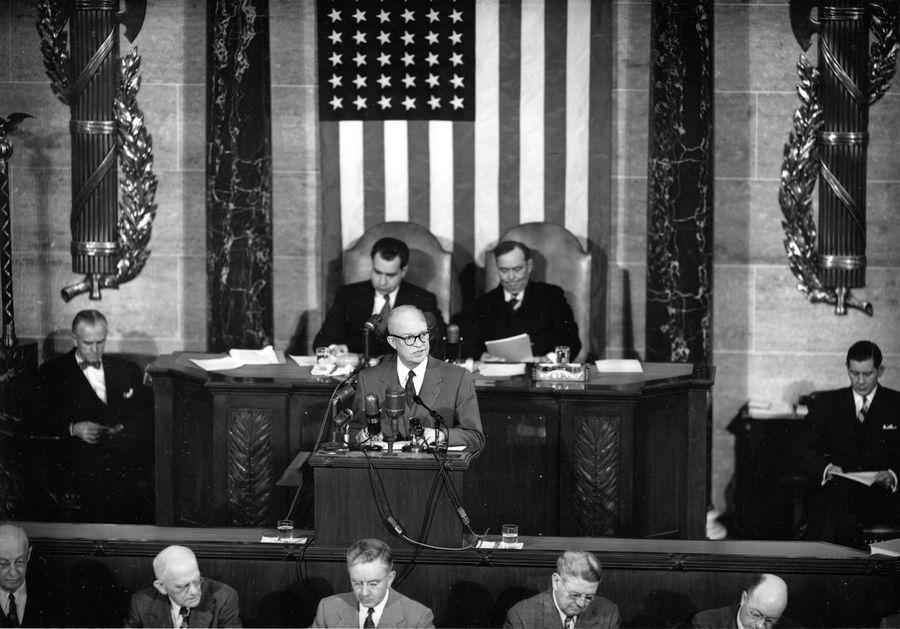
During the long period of the Cold War between the United States and the Soviet Union, world war and nuclear conflagration were a constant possibility. This knowledge bred a seriousness among voters, who understood that the experience, character, and temperament of presidential candidates could mean the difference between national life and death.
The period saw a string of presidents with significant military experience, including Harry S. Truman, Dwight D. Eisenhower, John F. Kennedy, Richard M. Nixon, Jimmy Carter, and George H.W. Bush. Ronald Reagan had also served, making training films for the Army Air Force. Voters expected seriousness that matched the times, and did not favor loose lips. Although Barry Goldwater was a serious person, he undermined his own campaign with undisciplined talk about nuclear weapons. Throughout the period, Americans placed high expectations on their presidents; character was arguably a proxy for the ability to face the world with both courage and self-restraint. They also expected physical vigor; the only moments that Eisenhower’s or Reagan’s reelections were in doubt were when Ike suffered a heart attack and Reagan’s mind seemed unfocused in his first debate against Walter Mondale.
Lies, Assault and Cover-ups Don't Stop Donald Trump
Trump Stands by His Man; Obama on a Health Scourge; Hayden Interview; Reagan's Courage
Analysis: For Trump, Few Limits to Win-At-Any-Cost Approach
What If Clinton Isn't Indicted?
Bill Clinton broke the mold, and it is no coincidence that he did so the year after the fall of the Soviet Union. It is unlikely that someone with Clinton’s profile would have won the presidency even four years earlier, as a draft evader, a semi-admitted drug user, a man with a troubled relationship with both the truth and marital fidelity. (Yes, John F. Kennedy had shared some of those characteristics, but that was not widely known at the time or he likely would not have won, either.) Glib and “saxy” were in; stoic and heroic were out.
Of the five presidents from 1992 to today, it is likely that four would not have been elected during the Cold War. To Clinton must be added Barack Obama, who had neither foreign policy nor executive experience – and hadn’t finished a single term in the U.S. Senate; Donald Trump, who had no political experience at all and was noted for his bombastic personality and untethered style of communication; and Joe Biden, who actually was rejected in the last Cold War election (in 1988) and who by 2020 was a nearly 80-year-old self-described “gaffe machine” possessed of a long but misguided foreign policy record. None had served in the military in any capacity. Only George W. Bush, with six years as governor of the second-most-populous state, a stint in the Air National Guard, and a retinue staffed partly by his father’s national security team would have been plausible.
To accentuate the point, since the onset of the current Ukraine crisis, Biden has stumbled verbally many times, forcing his staff to re-interpret his comments for the world. Some of those missteps might yet have serious negative consequences for Ukraine, the U.S., or America’s NATO allies. And one can only imagine what President Trump might have tweeted by now were he still in the White House. Neither man seems able to control what he says, neither seems burdened by any notable amount of humility, and both suffer from a thin skin that compels them to lash out whenever they feel challenged or disrespected. One is flamboyant, the other mundane; one is hated by the press, the other is protected by it. Their policies, for the most part, are miles apart. But those differences would probably not have saved either of them in the electoral environment of the Cold War.
If that political environment has really returned – and it is too early to tell if it has – we will begin to know next year, as the parties’ nomination races begin to unfold.
If Trump begins to sink and more sober options such as Tom Cotton, Mike Pence, or Nikki Haley begin to rise, we may be the seeing the effect. All three are measured, and all three have national security bona fides – Pence as former vice president, Haley as former U.S. ambassador to the United Nations, and Cotton as a U.S. Senator and decorated airborne infantry officer. If he chose to make another run at it, Marco Rubio would be a plausible choice in this environment. Ron DeSantis is a strong contender and could argue that he has the self-control that Trump lacks, but at the moment he is a domestic candidate.
On the Democratic side, revived cold war imperatives might argue for moving past both Biden, who is rapidly showing himself not up to the task, and Kamala Harris. While Harris could be defeated in the primaries, Biden would have to agree to step aside. If a Democratic dark horse emerges – someone difficult to predict today but possessed of a steady temperament and significant knowledge and background in national security – that would be added confirmation that a shift was taking place.
It is not impossible that the Russian invasion of Ukraine will end abruptly, some peace agreement will restore the status quo ante (minus several Ukrainian cities that no longer exist), and international relations will return to the pre-1992 norm. If that doesn’t happen – and no one should assume it will – the expectations that govern presidential elections will likely change along with the international environment. Exactly what that will mean in practice is not easy to say, but we may find that 2024 is closer to 1988 than to 2020.

Democrats Won the Midterms. Common Sense Won, Too
Jordanne Kemper • RealClearPolitics
The 120th Congress Shapes Up
Carolina Lumetta • RealClearPolitics
Flooding GOP Primaries With Democrats
Robert Natelson • RealClearPolitics
Washington Keeps Rewarding Oracle—Veterans Keep Paying the Price
Darin Gaub • RealClearPolitics
The Seeds of Unrestricted Warfare
John Teichert • RealClearPolitics
The Primary System Is Losing the Next Generation
Sean Trende • RealClearPolitics
RCP Today
Top stories on RealClearPolitics
The Takeaway
Polling intelligence and analysis delivered to your inbox
World News
Featuring the latest world news
Policy
Featuring the latest policy news
Support Our Mission
As part of RealClearPolitics, authors aim to provide balanced, non-partisan analysis by presenting top reporting and commentary from all sides of the political spectrum.
Trusted by policymakers and citizens alike since 2000