
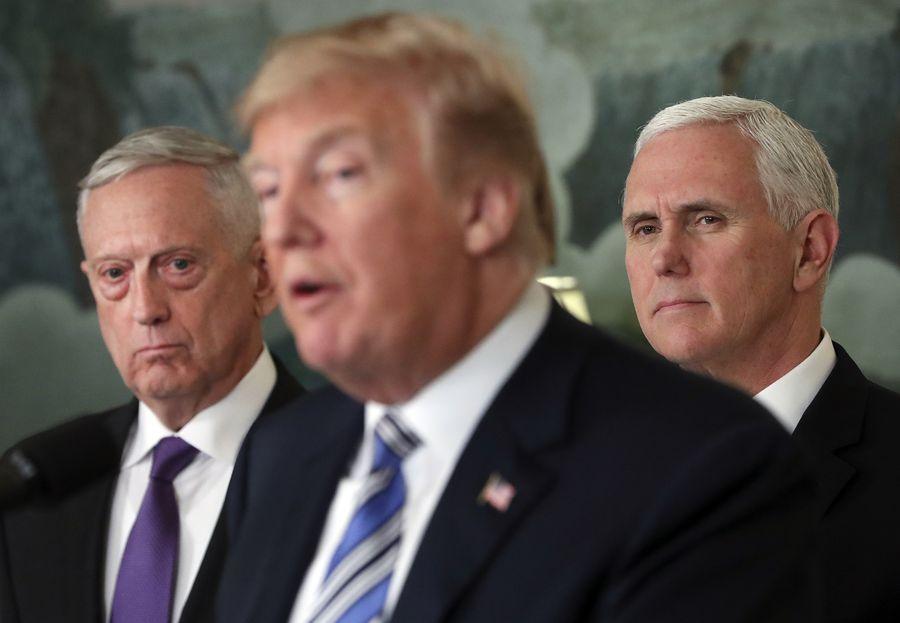
FILE - In this March 23, 2018 file photo, Defense Secretary Jim Mattis, left, and Vice President Mike Pence, right, listen to President Donald Trump, center, speaks in the Diplomatic Room of the White House in Washington. Mattis warns bitter political divisions have pushed American society to the "breaking point" in his most extensive public remarks since he resigned in protest from the Trump administration. (AP Photo/Pablo Martinez Monsivais)
The Divide Over Division
COMMENTARY
Published June 17, 2020 • Read time: 4m
President Trump has been charged with many derelictions, but one that stands out as the unkindest cut of all is the statement by retired Gen. James Mattis in late May. “I have watched this week’s unfolding events, angry and appalled,” said the former secretary of defense. “Donald Trump is the first president in my lifetime who does not try to unite the American people — does not even pretend to try. Instead, he tries to divide us.”
This was Mattis’ first statement about President Trump since he resigned his Cabinet post in December 2018, and for that reason — as well as its evident bitterness -- drew particular attention in the media. The charge was not accompanied by any examples, and it’s worth considering what Mattis was referring to.
The statement was inaccurate on its face because it was during Mattis’s lifetime when President Nixon said he was speaking on behalf of something called the “Silent Majority” of Americans — a statement clearly meant to divide one group of Americans from others. Mattis was also alive when President Obama said that working-class Americans “cling to guns and religion” in order to cope with change, and when Hillary Clinton called Trump supporters “deplorables.” These were clear attempts to divide the country and benefit politically from doing so.
Certainly, President Trump has used his position and his Twitter account to denounce individuals and media outlets. These are painful to see — one would hope that a president would have a thicker skin — but attacking one’s critics is not an effort to divide the country. At worst, it is a futile attempt by Trump to defend his own reputation against what he believes are unwarranted attacks.
Lies, Assault and Cover-ups Don't Stop Donald Trump
Trump Stands by His Man; Obama on a Health Scourge; Hayden Interview; Reagan's Courage
Analysis: For Trump, Few Limits to Win-At-Any-Cost Approach
What If Clinton Isn't Indicted?
Yet the country is divided today, possibly more than ever, and the question indirectly raised by Gen. Mattis is whether this is Mr. Trump’s fault.
Memories can be short when so many vexing and unusual things are happening at the same time. But has Gen. Mattis forgotten the Russia-collusion charge, which for almost three years prompted many formerly respected people like the director of the FBI (James Comey), the senior Democrat on the House Intelligence Committee (Adam Schiff), and a former director of the CIA (John Brennan) to say on national television that President Trump was an agent of a foreign power, a traitor to the country, and engaged in obstruction of justice?
These accusations certainly divided the country, but they were not initiated by President Trump and eventually were proved false. Only a few months after these charges were cleared, the Democratic House began an effort to impeach the president. Again, the country — including both the House and Senate — was sharply divided, but President Trump did not bring this on. Eventually, a sharply divided House voted for impeachment and an equally divided Senate voted to acquit him of the charges.
So where has President Trump divided the country? To be sure, his policies have been controversial, and he has pursued them more aggressively than any other president in memory. Forcing NATO countries to contribute more for their own defense, building a wall on the southern border, withdrawing from both the Paris climate accord and the Iranian nuclear pact, withdrawing troops from the Syrian border (the apparent trigger for Mattis’s resignation), imposing tariffs on China, cutting taxes and reducing regulation have all been unpopular with one or another group of Americans. But are controversial policies really what Gen. Mattis meant by dividing the country?
Recent events, such as the horrific death of George Floyd, a black man, at the hands of a white Minneapolis police officer, certainly shocked all Americans, but what divided the country was surely the looting and burning that occurred in many U.S. cities. President Trump, while acknowledging that peaceful demonstrations were a justified reaction to that heinous event, threatened to restore civil order if local governments did not. That too was a controversial policy response to events and not an effort to divide the country.
Divisions among the American people over a president’s policies are healthy in a democracy. These are necessary divisions. If a president’s policies are sufficiently unpopular, the next election will remove him from office. Thus far, although President Trump has pursued controversial policies, there is no evidence that dividing the country was one of them. Gen. Mattis made a serious charge without factual support; it should be withdrawn.

The Danger Before the Attack
Leslie J. Sullivan • RealClearPolitics
Jon Finer’s Old and Dangerous ‘New Approach’ to Israel
Peter Berkowitz • RealClearPolitics
The President Deserves Better
John Ullyot • RealClearPolitics
Congress Doesn’t Need Another Blame Game. It Needs To Find What’s Broken
Jarrod Bernstein • RealClearPolitics
Democrats Won the Midterms. Common Sense Won, Too
Jordanne Kemper • RealClearPolitics
The 120th Congress Shapes Up
Carolina Lumetta • RealClearPolitics
RCP Today
Top stories on RealClearPolitics
The Takeaway
Polling intelligence and analysis delivered to your inbox
World News
Featuring the latest world news
Policy
Featuring the latest policy news
Support Our Mission
As part of RealClearPolitics, authors aim to provide balanced, non-partisan analysis by presenting top reporting and commentary from all sides of the political spectrum.
Trusted by policymakers and citizens alike since 2000