
Poland Presidential Election
Poland Ponders Its Future Under Nawrocki
Published June 4, 2025 • Read time: 4m
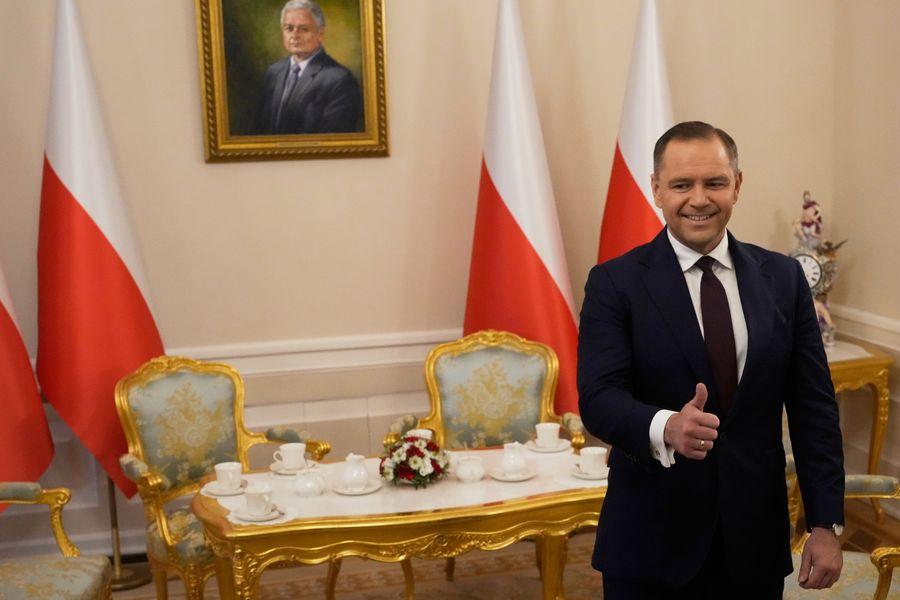
Warsaw — The mood here on Monday was subdued. Political signs supporting Warsaw’s progressive mayor, Rafal Trzaskowski, for president of Poland still littered the capital city, hanging from apartment balconies and highway overpasses. But Trzaskowski had lost Sunday’s runoff election to Karol Nawrocki, a conservative historian backed by Trump.
With a Trumpian flair for political invincibility, Nawrocki overcame a bundle of scandals (including reports he had hired sex workers and defrauded an elderly pensioner), eventually outperforming opinion polls and even exit polls to win the presidency.
The first exit poll – published immediately after voting ended at 9:00 p.m. local time on Sunday – showed Trzaskowski winning by just over half a point. He declared an early victory. “We won, although the phrase ‘razor's edge’ will forever enter the Polish language and politics,” Trzaskowski told his supporters in Warsaw.
Meanwhile, Nawrocki told his supporters to remain hopeful. “I believe that we will wake up tomorrow with President Karol Nawrocki.” Sure enough, by the time votes were officially tallied, Nawrocki had won by nearly two points, ending Trzaskowski’s second presidential bid in failure.
The result will affect European politics at a time when security concerns grip the continent. Donald Tusk, Poland’s center-right prime minister and the former president of the European Council, backed Trzaskowski’s campaign in hopes that the mayor’s pro-Europe inclinations would lead to expanded influence for Poland in Brussels. But Nawrocki, who is backed by the Law and Justice (PiS) party, can stymie Tusk’s domestic and foreign policy agendas through veto power.
Lies, Assault and Cover-ups Don't Stop Donald Trump
Trump Stands by His Man; Obama on a Health Scourge; Hayden Interview; Reagan's Courage
Analysis: For Trump, Few Limits to Win-At-Any-Cost Approach
What If Clinton Isn't Indicted?
Nawrocki opposes EU ambitions to further integrate, share the burdens of immigration, and address climate change collectively. Though Tusk will continue to represent Poland at EU summits, Nawrocki and PiS can challenge the prime minister’s legitimacy abroad by tactfully fracturing his coalition at home.
Nawrocki may also work to alter the generally pro-Ukraine stance of both Poland and PiS. Since Russia’s 2022 invasion of Ukraine, Poland has received nearly 1 million Ukrainian refugees and given the equivalent of over $5 billion in aid (in the form of cash and military equipment) to Ukraine’s war effort. But some Poles are growing weary of all the refugees and the spending. And they’re giving voice to that frustration with their vote.
Slawomir Mentzen, a far-right activist from the Confederation party who finished third on the first presidential ballot with nearly 15% of the vote, has been critical of Ukraine. Before the runoff between Trzaskowski and Nawrocki, Mentzen asked both candidates to sign a declaration that included a pledge to, among other things, resist the EU and oppose Ukraine’s accession to NATO. Nawrocki signed the declaration despite broad support for Ukraine among PiS leaders and supporters.
Though Mentzen never formally endorsed Nawrocki, an analysis of Sunday’s vote found that nearly 90% of Mentzen’s first-round voters backed Nawrocki in the presidential runoff.
Progressive unity proved much more elusive. Multiple voters told me of friends and colleagues who had voted for some of the most liberal candidates in round one only to vote for Nawrocki in the runoff as a way of sticking it to Prime Minister Tusk, whom they believe has neglected his 2023 campaign promise to expand abortion rights.
Nawrocki, by contrast, garnered overwhelming support in rural areas by focusing on conservative Catholic values and anti-abortion policies. PiS has also cultivated support in farming communities by championing government subsidies for farmers and parents. A major question moving forward is whether these voters simply care more about issues like abortion than foreign policy or are willfully shifting their support away from Ukraine.
In Warsaw, Poland’s second tallest building is easily spotted from almost anywhere in the city. The Palace of Culture and Science, built in 1952 above the rubble caused by Nazi bombs, was commissioned by Joseph Stalin as “a gift of the Soviet people for the Poles.” Its socialist-realist architectural style hovers above the city as a persistent reminder of former stifling Soviet occupation.
Since the fall of the Soviet Union in 1989, Poland has experienced steady economic growth, especially recently. The nation now boasts the sixth largest economy in Europe, and the government spent more on defense as a percent of GDP in 2024 than any other EU country. But some Poles fear their countrymen don’t fully recognize Putin’s ambitions to rehang the iron curtain.
“I have hope for Poland’s future,” said Patryk Andrysiak in front of Poland’s presidential palace on Monday. “I moved back here from England recently because the economy is getting really good. But the election worries me. I don’t think Nawrocki will be able to affect Ukraine a lot through his position. But the fact that so many voters chose Nawrocki means that people in Poland are not as worried about Russia attacking Ukraine as they should be. That’s a problem.”

Democrats Won the Midterms. Common Sense Won, Too
Jordanne Kemper • RealClearPolitics
The 120th Congress Shapes Up
Carolina Lumetta • RealClearPolitics
Flooding GOP Primaries With Democrats
Robert Natelson • RealClearPolitics
Washington Keeps Rewarding Oracle—Veterans Keep Paying the Price
Darin Gaub • RealClearPolitics
The Seeds of Unrestricted Warfare
John Teichert • RealClearPolitics
The Primary System Is Losing the Next Generation
Sean Trende • RealClearPolitics
RCP Today
Top stories on RealClearPolitics
The Takeaway
Polling intelligence and analysis delivered to your inbox
World News
Featuring the latest world news
Policy
Featuring the latest policy news
Support Our Mission
As part of RealClearPolitics, authors aim to provide balanced, non-partisan analysis by presenting top reporting and commentary from all sides of the political spectrum.
Trusted by policymakers and citizens alike since 2000