
CORRECTION Pence Electoral Votes
Pence Has Earned a Look, but Faces Uphill Climb
COMMENTARY
Published March 1, 2022 • Read time: 6m
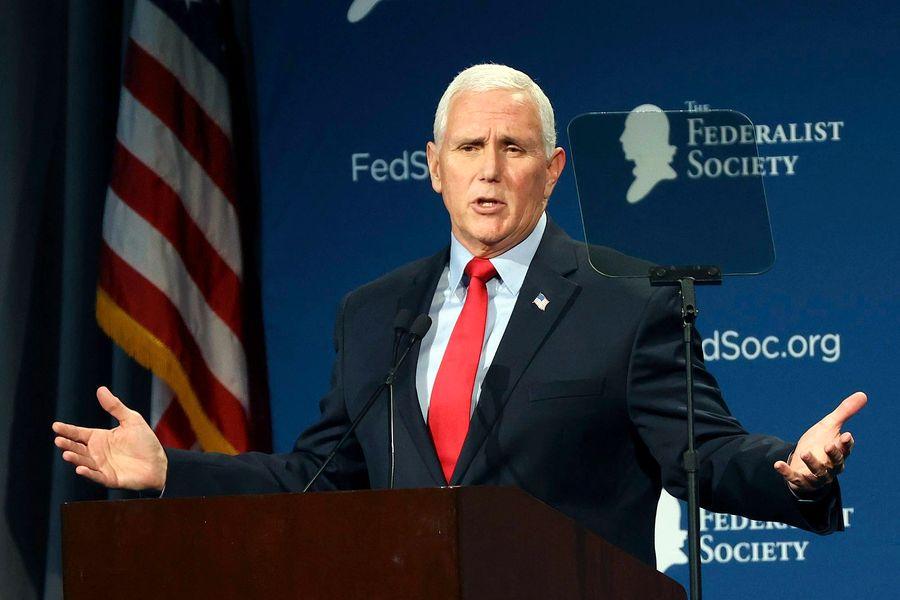
When Mike Pence spoke at a Federalist Society conference in early February, he drew attention for declaring flatly that Donald Trump “is wrong” in asserting that his former vice president somehow had the discretionary authority to refuse to count legally certified electoral votes.
Pence was at the center of the dispute over the electoral vote count on Jan. 6, 2021. For days, Trump had publicly pressured Pence to adopt a novel and dangerous interpretation of his role in the process, which had always been understood as purely ceremonial. At the “Stop the Steal” rally on Jan. 6, Trump told the crowd that Pence just had to do “the right thing” – which in Trump’s telling meant refusing to count the electoral votes from a handful of swing states Trump was disputing – and all would be well.
Instead, Pence released a statement indicating that he would adhere to the traditional constitutional role of the vice president in the vote counting. When a portion of the rally crowd entered the Capitol, some were heard shouting, “Hang Pence!” The Secret Service ushered the vice president to a secure location minutes ahead of the crowd.
Now, Republicans are beginning to look ahead to their presidential nomination of 2024, and Pence is in the mix – or should be. The first question about 2024 is whether Trump will run again to try to reclaim his lost prize. The second is whether Florida Gov. Ron DeSantis would run anyway, and whether DeSantis would prove as formidable as he seems at the moment. But a third question is about Pence: Will he run, and does he have a chance? In most polls taken recently of a prospective 2024 Republican primary contest without Trump, Pence is in second place, with a high showing of 25%.
Lies, Assault and Cover-ups Don't Stop Donald Trump
Trump Stands by His Man; Obama on a Health Scourge; Hayden Interview; Reagan's Courage
Analysis: For Trump, Few Limits to Win-At-Any-Cost Approach
What If Clinton Isn't Indicted?
Leaving aside the question of Trump’s entry into the race, vice presidents and former vice presidents are typically strong contenders, so it is worthwhile checking Mike Pence’s political balance sheet.
Though often underestimated, Pence clearly has strengths. As vice president, he was Trump’s liaison to important groups in the Republican Party, including the congressional contingent and social conservatives. Those connections could stand him in good stead in a nomination race.
Pence is also a bridge-builder in more than one way. In theory, he can appeal to the large constituency both inside and outside the Republican Party who agreed with Trump’s policies but were put off by his personality, character, and temperament. Pence’s performance in the 2020 vice presidential debate was outstanding, at least in comparison to the performance by his boss in the preceding debate. Pence was self-assured and calm, arguably doing a more effective job of defending Trump’s record than Trump himself had done. More than a few people wondered whether Republicans would have been better off with Pence at the top of the ticket.
Prior to the vice presidency, Pence served in Congress and as governor of Indiana, giving him both a federal and a state-centric perspective – a useful combination in our republic. He has some experience in both national security and domestic policy.
His willingness on Jan. 6 to defy Trump’s pressure tactics and surrender his own power in defense of constitutional principles is a mark in his favor, though it will not be seen that way by many Trump loyalists. In 2020 voters turned to Joe Biden for a “return to normalcy,” but they wound up with vaccine mandates, a border crisis, an attempted federal takeover of election administration, and the tattered remnants of fiscal sanity hanging by one or two votes in the Senate. If they still want stability in 2024, Mike Pence might look like a good choice.
On the other side of the ledger, Pence would also bring to any contest two sets of liabilities, one personal in nature and the other an institutional liability tied to his previous job.
All vice presidents and former vice presidents face the dicey task of trying to appear loyal and benefit from the upside of the president they served, while simultaneously separating themselves from his shortcomings and from the public impression that they are subservient to him.
This challenge is easier to navigate for a former veep than for a sitting vice president, when any hint of criticism of the president appears as bald disloyalty. The recent historical record shows that gaining the nomination is only half the battle. Literally. Of the last six vice presidents nominated who succeeded in winning their party’s nomination (Richard Nixon, Hubert Humphrey, Walter Mondale, George H.W. Bush, Al Gore, and Joe Biden) exactly three succeeded in winning a general election – and it took Nixon two tries.
Pence will undoubtedly be weighed down by this historical tendency. He may appeal to people who liked Trump’s policies but not Trump; he may also fall between the cracks as someone whom hard-core Trumpists now see as a traitor and whom others see as too closely tied to Trump. He will always be Donald Trump’s vice president and chairman of Trump’s COVID Task Force, at a time when many Republicans, wanting to win, will be looking for something new.
More specific to Pence, some will see him as too tied to social conservatism, or not flashy enough for the contemporary American political scene. Likewise, his gentlemanly and honorable demeanor, while a welcome respite to some, may not be a good fit with the aggressive approach normalized by Trump and embraced by a significant fraction of the Republican Party. Although he would bring some strengths to a campaign, polls show him starting in a significantly weaker position than previous vice presidents. The only modern vice president to start in a weaker position than Pence was his fellow Hoosier Dan Quayle, who sought the 2000 GOP nomination. Quayle announced his candidacy six years after leaving office (in January 1999) and withdrew shortly after finishing eighth in the Iowa straw poll held in August 1999.
Altogether, Pence has an uphill climb to the presidency, but he should not be entirely ruled out, especially if Trump decides not to run. He has skills and virtues that were widely overlooked in the drama of the Trump years. He is not a hare, but sometimes the turtle wins the race.

Democrats Won the Midterms. Common Sense Won, Too
Jordanne Kemper • RealClearPolitics
The 120th Congress Shapes Up
Carolina Lumetta • RealClearPolitics
Flooding GOP Primaries With Democrats
Robert Natelson • RealClearPolitics
Washington Keeps Rewarding Oracle—Veterans Keep Paying the Price
Darin Gaub • RealClearPolitics
The Seeds of Unrestricted Warfare
John Teichert • RealClearPolitics
The Primary System Is Losing the Next Generation
Sean Trende • RealClearPolitics
RCP Today
Top stories on RealClearPolitics
The Takeaway
Polling intelligence and analysis delivered to your inbox
World News
Featuring the latest world news
Policy
Featuring the latest policy news
Support Our Mission
As part of RealClearPolitics, authors aim to provide balanced, non-partisan analysis by presenting top reporting and commentary from all sides of the political spectrum.
Trusted by policymakers and citizens alike since 2000