
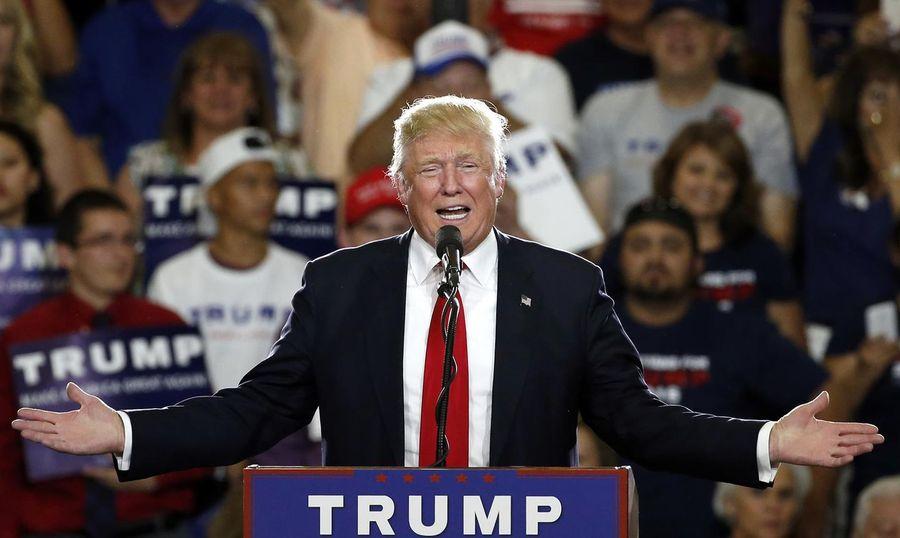
Obama's Continued Popularity May Bode Well for Trump in November
Published May 29, 2016 • Read time: 7m
For Hillary Clinton’s presidential campaign, working to tie the presumptive Democratic nominee to President Obama in the mind of the electorate makes perfect sense. Recent headlines repeatedly iterate the president’s high approval ratings--at their peak since his second inauguration--in a reminder of his own popularity despite the surrounding political landscape.
What exactly is driving the upswing? Josh Kraushaar in National Journal notes how counterintuitive the trend is. Assessed in a vacuum, many of the typical metrics of executive success reflect poorly on the administration:
"The president’s senior foreign policy strategist, Ben Rhodes, admitted to spinning misleading narratives to sell a controversial nuclear deal with Iran. The economy continues to sputter along, with quarterly GDP growth advancing at its lowest level in two years. Obama’s own FBI director, James Comey, is sounding the alarm over a spike in violent crime in most of the largest U.S. cities. Most recently, the president issued a controversial directive requiring public schools to let transgender students choose the bathroom that fits their gender identity, sidestepping public debate or any congressional role in the decision."
Kraushaar attributes the growing divorce between the popularity of a politician and that of his or her policies to two primary sources: doggedly loyal electoral blocs and the power of personality, especially as negotiated by the media. President Obama’s generally friendly press coverage is a frequent point of contention on the right, but his commanding lead over social media chatter in both 2008 and 2012 suggests an even more basic appeal to Americans.
Lies, Assault and Cover-ups Don't Stop Donald Trump
Trump Stands by His Man; Obama on a Health Scourge; Hayden Interview; Reagan's Courage
Analysis: For Trump, Few Limits to Win-At-Any-Cost Approach
What If Clinton Isn't Indicted?
A cultural phenomenon whose savvy media use amplified his personal authenticity to voters, Obama seems well matched by Donald Trump. Republican strategist Patrick Ruffini calls to attention the degree to which Trump has dominated conversation on Twitter, and the results are staggering. Since September 5th (the start point of the data available), Trump has topped Twitter conversation of all candidates in either party for the entire campaign, except for the handful of days around the first Democratic debate on October 13th. CNN reports that he has received $2 billion in free media coverage in the campaign season, more than all of his Republican competitors combined and over twice as much as Hillary Clinton.
US Presidential Candidate Twitter Buzz
https://interactive.twitter.com/candidateRace16/
While parsing through the causes of this free media demands in-depth analysis of many factors, the perception of Trump as 2016’s most authentic candidate surely plays a role. For cable news viewers and social media users, Trump offers something dramatically different from politics as usual, and the proportionate response in media consumption calls to mind Obama’s campaigns in 2008 and 2012.
So, what does this mean in terms of policy? Commentators have repeatedly noted how wildly objectionable several of Trump’s proposals are to large swathes of the electorate, often with the assumption that they will by consequence doom him in November. But as President Obama’s recent high ratings suggest, the relationship between personality and policy may be far weaker than believed. Pollsters Jon Cohen and Mark Blumenthal point out how analysts are already struggling to square Trump’s higher-than-anticipated support among Hispanic voters with policies such as his wall along the Mexican border. And while his underwater numbers across several key demographics are reason for major concern, the speed at which he has so far reversed electoral opposition and rallied support among GOP primary voters in 2015 and much of Republican leadership in 2016 demonstrate an impressive ability to transition from the red to the black.
For Trump, authenticity begets buzz; it allows him to dominate conversation, set the agenda, and grab hold of the race in a way that won him the Republican primary and has placed him in a much stronger general election position than he might otherwise occupy. This is in stark contrast to Clinton, whose unlikely, insurgent primary competitor Obama himself specifically anointed as "authentic,” and who was derided on a similar note by Vice President Biden. The decision of the Clinton campaign to follow the administration’s at best middlingly popular policy agenda while lacking the same, broad personal appeal to the electorate--and with some serious image problems of her own--is puzzling in this light.

To be fair, as someone with a historically peripheral relationship to electoral politics, Trump has had decades to nurture a media personality seen as “authentic,” during which he’s inoculated himself against the press criticism typical of politicians through off-the-cuff interviews with Howard Stern and salacious front-page coverage on tabloids. On the campaign trail today, Trump freely and consistently admits how he’s played the system. But, so far, that frankness signals a kind of refreshing authenticity that utterly subverts much of the electorate’s expectations of the political class. Valid or not, there exists a perception about Trump that he puts it all out on the line--his affairs, questionable business ethics, and so forth--which enables him to sidestep otherwise campaign-ending attacks. Clinton, on the other hand, is viewed as a fundamentally political creature, one whose relationship with the country has always been deeply tied to electoral politics and whose behavior thus falls under jurisdiction of the societal norms we expect of politicians. The characterization helped to trump her in the 2008 primary--when an authentically charismatic, unconventional outsider seized the Democratic crown--and her campaign is no doubt concerned about avoiding a repeat, hence her awkward “reboot” last summer.
But while Trump has much to celebrate, there is also reason to question the security of his present advantage. Perhaps he may lose his media edge, either through a relative drop in coverage (unlikely) or, more plausibly, a negative shift in its tenor. One could foresee the latter as the general election heats up, but the question of to what degree negative coverage would dent Trump remains open. And Obama’s almost assured ascendance to defender-in-chief of the Clinton campaign once the primary concludes will pit two major forces--stylistically distinct but each seen as strongly authentic by major tranches of the electorate--at one another’s throats.
In any event, voters today seem more willing than ever to divorce political figures from policies so long as they have adequately distinguished themselves as cut from a different cloth than the rest of the elite. Through this prism, Clinton finds herself in an uncomfortable position. Sandwiched between a relatively well-liked outgoing president, an unexpected and perhaps quixotic challenger in the primary, and a blustery, no-holds-barred Republican candidate never elected to public office, any expectation of her sailing into the White House by merit of her lengthy political experience and close adherence to the Obama policy agenda is derailed.
Of course, there may very well be other factors at play. Obama’s approval ratings, discordant as they are with voters’ pessimism about the country’s direction, might be elevated for other reasons. The electorate may now see him in a more positive light compared to Trump and/or Clinton, or he may be uniquely skilled at distributing blame for unpopular policies in a way unavailable to Trump. In any case, it should give the Clinton campaign pause in its strategy of pursuing Obama’s political legacy while unable to match so far the president’s authentic appeal to voters. Kraushaar writes that the “Teflon that insulated Trump from his myriad critics during the primary has protected Obama from the ups-and-downs of political life.” We’ll see over the next several months whether the Clinton campaign possesses the tools needed to strip it off their Republican opponent.

Jon Finer’s Old and Dangerous ‘New Approach’ to Israel
Peter Berkowitz • RealClearPolitics
The President Deserves Better
John Ullyot • RealClearPolitics
Congress Doesn’t Need Another Blame Game. It Needs To Find What’s Broken
Jarrod Bernstein • RealClearPolitics
Democrats Won the Midterms. Common Sense Won, Too
Jordanne Kemper • RealClearPolitics
The 120th Congress Shapes Up
Carolina Lumetta • RealClearPolitics
Flooding GOP Primaries With Democrats
Robert Natelson • RealClearPolitics
RCP Today
Top stories on RealClearPolitics
The Takeaway
Polling intelligence and analysis delivered to your inbox
World News
Featuring the latest world news
Policy
Featuring the latest policy news
Support Our Mission
As part of RealClearPolitics, authors aim to provide balanced, non-partisan analysis by presenting top reporting and commentary from all sides of the political spectrum.
Trusted by policymakers and citizens alike since 2000