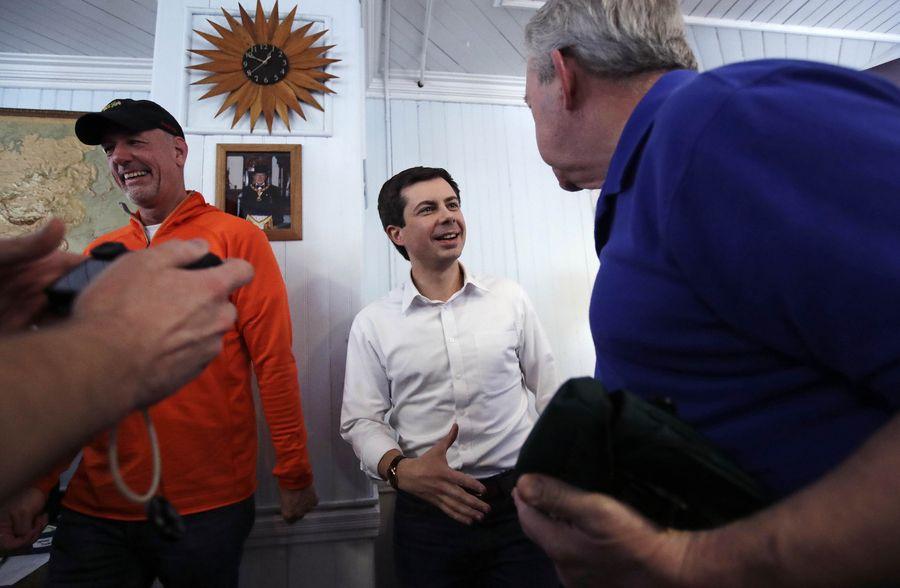
Mayor Pete Buttigieg, of South Bend, Indiana, shakes hands during a stop in Raymond, N.H., Saturday, Feb. 16, 2019. Buttigieg is weighing a run in the 2020 presidential race. (AP Photo/Charles Krupa)
Mayor Pete Breaks Out of the 1 Percent Club
COMMENTARY
Published March 29, 2019 • Read time: 4m
South Bend, Ind., Mayor Pete Buttigieg is having a moment. Actually, he’s been having a bunch of moments all over your TVs and on social media for about a month now.
I’ve been a fan of Mayor Pete since 2015 when I first saw him speaking out against Indiana’s cruel religious freedom law. Buttigieg, who had signed a human rights ordinance two years prior, argued – as many critics across the country did – that the law gives businesses the right to discriminate against gay customers.
“The interests of our state and our communities are not being well served when you refuse to budge on very divisive social issues like this. … All it would take to fix the damage would be to reverse the law,” Mayor Pete argued on MSNBC.
I liked what I saw and did some digging. The youngest mayor of a U.S. city? An Afghanistan veteran? A Rhodes scholar? An openly gay executive? Yes, please.
Americans are saying “yes, please” now, too. Mayor Pete is being rewarded in the polls with the latest Quinnipiac survey showing a substantial jump from 1 percent support to 4 percent, which ties him with Sen. Elizabeth Warren for fifth place behind former Vice President Biden, Sen. Bernie Sanders, Beto O’Rourke and Sen. Kamala Harris.
The increase in support is statistically significant and likely a harbinger of good things to come for Buttigieg’s candidacy.
All of this -- the surge in attention, the Capra-esque charisma he displays, and his plain speaking level headedness -- is playing out against a backdrop of the identity politics debate raging within the Democratic Party. This is what kept me up last night.
Lies, Assault and Cover-ups Don't Stop Donald Trump
Trump Stands by His Man; Obama on a Health Scourge; Hayden Interview; Reagan's Courage
Analysis: For Trump, Few Limits to Win-At-Any-Cost Approach
What If Clinton Isn't Indicted?
One of the things that makes me proudest to be part of the Democratic Party is that we promote candidates who increase representation of traditionally underrepresented groups. Our party sent the first African-American man to the White House. There are now 127 women serving in Congress and only 21 of them are Republicans, a 25-year low for the opposition party. There are 55 African-American lawmakers and only one in the House and one in the Senate is a Republican. We have 36 Latinos in Congress and four in the Senate, majority Democrats once again. There are 13 congressmen and three senators of Asian descent, all Democrats. And of the 10 openly gay or bisexual Americans serving in Washington, all are Democrats.
When we say, “If you can see it, you can be it,” we mean it. So where is the logic to putting Mayor Pete in a “white guy” category, lumping him in with the rest of the “white guys” (Beto, Biden and Bernie)? We must not risk losing sight of all the distinctive qualities they do not share.
Of course, they share the same skin color (by no means a disqualifier!), but their experiences make them vividly distinct from one another. And by virtue of the Three B’s being heterosexual, they are unequivocally distinct from Buttigieg.
No one told them that they couldn’t marry the people they love. They weren’t almost five times more likely to have attempted suicide when they were young. They weren’t apt to say they weren’t afforded the same employment opportunities.
Quite the opposite, in fact.
I’m not arguing for Mayor Pete’s candidacy per se, but I am cautioning against broad proclamations about what kind of candidate we want to go up against Donald Trump in 2020. For starters, it’s very early in our process. We have so many interesting and diverse candidates and we have yet to see the full field. But, I think it’s a mistake to let a broad brush backlash against white men swallow Mayor Pete up with it.
Recent polling from Gallup shows that 4.5 percent of Americans identify as LGBT. And the Public Religion Research Institute found that 7 percent of millennials identify as LBGT, a figure that will continue to grow. That’s a real chunk of the U.S. population, especially when you consider that, as a nation, we are 13 percent black and 18 percent Hispanic.
Every dimension of a candidate matters to voters and to our future -- we should do our absolute best to ensure that we don’t oversimplify people who are infinitely complex.

A RealClear Thanksgiving: Investing in a Better Future
David DesRosiers • RealClearPolitics
Trump’s Newsom Problem: Antagonist-in-Chief
Carolina Lumetta • RealClearPolitics
America’s Free Spirit
John Maxwell Hamilton • RealClearPolitics
The GOP Majority Should Go Out in Glory
Daniel McCarthy • RealClearPolitics
Republican Majorities Could Return Sooner Than Expected
J.T. Young • RealClearPolitics
The Danger Before the Attack
Leslie J. Sullivan • RealClearPolitics
RCP Today
Top stories on RealClearPolitics
The Takeaway
Polling intelligence and analysis delivered to your inbox
World News
Featuring the latest world news
Policy
Featuring the latest policy news
Support Our Mission
As part of RealClearPolitics, authors aim to provide balanced, non-partisan analysis by presenting top reporting and commentary from all sides of the political spectrum.
Trusted by policymakers and citizens alike since 2000