
Election 2020 Debate
Long Shots Part 2: Why Do They Do It?
COMMENTARY
Published May 15, 2023 • Read time: 13m
Join the Conversation
0There is a very old joke, says Michael Genovese, author of “The Modern Presidency”: “Every morning, Senators wake up, look in the mirror and see a President.”
“Politics attracts people of ambition who have large egos and who believe that they have special talents,” Genovese says. “Most prominent politicians look at the incumbent in the White House and think, ‘I can do that!’”
As Genovese suggests, it’s not just senators. It’s governors, House members, and even mayors. Also, ex-senators, ex-governors, and ex-mayors. (Pete Buttigieg was not alone in 2020, in other words, although the dinky size of his city was noteworthy.) Four years earlier, unemployed one-time Democratic governors Martin O’Malley and Lincoln Chafee also ran for president. In 1992, Bill Clinton not only faced two sitting senators and one ex-senator in the Democratic primaries (Tom Harkin, Bob Kerrey, and Paul Tsongas), but two ex-governors: Jerry Brown and Douglas Wilder.
The 2016 Republican presidential field included not just four U.S. senators and two governors, but seven ex-governors and an ex-senator (Rick Santorum). Santorum had run for president four years earlier (having lost his 2006 reelection campaign in Pennsylvania by a landslide). But Santorum was hardly the biggest long shot in 2016. That year’s GOP field was so large the debates had to be run in two sessions and included candidates with no political experience at all: California business executive Carly Fiorina, brain surgeon Ben Carson, and a certain reality TV star who moonlighted as a New York real estate mogul.
Lies, Assault and Cover-ups Don't Stop Donald Trump
Trump Stands by His Man; Obama on a Health Scourge; Hayden Interview; Reagan's Courage
Analysis: For Trump, Few Limits to Win-At-Any-Cost Approach
What If Clinton Isn't Indicted?
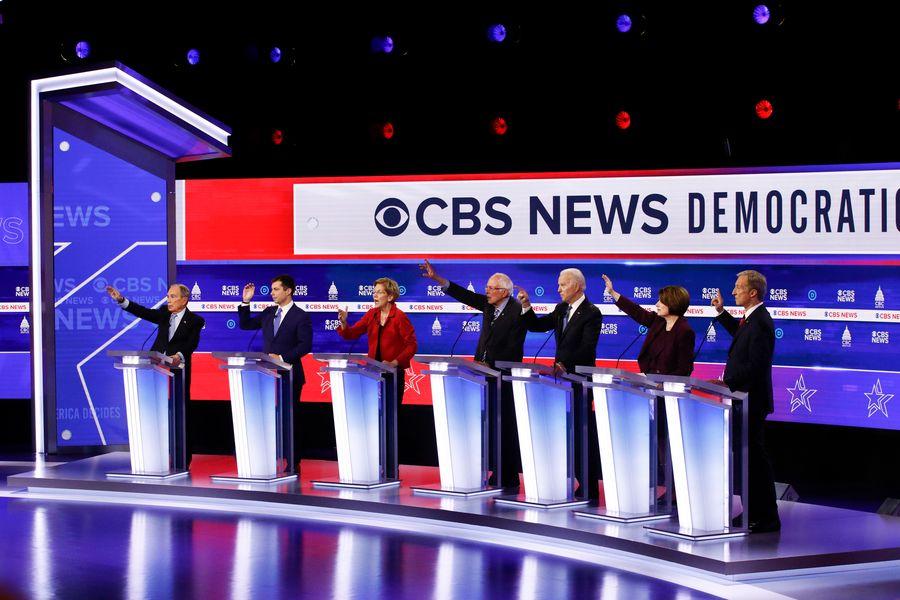
Four years later, the Democrats broke the Republicans’ dubious record for excess participation. At one point or another in the 2020 primary season, the field eventually bested by Joe Biden included seven senators and a former senator, four House members, three ex-House members, two governors, two ex-governors, two mayors and two ex-mayors, and two billionaires (although we’re counting Mike Bloomberg twice in those last two categories). Rounding out the field were political neophytes Andrew Yang and New Age author Marianne Williamson.
Williamson is back again this year, joined by a Kennedy family scion known for his environmental activism and belief that vaccines cause autism. They want President Biden to debate them, which seems unlikely. The Republican field is also taking shape. It includes some charismatic and highly qualified candidates along with the usual raft of pretenders – some serious, some preposterous – who have no conceivable path to the nomination.
So, what are all these people thinking?
Presidential scholar George C. Edwards III suggests a few reasons that the longest of longshot candidates enter the race: “Some have delusions of grandeur; some have wealthy friends who want to keep him or her busy.” And it isn’t always the candidates who are ambitious, Edwards says: “Some have a wife who wants to be First Lady.”
Take the long shot and “you will always be a person who ‘ran for president,’” Genovese says. “You are in the elite of the elite. Even unknown outsiders get attention and some coverage.” Marianne Williamson? Really? “You are somebody,” Genovese adds. “You are treated differently; you are near the top. Even if you have no chance, you matter.”
Your chances may be one in a million, but many of these White House wannabes have faced great odds before and overcome them. “Many think they are magic,” says Genovese. “Running for president scratches an itch that most of them have.”
Perhaps the question isn’t why so many run for the top office, but why so few do. “Competitive people in competitive situations look to the top and hunger to be there.” It is as true for politics as it is for baseball. “It is what you strive for,” Genovese says. “It is the brass ring.”
Shannon Bow O’Brien is a professor at the University of Texas, Austin, where she teaches a course titled “The American President.” Some longshot candidates “watch too much television and too many movies and they believe they are the chosen one capable of capturing the national zeitgeist,” she notes. That explains Andrew Yang’s 2020 bid, she says, and this year’s gambit by Vivek Ramaswamy – “the Andrew Yang of the GOP.”
Some campaigns are just jokes. Literally. Think Pat Paulsen’s 1968 run. The comedian’s campaign was announced on “The Smothers Brothers Show,” a Friday night ’60s sitcom. He wasn’t the first. In 1928, satirist Will Rogers (“I don’t make jokes. I just watch the government and report the facts.”) mounted a mock presidential campaign. Although Rogers didn’t campaign, on Election Day he declared victory and resigned, a gag that perhaps seemed funnier before the ugly aftermath of the 2020 campaign.
Following in Rogers’ footsteps, comedienne Gracie Allen announced her 1940 presidential “campaign” with a campaign jingle:
“Even big politicians don't know what to do;
Gracie doesn't know either, but neither do you;
So vote for Gracie.”
Stephen Colbert apparently enjoyed his 2008 spoof candidacy; he “ran” again in 2012, thereby bringing Harold Stassen to the minds of political junkies.
The one-time “Boy Governor” of Minnesota (he was elected in 1938 at age 31), Stassen started as a serious politician, and became a running joke, mostly by mounting quixotic presidential campaigns again and again and again. More than that, actually. Stassen ran as a “favorite son” candidate in 1940, apparently to get a top speaking slot at the Republican National Convention. He gave a nice speech and endorsed GOP nominee Wendell Willkie. He reprised his effort in 1944. He ran in the 1948 campaign, too, making the cover of Time magazine and coming close to getting the Republican nomination.
But Harold Stassen wasn’t a man who knew when to quit. He ran again in 1952, 1964, and 1968 (against Pat Paulsen, among others). He wasn’t much of a threat to Richard Nixon, but the strength of the GOP nominee wasn’t his primary concern or Stassen wouldn’t have run against Ronald Reagan in 1980 and 1984. His last two campaigns were in 1988 and 1992, a Harold Stassen presidential candidacy by then being as certain a quadrennial event as the Olympics. And though Stassen grew defensive about it, his seriousness of purpose never went away.
“I know I’ve had an impact, that some things I’ve done have really counted for world peace, for the passion of the individual,” Stassen said late in his career. “I sometimes wish people would ask not how many times I’ve run a political campaign, but how many times I’ve been right on the issues.”
It’s a sentiment that resonates with Dennis Kucinich. The youthful-looking Democrat was also 31 when he won his first election – as mayor of Cleveland – where, yes, he earned the inevitable sobriquet “Boy Mayor.” But Kucinich was a seasoned Ohio congressman in his late 50s when he ran for president in 2004 (he would run again in 2008). In a Feb. 26, 2004, debate at the University of Southern California, CNN host Larry King pointedly peppered Kucinich with the question all these long shots get asked: “Why stay in?”
It was a legitimate query. Kucinich had finished up the track in New Hampshire in the first half-dozen primary states, and was polling very low in all the looming Super Tuesday states. First-tier candidates Howard Dean, Dick Gephardt, and Joe Lieberman had already dropped out. But as he looked around the table at his opponents, Dennis saw not just John Kerry and John Edwards, the eventual Democratic ticket, but Al Sharpton as well. If Kucinich was insulted by Larry King’s tone, he didn’t say so. Instead, he gave his rationale for running, which wasn’t that he thought he was going to win.
“I’m the voice for getting out of Iraq,” he said. “For universal single-payer health care. For getting out of NAFTA and the WTO. For having our children go to college tuition-free.”
“You’re here to make statements then?” King said.
Ignoring the snark, Kucinich forged ahead. He was for same-sex marriage, he said, at which the host sneered, and medical coverage for all.
“In other words, socialism,” King said dismissively.
Larry King is gone now, and it’s likely that his views on gay marriage “evolved” along with the Democrats, the Supreme Court, and society as a whole. As for Dennis Kucinich, he turned out to be a stalking horse not just for Bernie Sanders, but the modern Democratic Party – and much of the populist wing of the GOP – as the Washington Post pointed out in a 2018 story touting his “vindication.”
In 2004, he didn’t quit until the party’s convention, and couldn’t carry his own congressional district against Kerry, let alone the state of Ohio, but Kucinich was thinking bigger. “This is a spiritual matter,” he told supporters at a Portland rally in mid-March, “not just a practical political matter.”
To a New York Times reporter present for that event, he explained, “In a way, I feel like Johnny Appleseed. I’m planting seeds all over this country: seeds of peace, seeds of hope. At some point, maybe years from now, there will be orchards. So in a sense, it's about more than this election. It’s about more than politics. It really is about envisioning a new America.”
So laugh at Marianne Williamson and Robert F. Kennedy Jr. if you want to. Or maybe take the long view. Then again, don’t get too dewy-eyed.
Looking Ahead
Lara Brown, author of several books on the presidency, including “Jockeying for the American Presidency: The Political Opportunism of Aspirants,” says if you want to win a major party presidential nomination, first you need to be known. Many hopefuls are short on name recognition. They “leap into the presidential race in order to set themselves up for a run four years down the road,” says Brown. “This is a time-tested, successful strategy – get known, lose the race, but place well and build a base.” Brown suspects that Sen. Tim Scott may be following that strategy: “He may be looking towards 2028 more than 2024.”
Brown points out that many aspirants, such as Ronald Reagan and John McCain, won their party’s nomination on their second attempt.” That goes double for candidates who fail in their effort to get nominated for president, but who do get the nod to be the nominee’s running mate, such as George H.W. Bush, Al Gore, and Joe Biden. Will it work for Kamala Harris? Even the comedians get this angle: In 2016, Jimmy Kimmel announced he was running for vice president.
It’s unclear what office obscure California congressman Eric Swalwell had in mind for himself when he ran for president in 2020. He wanted to create national recognition for himself. But why? Perhaps to run for the Senate someday. Maybe he desires a cabinet position. Simple ego isn’t out of the question. As far as really competing for the nomination, well, that’s a lot harder for a member of the House than it is for a governor or member of the Senate. “The last member of the House to become president was James Garfield in 1881,” Shannon O’Brien notes, adding that “unless Swalwell is utterly clueless about history,” he would have to have known that becoming president from the House is “the long shot of long shots.”
Shirley Chisholm wasn’t just a long shot when she made a try for the Democratic nomination in 1972, she was a no-shot. But just running can be a political achievement. Chisholm, an African American member of the House “wanted to make history,” says O’Brien. She knew she wouldn't win but angled to get the issues she cared about – racial relations and women’s liberation – on the national platform. And, says O’Brien, she paved the way for other non-establishment candidates, even those with different politics, such as Herman Cain, who “thought he had a good shot at a VP position and could help attract black voters to the GOP.”
Chisholm wasn’t alone in running to bring attention to the issues she cared about. “There are those who run to highlight an issue,” says Genovese. “Some offer themselves because they are committed to that cause, others use the cause as a catapult to high office.”
It’s a common strategy, according to Brown. She cites not just Kucinich, but also Pat Buchanan, Steve Forbes, and Bernie Sanders. They hoped to get traction with voters and move their parties in their direction.
Once in a while, they surprise us – and themselves. And they do tend to catch the White House bug. Bernie Sanders, for example, initially ran in 2016 to nudge his party to the left, but by the spring of 2020, he was drafting his inaugural address in his head – and was close to winning the Democratic nomination until Joe Biden arose like an aging phoenix in South Carolina.
Lara Brown says self-promotional reasons that are not strictly political also come into play – “branding, marketing, and a public following can lead to money.” One might get a contract with a TV network, get paid for speeches after the election cycle, or write a book.
The quest for profitable celebrity may be an increasingly common goal of presidential wannabes. But it isn’t new.
Now the dean of academics at the Institute of World Politics, James Robbins was a graduate student at the Fletcher School in Boston in January 1991 when the New York Times reported that George McGovern, “looking tanned and relaxed,” was exploring a run for the White House the following year. It seemed crazy to Robbins.
“This was when George H.W. Bush was enjoying over 90% approval ratings” in the wake of Operation Desert Storm, he recalled. How could McGovern even think of running, having lost 49 states to Richard Nixon in 1972, and winning a mere four convention delegates in his 1984 nomination bid?
So Robbins went to one of his Fletcher School professors, old Washington hand John P. Roche. Consultant to John F. Kennedy and special White House adviser to Lyndon Johnson, Roche was as savvy about the nuts and bolts of practical politics as he was about political philosophy. Roche was exasperated Robbins hadn’t caught on to the basics. “I thought I taught you,” Roche said, “he’s raising his speaking fees!”
Finally, there are always some people who run for the thrill – they generally aren’t very serious and rarely get very far, but Brown says, “They are part of what makes the contests such spectacles.”
“Long shot candidacies are free advertising for people and ideas,” says Harvard professor and best-selling author Arthur Brooks. “Even marginal candidates get some press, so you can underline a couple of things you think are important, or get your name into the brains of journalists,” Brooks says. “A long shot candidacy is also a way to start the train toward bigger things. Most winners first lose by a lot, and then lose by a little, and then, maybe, win.”
In that sense, taking a shot at the big job is not unlike the old lottery ticket slogan: You can’t win if you don’t play. Which is one way of remembering that among the cacophony of voices vying for the 2016 Republican nomination – the field that included Ben Carson and Carly Fiorina – one belonged to a candidate with no political experience either, and far less fealty to the Republican Party than anyone else on that stage. And yes, he’s not only the former president, but the front-runner for the 2024 nomination.
(Part one here.)

The GOP Majority Should Go Out in Glory
Daniel McCarthy • RealClearPolitics
Republican Majorities Could Return Sooner Than Expected
J.T. Young • RealClearPolitics
The Danger Before the Attack
Leslie J. Sullivan • RealClearPolitics
Jon Finer’s Old and Dangerous ‘New Approach’ to Israel
Peter Berkowitz • RealClearPolitics
The President Deserves Better
John Ullyot • RealClearPolitics
Congress Doesn’t Need Another Blame Game. It Needs To Find What’s Broken
Jarrod Bernstein • RealClearPolitics
RCP Today
Top stories on RealClearPolitics
The Takeaway
Polling intelligence and analysis delivered to your inbox
World News
Featuring the latest world news
Policy
Featuring the latest policy news
Support Our Mission
As part of RealClearPolitics, authors aim to provide balanced, non-partisan analysis by presenting top reporting and commentary from all sides of the political spectrum.
Trusted by policymakers and citizens alike since 2000