
Illinois Daily Life
Long Shots Part 1: You Gotta Have a Gimmick
COMMENTARY
Published May 14, 2023 • Read time: 9m
Join the Conversation
0Faith Dane – or just plain “Faith,” the moniker she legally adopted late in life – was a candidate as relentless as she was unlikely. Noisy too. A perennial hopeful to be mayor of Washington, D.C., Faith was a regular participant in the Fourth of July parade in the city’s upscale Palisades neighborhood. Most of the politicians who walk the parade route can be counted on to stroll along MacArthur Blvd., throwing candy and handing out stickers.
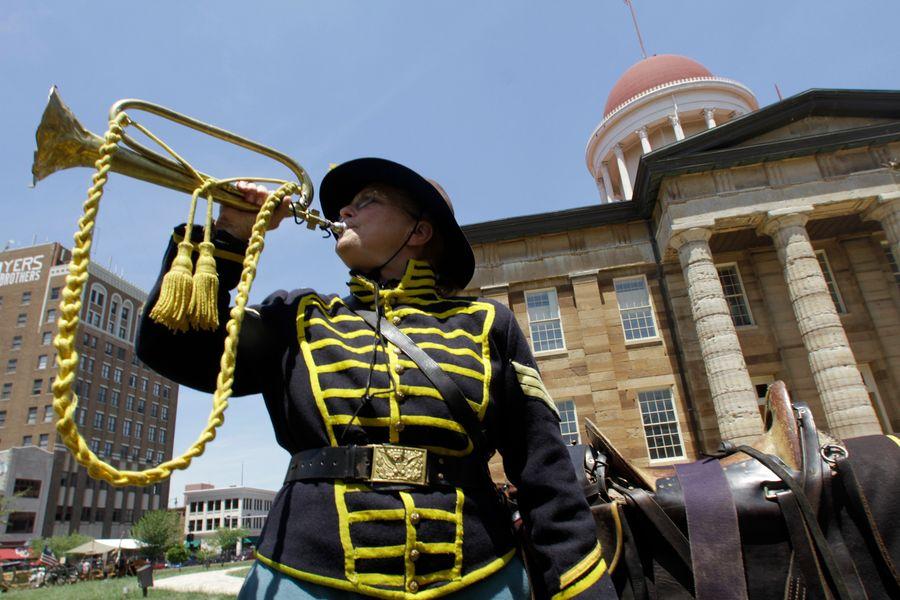
Not Faith: She rode on the hood of a car and blew a bugle. She never did get many votes, let alone win an election. That said, as the 2024 presidential candidates proliferate, they could learn something from Faith and her bugle.
Faith had a brief career as an actress, playing a run-down burlesque ecdysiast in both the Broadway and Hollywood productions of “Gypsy.” Her character was called Miss Mazeppa, and her stripping shtick was to blow a bugle while doing the bump and grind. Her big number was “You Gotta Get a Gimmick” if you want to get ahead.
Faith’s bugle gimmick didn’t get her ahead at the ballot box, but it did get her at the front of the D.C. parade. Attention was paid to her and to the cause she cared for, which was self-publicity. She wasn’t looking for more. The candidates elbowing their way into the presidential race could do worse than to figure out what their bugles will be, and where the gimmicks they choose will likely take them.
Consider Robert F. Kennedy Jr., who recently threw his hat in the ring, declaring he will challenge President Biden for the Democratic Party nomination. RFK Jr. doesn’t have to come up with a gimmick: He’s had one for years as one of the most prominent purveyors of the contention that vaccines cause autism.
Lies, Assault and Cover-ups Don't Stop Donald Trump
Trump Stands by His Man; Obama on a Health Scourge; Hayden Interview; Reagan's Courage
Analysis: For Trump, Few Limits to Win-At-Any-Cost Approach
What If Clinton Isn't Indicted?
Before the pandemic, anti-vaxxers were a fringe on the left. Come the coronavirus contagion, it was conservative populists who balked at being ordered by the government to get themselves injected. Kennedy hasn’t tamped down on his criticisms of vaccines, even though those complaints put him at odds with his own party. His opposition to vaccines even led RFK Jr. to praise Tucker Carlson.
Kennedy offered a Big Rx conspiracy to explain Carlson’s abrupt exit from the airwaves: “Fox fires @tuckercarlson five days after he crosses the red line by acknowledging that the TV networks pushed a deadly and ineffective vaccine to please their Pharma advertisers.” Anti-vax and pro-Tucker, Kennedy should be alienating Democrats. Yet, a recent Fox News poll found that 19% of Democratic primary voters are already backing him.
For now, Biden has only one other opponent for the Democratic nomination, Marianne Williamson. When she ran for president in the 2020 race, she had what looked like a gimmick: She was the rare candidate who was a self-help guru. But her curious and comic performance on the campaign trail didn’t help her, so this time around, she has a more of-the-moment shtick. Williamson has become a TikTok celebrity. If ever there was an internet gimmick perfect for campaigning, TikTok is that gimmick.
Platforms change quickly. Facebook and Twitter, the Big Tech vehicles for modern campaigning, may be past their prime. If Joe Biden should find the campaign trail too arduous, and his basement too restrictive, it isn’t inconceivable that he could bow out. With her TikTok celebrity status, Williamson may figure she would have a vehicle for seizing the moment. Yes, it’s delusional.
Consider Republican contender Vivek Ramaswamy. An unknown before climbing up on the stump, how does he draw attention? TikTok is not his brand of bugle. He favors in-depth discussions of serious socio-economic policy issues. And so he’s become an author (“Woke, Inc.”) and a podcaster. Ramaswamy’s choice of communication technology fits with his choice of policies. He may find that both present him with an uphill battle to win young voters. For example, Ramaswamy maintains that today's youth have no one but themselves to blame for their problems. “People don’t want to work today,” Ramaswamy declared on Fox News. Why? Because the youth of today are lazy, he said, testing a dubious message. There are, let us say, messages that might play better with the 18-25 demographic.
On her TikTok, Marianne Williamson maintains young voters aren’t lazy, just tired of getting a raw deal. “Incremental change is not enough,” she says. “We need a fundamental economic u-turn.” Oh yes, and legalized marijuana too.
That may explain why Williamson has nearly a half-million TikTok followers, and Vivek has about 180.
Ramaswamy, an early and inexperienced entrant, has struck more than a few observers as the Andrew Yang of this election cycle. A candidate in the Democratic primaries, Yang barely registered in the polls for most of the contest and nearly missed the cut-off criteria to get into the debates. To hear his campaign manager tell it, Yang struggled because he hesitated to go all in with his gimmick: promising to hand out federal money as a guaranteed basic income. He didn’t blow his horn as the “free money guy,” at least not until the Houston debate, his last chance to stand out in the crowd of debaters.
Yang took campaign manager Zach Graumann’s suggestion that he double down on the free money gimmick: He persuaded Yang to give money to people who went to his website and registered. It was ostensibly an effort to test Yang’s assertion that people are more successful if they have the backstop of extra cash in the bank. In truth, it was the blaringest bugle of the campaign.
When it was Yang’s turn to talk, he said, “I’m going to do something unprecedented tonight.” He said. “My campaign will now give a freedom dividend of $1,000 a month for an entire year to ten American families, someone watching this at home right now.”
Now that’s a gimmick.
According to Graumann, in his campaign travelog, “Longshot,” it was a huge success. Yang “had more web mentions the night of the debate and over the three days that followed than nearly any other human being on Earth.” The strategist crowed that “Suddenly, Andrew Yang was a beloved international celebrity.”
This is not a new template: After striking it rich in the private sector, a business type tries to convert wealth into fame and political relevance by running for president. Ross Perot was already well known when he campaigned in 1992.
So was Steve Forbes, who invested some $70 million of his family fortune running for the 1996 and 2000 GOP nominations. His example was not lost on Carly Fiorina, who spent $25 million on her 2016 campaign (none from her family’s $59 million net worth). Fiorina earned nary a delegate, a lesson not lost on even richer candidates. Her gimmick was a supposedly independent super PAC named CARLY, the Federal Elections Commission having nixed the name “Carly for America.” CARLY, the candidate claimed with barely a straight face, was an acronym for Conservative, Authentic, Responsive, Leadership for You.
Tom Steyer’s 2020 calling card was aggressively attacking global warming. The California billionaire burned through an estimated $267 million of his $1.6 billion pile in the Democratic primaries, but lasted only through the South Carolina primary.
Then there was former New York City mayor and media mogul Michael Bloomberg. Eschewing donations, Bloomberg skipped Iowa and New Hampshire and spent $558 million on television ads alone. All for the dubious honor of having Elizabeth Warren inform the electorate that Bloomberg had signed nondisclosure agreements with female employees who said he’d called women “fat broads” and “horse-faced lesbians.” Mike, we hardly knew ye.
At least Bloomberg was spared the ignominy of begging for money, the more traditional candidate complaint. Rep. Patricia Schroeder, a pioneering Colorado Democrat, enjoyed her brief time in the spotlight as a 1988 long shot. Perhaps enjoyed is not quite the right word.
“I felt like a total whore, running after rich people begging with your tin cup,” Schroeder later told political writer Rick Berke. Schroeder’s problem was that she was still in office. For those who aren’t, running for president can be lucrative. Mike Huckabee was just a middle-class guy who made $ 70,000 a year as governor of Arkansas. But running for president in 2008 upon leaving office made his books best-sellers, spiked his speaking fees, and landed him a Fox News show. “The Huck” is now a millionaire.
For conservative gadfly Alan Keyes, running for office didn’t merely enhance his profile – it was his vocation. Keyes ran for the GOP nomination in 1996, 2000, and 2008, and for the Senate in Maryland (twice) and in Illinois, a state where he did not reside, in 2004 when he lost in a landslide to Barack Obama. Keyes’ gimmick was a willingness to say anything. Five years after losing to Obama in Illinois, he was denouncing the 44th U.S. president as a Kenya-born “usurper” who was “a radical communist.”
Being willing to say just about anything is a professional hazard for candidates who know they’re going nowhere. But you still gotta have a shtick. In the 2012 GOP primary season, Herman Cain’s was “9-9-9,” the numbers he called out in a rich cadence to describe some long-forgotten economic plan. Chris Christie’s was making self-deprecating fat man jokes while lashing out at people who called him fat. All of which brings to mind the quadrennial observation about the mindset of those who risk such ignominy, posed pithily by onetime Los Angeles mayor Eric Garcetti: “No sane person would run for president, right?”
Or maybe running for president is what makes them crazy. Alexander Haig sought to cap off his long career in public service by seeking to replace Ronald Reagan. So he trudged off to New Hampshire, a forgotten and forlorn afterthought to Bob Dole and George H.W. Bush. The old Army general’s gimmick entailed randomly accosting strangers in diners and public spaces who couldn’t quite place him. “You won’t escape!” he barked with an outstretched hand to a startled woman in a grocery store. “I gotcha.”
When a male voter recoiled from his grasp, Haig quipped that the man thought he was “a process server from his ex-wife.” To another, he conceded, “You gotta be a little nuts to be doing this.”
As if to underscore this point, Haig sought to jog voters’ memories with a screwy slogan, “Shake a leg for Haig!” He’d have been better off with a bugle.
(Part two here.)

The GOP Majority Should Go Out in Glory
Daniel McCarthy • RealClearPolitics
Republican Majorities Could Return Sooner Than Expected
J.T. Young • RealClearPolitics
The Danger Before the Attack
Leslie J. Sullivan • RealClearPolitics
Jon Finer’s Old and Dangerous ‘New Approach’ to Israel
Peter Berkowitz • RealClearPolitics
The President Deserves Better
John Ullyot • RealClearPolitics
Congress Doesn’t Need Another Blame Game. It Needs To Find What’s Broken
Jarrod Bernstein • RealClearPolitics
RCP Today
Top stories on RealClearPolitics
The Takeaway
Polling intelligence and analysis delivered to your inbox
World News
Featuring the latest world news
Policy
Featuring the latest policy news
Support Our Mission
As part of RealClearPolitics, authors aim to provide balanced, non-partisan analysis by presenting top reporting and commentary from all sides of the political spectrum.
Trusted by policymakers and citizens alike since 2000