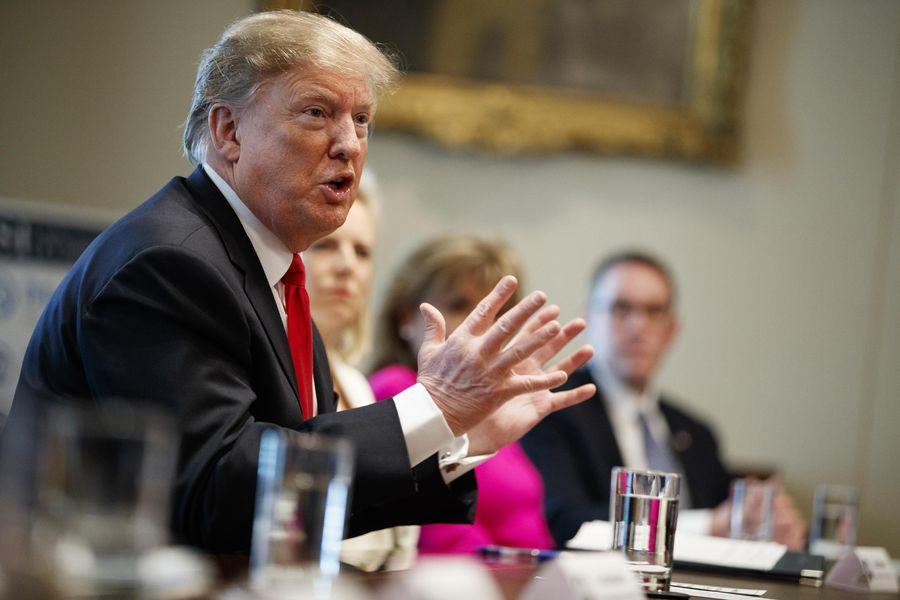
President Donald Trump speaks during an event on human trafficking in the Cabinet Room of the White House, Friday, Feb. 1, 2019, in Washington. (AP Photo/ Evan Vucci)
Heraclitus and Presidential Character
COMMENTARY
Published Feb. 5, 2019 • Read time: 5m
In a recent column in National Review, conservative commentator Jonah Goldberg predicted the demise of Donald Trump by invoking a fragment of logic made famous by the pre-Socratic philosopher Heraclitus. What dooms the president, Goldberg wrote, is ethos anthropoi daimon, popularly rendered as “man’s character is his fate.” Goldberg asserts that Trump’s bad character is undebatable, arguing that this guarantees his downfall.
In separate essays, fellow conservatives Roger Kimball and Daniel McCarthy took Goldberg to task for this claim, pointing out that his translation of Heraclitus’ gnomic aphorism might be problematic, and also questioning whether the irredeemable nature of Trump’s character is an established fact. Nevertheless, in order to defend Trump, Kimball resorts to a logical fallacy we academics call tu quoque: Bill and Hillary Clinton also have bad character, he avers, and therefore character isn’t truly important.
McCarthy’s approach is to revise the interpretation of Heraclitus to something like “You’re only as happy as your outlook on life,” with the implication being that “haters will be unhappy.” Turning Goldberg on his head, McCarthy’s Heraclitus teaches that we shouldn’t get all worked up about having a moral reprobate in the White House, lest we make ourselves miserable.
As a teacher of ancient texts to several generations of college students, I find these applications of ancient philosophy to Trumpian commentary quite refreshing. It is the case that the pre-Socratics along with Homer, Plato, and Aristotle have beautiful insights into the nature of political life that are worth the time it takes to bring them into focus.
Lies, Assault and Cover-ups Don't Stop Donald Trump
Trump Stands by His Man; Obama on a Health Scourge; Hayden Interview; Reagan's Courage
Analysis: For Trump, Few Limits to Win-At-Any-Cost Approach
What If Clinton Isn't Indicted?
To that end, it should be pointed out that ethos anthropoi daimon doesn’t mean what either Goldberg or McCarthy take it to mean. It is neither a fortune cookie moralism (character-fate), nor a psychological truism (attitude-happiness). Its bottomless significance lies in the more literal translation, “Human dwelling is in divinity.” If we read him carefully, Heraclitus is both more interesting and less helpful to either side of the debate. Still, it would be profitable for even the most devoted partisan to take a moment to contemplate what Heraclitus might be signaling.
Debating the content of Trump’s character, however, is dubious. One can reflect on ethical life abstractly or within one’s own inner experience, but the souls of others are not our province. What is our business, however, is the regime. What are the ideas and ideals we wish to hold up as models for civic life? This kind of question figures notably and urgently in the writings of America’s founders.
The questionable assumption Kimball and McCarthy make is that the presidency is like any other job. There’s a finite, particular set of tasks to be performed and what’s needed is someone who is able to discharge those tasks competently. We don’t need someone of good character to lead us; we just need a person who can get the job done. I’m not sure this assumption is correct. Even if we grant that the only option available to Republicans in 2016 was Donald J. Trump, it is not clear to me that this implies character isn’t an important aspect of the presidency.
It’s hardly outlandish to judge a president harshly if he uses his office for bullying, pandering, and preening. In a democratic republic, high political station is the intersection of the citizenly and the statesmanlike. We see ourselves reflected in the people we raise up. They represent us; they teach us about ourselves and display our collective vision of the country. They need not be perfect, or even great, but they shouldn’t be awful. Rather than fretting about Trump’s character we should be more worried about what he shows us about ourselves.
The personal embodiment of the regime is not the end all and be all of the presidency. But it’s not nothing. The striking thing about Trump is his indifference to this feature of the office. What’s worse is the open rejection of this concern by conservative opinion-makers. The naked hypocrisy of this rejection should be embarrassing enough (given conservative critiques of the Clintons across the decades), but if this line of thinking accurately represents a remaking of the presidency, one that holds that the president is merely an instrument of a party docket, it would represent the triumph of what conservatives have often derided as amoral postmodern cynicism.
For those of us who have spent our careers striving against an inhumane culture in the attempt to foster republican virtues and enlightened habits of mind in undergraduates, it is distressing to see the rise of a president who in the sheer momentum of his ascent has seemed to persuade previous proponents of civil discourse that civility and character are expendable luxuries. Perhaps they are right, but if so the American predicament is more dire than many of us previously thought.
In addition to these ethical concerns, conservatives still face a very practical political problem. As Trump continues to solidify the sense that he cannot be trusted, even by his staunchest allies, and that his primary hold on members of Congress is the threat of ridicule and electoral sabotage, his particular brand of power will fade and his base will begin to melt away.
Political scientists identify realignment as a very real phenomenon in the dynamics of national politics. Energy within galvanized parties builds toward critical inflection points triggering large, sudden reversals. Seismic shifts, sometimes lasting more than a decade, occur with regularity. A polarizing figure who drives up fierce negative voting behavior is one of the more conspicuous triggers for sudden realignment. Have conservatives adequately calculated the hazards of falling in line behind a man like this? Is the satisfaction of sticking a finger in the eye of elites and deadbeat allies worth the long-term political risk of transforming the GOP into the Party of Trump? Conservatives would do well to ponder whether the actual policy successes of this administration are worth a generation in the wilderness.

A RealClear Thanksgiving: Investing in a Better Future
David DesRosiers • RealClearPolitics
Trump’s Newsom Problem: Antagonist-in-Chief
Carolina Lumetta • RealClearPolitics
America’s Free Spirit
John Maxwell Hamilton • RealClearPolitics
The GOP Majority Should Go Out in Glory
Daniel McCarthy • RealClearPolitics
Republican Majorities Could Return Sooner Than Expected
J.T. Young • RealClearPolitics
The Danger Before the Attack
Leslie J. Sullivan • RealClearPolitics
RCP Today
Top stories on RealClearPolitics
The Takeaway
Polling intelligence and analysis delivered to your inbox
World News
Featuring the latest world news
Policy
Featuring the latest policy news
Support Our Mission
As part of RealClearPolitics, authors aim to provide balanced, non-partisan analysis by presenting top reporting and commentary from all sides of the political spectrum.
Trusted by policymakers and citizens alike since 2000