
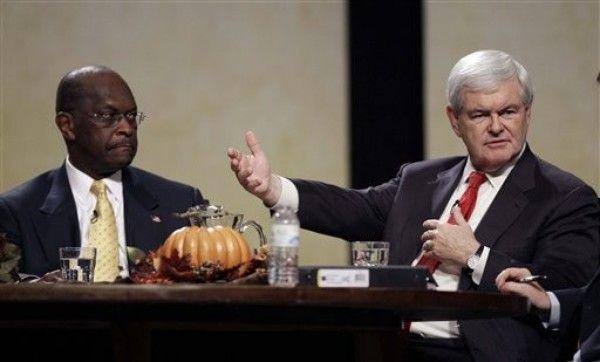
Experts: Cain Exit Would Be More Good News for Gingrich
Published Nov. 30, 2011 • Read time: 6m
Tuesday morning, on the heels of explosive new allegations of sexual impropriety, GOP presidential hopeful Herman Cain told supporters on a conference call that he would spend the next few days "reassessing" whether to remain in the race.
If Cain were to excuse himself from the 2012 Republican presidential field, he would leave roughly one-sixth of Republican voters looking for another candidate to support with less than five weeks before Iowans kick-start the GOP nominating process on Jan. 3.
Cain has already been hemorrhaging support over the last month, a casualty of allegations of sexual misconduct (and his campaign's inept response to those allegations) as well as a series of interviews in which he demonstrated an apparent lack of knowledge regarding foreign affairs. The Republican who has benefited most from Cain’s collapse is Newt Gingrich, who has surged in the polls.
This is particularly true in Iowa, where Cain’s poll numbers have fallen from 20 percent three weeks ago to about half that today. And as Cain contemplates his political path in the wake of the most recent challenge -- a credible-sounding Atlanta woman publicly proclaimed that she had a 13-year affair with the married candidate -- experts say the next question is whom do Cain’s remaining supporters like second best.
“In the second-choice question, Newt is running best -- and this stands to reason,” said conservative political consultant and political author Craig Shirley. “Some social conservatives who have supported Herman Cain will turn to Michele Bachmann, others to Rick Santorum, maybe, but Cain and Newt track closely. Each has a populist, outsider appeal.”
Former White House press secretary Mike McCurry, who worked on Democratic presidential campaigns in 1988 and 1992, concurs. “My guess is that Cain’s support is from those who want a pragmatic and unorthodox approach to conservatism,” McCurry said Tuesday. “Gingrich is the current flavor of that constituency and he will likely enjoy a boost if the Cain support needs to find a new home.”
Pollster Scott Rasmussen agrees. “Some of Cain’s support will go to ‘I’m not sure,’ ” Rasmussen said, “but some will go to Newt Gingrich because he’s the most viable ‘not Romney’ candidate right now.”
In Iowa, this matters more than in most places. On caucus night, supporters of minor candidates are openly urged to switch to other camps before the votes are counted -- publicly. But the polls aren’t definitive in answering the question. A Bloomberg News poll of Iowa Republican voters conducted Nov. 10-12 showed Gingrich and Cain tied as the top “second choice” candidates at 15 percent, with Mitt Romney a close third at 14 percent and Rick Perry the only other one in double digits at 11 percent.
But the lack of hard data doesn’t preclude informed guesswork. One Romney confidante said Tuesday that she had picked up rumblings in Iowa that Santorum, the socially conservative former Pennsylvania senator, was making inroads among former Cain backers. But given his anemic poll numbers throughout the campaign, that might be wishful thinking.
Dave Funk, the GOP co-chairman in Polk County, Iowa, believes a Cain exit will help both Gingrich and Perry. The Texas governor “will regain some of the supporters he lost to Cain,” Funk said, while others will be attracted to the surging Gingrich.
Craig Shirley’s business partner Diana Banister points out that much of Cain’s support in the Hawkeye State had come at Bachmann’s expense, and expressed the view that the conservative Minnesota congresswoman may get a second look.
“I would say that she and Newt will benefit most,” Banister said Tuesday. “Newt will do so because he is surging in the polls and getting more attention than he had earlier in the year. Bachmann, because her conservative message is still intact, and that’s what they’re looking for.”
Edward J. Rollins, who worked earlier in this campaign for Bachmann, said that the congresswoman -- along with Santorum and Perry -- will get some of the Cain support, but that Gingrich stands to be the primary beneficiary. Rollins, who was the 1984 campaign manager of Ronald Reagan’s 49-state landslide, is also convinced that it doesn’t really matter whether Cain formally withdraws, because his strategy was always wholly contingent on Iowa, a place where he now has no chance. His former supporters there are already casting about for another choice.
“My sense is that Cain’s candidacy was in a downward spiral with no real organization in Iowa or beyond,” Rollins told RealClearPolitics. “With less than five weeks before the Iowa caucus, he is not going to be able to turn this around. Money people are not going to support him. The religious right and Tea Party have serious doubts about him after five women have told stories and he has denied them all. Equally important, he lacks substance. Gingrich is on the rise and will pick up a lot of his support. Bachman, Perry and Santorum may add some but Newt will be the big winner.”
Delving deep into the polling data, as his is wont, Pat Caddell (who opposed Rollins in the 1980 presidential campaign) concludes that Cain’s demise would benefit a candidate who consistently flies below radar: Ron Paul.
“If Cain gets out, the first instinct is to think this will help the leading ABR (‘Anyone but Romney’) candidate: Gingrich. However, there’s some reason to believe that his withdrawal may also possibly boost Paul,” Caddell said. “If you look closely at the latest Insider Advantage poll, its results show that both Cain and Paul have quite similar [supporters] in makeup: heavily male and independent. Indeed, while most of the focus has recently been on Gingrich and Romney, I’m beginning to think that the real overlooked dark horse may be Ron Paul.”
If the polls aren’t much help, neither is historic precedent. But though the circumstances were different, the 1992 campaign shows how dramatically a candidate’s defection can alter the dynamics of a presidential race. That year, independent Ross Perot was in a tight, three-way general election race with President George H. W. Bush and Democrat Bill Clinton when he abruptly quit. Perot later got back in, but the flow of the race had been permanently altered, with Clinton as the beneficiary.
McCurry says the differences between the current situation and that example are many. “We’re still in the intramurals,” he said, and one lesson is worth remembering from almost all presidential campaigns. “I think there are several more turns of the wheel before we get to Iowa and New Hampshire and South Carolina, and surely those events will do something to rearrange the field,” he said. “They always do.”


RCP Today
Top stories on RealClearPolitics
The Takeaway
Polling intelligence and analysis delivered to your inbox
World News
Featuring the latest world news
Policy
Featuring the latest policy news
Support Our Mission
As part of RealClearPolitics, authors aim to provide balanced, non-partisan analysis by presenting top reporting and commentary from all sides of the political spectrum.
Trusted by policymakers and citizens alike since 2000