
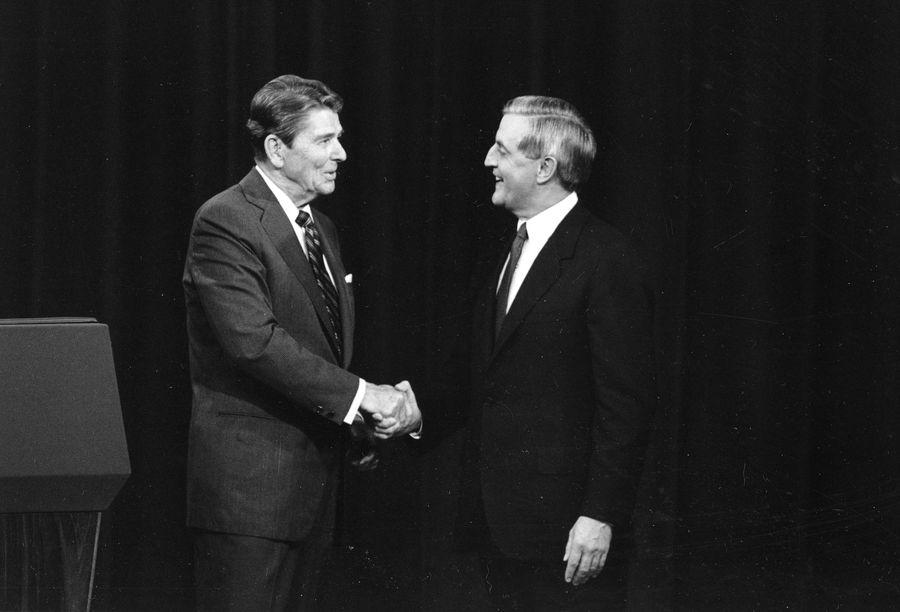
FILE - In this Oct. 22, 1984, file photo, President Ronald Reagan, left, and his Democratic challenger Walter Mondale, shake hands prior to their televised presidential debate, in Kansas City, Mo. When Reagan won the White House in 1980, he was 69 _ the oldest man ever elected to the office. During his successful 1984 re-election campaign, he faced questions about his age in his head-to-head contest with 56-year-old Walter Mondale, the former vice president. They spend hours mastering policy. Learning to lean on the podium just so. Perfecting the best way to label their opponents as liars without whining. But presidential candidates and their running mates often find that campaign debates turn on unplanned zingers, gaffes or gestures that speak volumes. Debate wins and losses often are scored based on the overall impressions that candidates leave with voters. In the history books, though, small debate moments often end up telling the broader story. (AP Photo/Ron Edmonds, File)
Elections Have Consequences. Especially Ronald Reagan's.
COMMENTARY
Published Nov. 5, 2019 • Read time: 5m
One year from now, Americans will go to the polls to choose their next president. Regardless of who is nominated by the two major parties, there is no doubt the campaign will be hard-fought and, presuming Donald Trump is the Republican nominee, it will be bare-knuckled. But one way or another, it will be over once a winner is declared. Unless there are hanging chads. Once the result is known, we can get back to the business of finding common ground on solutions to the considerable problems we face as a country. At least that’s the way it’s supposed to work, the way it used to work.
Recently, however, that has not been the case. For a variety of reasons, presidential campaigns have continued well beyond Election Day. That’s not just because of legitimate issues of how votes are counted. No, it’s because political activists on both sides seem unwilling to put the country’s interests before their party’s.
This polarization is due in part to the inevitable dividing of liberals and conservatives, but it also due to the political consulting community and some in the national media, who thrive on conflict instead of resolution. Both parties have made themselves a captive of their respective “bases.”
In 1980, though, Ronald Reagan won one-fourth of all Democrats votes that year and he won even more in 1984. Lest we forget, when first elected president Reagan had been a Democrat longer than he had been a Republican -- specifically, 30 years as an FDR Democrat versus 18 years as a Goldwater Republican. But he didn’t leave his Democratic past behind. He always carried with him the idealism of Franklin Roosevelt and spoke like John Kennedy, preferring the inclusive “we,” “us,” and “ours” to the self-focused “I,” “me,” and “my.” That explains his call for a “community of shared values” at the 1980 GOP convention in Detroit, where he also paid more tribute to Roosevelt than he did to any Republican.
Lies, Assault and Cover-ups Don't Stop Donald Trump
Trump Stands by His Man; Obama on a Health Scourge; Hayden Interview; Reagan's Courage
Analysis: For Trump, Few Limits to Win-At-Any-Cost Approach
What If Clinton Isn't Indicted?
Although as president he stayed true to his party and his philosophy, he was always willing to work with Democrats, and compromise with them, on issues ranging from tax reform to arms control.
Reagan always understood the difference between politics and policy and once the election was over, it was time to govern all the people and not just the base.
As we think about where we were then vs. where are now, it’s worth remembering that 35 years ago, Ronald Reagan was re-elected president of the United States by a landslide. He carried 49 states. Minnesota, the home state of his Democratic opponent, former Vice President Walter F. Mondale, was the only one Reagan lost.
Reagan’s re-election was never really in doubt, but being superstitious creatures of habit, the Reagans did what they always did on election nights when he was a candidate for office – joined a small group of close friends for dinner at the Los Angeles home of Marion and Earle Jorgensen. Even though he knew the likely outcome, Reagan was interested in news reports of how he was doing state by state. Every few minutes he would discretely leave the other guests to join aides in the staff room – actually a spare bedroom – to watch televised reports on a very small set sitting on a flimsy table. When it was clear that he had won, and the magnitude of his victory began to be apparent, Nancy joined him. It was there that Reagan received a gracious concession call from Mondale, as well as a congratulatory call from his re-elected vice president and eventual successor, George H.W. Bush.
He was happy, of course, but measured. The Gipper wasn’t spiking the football. Mrs. Reagan and the staff were less restrained. When Deputy White House Chief of Staff Michael Deaver suggested to Reagan that he invite Mondale to the White House as a show of national unity, one aide blurted out, “For what, a tour?” Mrs. Reagan laughed. Reagan himself paid no attention to his wife or the irreverent staffer and quickly agreed to Deaver’s gracious suggestion.
From the Jorgensens’ home, the Reagans went to their hotel, where they invited a small group of reporters to join them as they watched continuing reports of election returns. Even then he was unwilling to indulge in anything approaching self-praise or gloating, despite considerable baiting from reporters. Instead, when asked what he would say to the defeated Mondale, Reagan was empathetic, saying that “he must be feeling awful tonight. I'm quite sure that there isn't anything I could say that would make him feel any better.” Asked specifically if he felt sorry for Mondale, Reagan said, “Yes, I think if you're in the race at all, you know how someone would – how you'd feel yourself. So, you can certainly sympathize with someone else.”
But some overeager campaign staffers urged Reagan to pursue a recount in the Gopher State, which Mondale had only narrowly won. They were convinced the Democrats there had voted graveyards. Reagan brushed off the suggestion, saying 49 states was enough. Still, he confided in his diaries his dismay at the national media, which tried to say it wasn’t a mandate. “Well, 49 states, 59% of the vote & 525 electoral votes. The press is now trying to prove it wasn’t a landslide…” Reagan mirthfully wrote in his confidential journal.
As nice as Reagan’s words about Mondale were, what is most important about that night was what the Gipper said he hoped the end of the campaign would mean for America. Maybe remembering what Deaver had suggested, he said, "I hope that we can close ranks for the good of the country.”
The good of the country.
Imagine that.
Democrats Won the Midterms. Common Sense Won, Too
Jordanne Kemper • RealClearPolitics
The 120th Congress Shapes Up
Carolina Lumetta • RealClearPolitics
Flooding GOP Primaries With Democrats
Robert Natelson • RealClearPolitics
Washington Keeps Rewarding Oracle—Veterans Keep Paying the Price
Darin Gaub • RealClearPolitics
The Seeds of Unrestricted Warfare
John Teichert • RealClearPolitics
The Primary System Is Losing the Next Generation
Sean Trende • RealClearPolitics
RCP Today
Top stories on RealClearPolitics
The Takeaway
Polling intelligence and analysis delivered to your inbox
World News
Featuring the latest world news
Policy
Featuring the latest policy news
Support Our Mission
As part of RealClearPolitics, authors aim to provide balanced, non-partisan analysis by presenting top reporting and commentary from all sides of the political spectrum.
Trusted by policymakers and citizens alike since 2000