
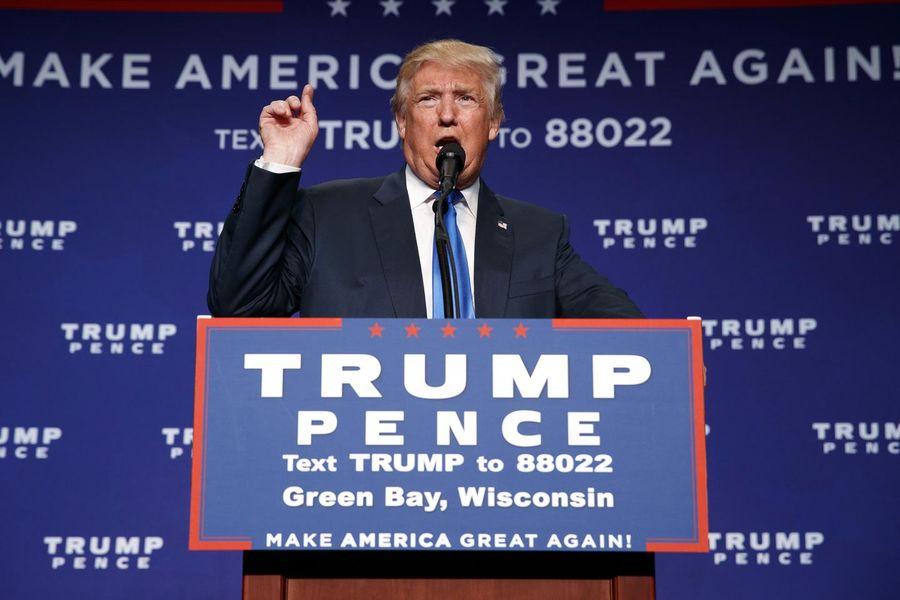
Republican presidential candidate Donald Trump speaks during a campaign rally, Monday, Oct. 17, 2016, in Green Bay, Wis. (AP Photo/ Evan Vucci)
Donald Trump and the Perils of Promising Too Much
Published Oct. 19, 2016 • Read time: 4m
Although Donald Trump’s campaign may lack many things, making ambitious promises isn’t one of them. During his first two debates with Hillary Clinton, the Republican nominee claimed—again—that he “will be reducing taxes tremendously,” he’s “going to cut regulations,” he “will knock the hell out of ISIS,” and he “will be a president for all of our people.” Even non-Trump voters could find some promises to like, if they try hard enough.
But this is hardly good news for Trump. As we explain, his rampant promises are a testimonial to how little the business mogul knows about voters and how unlikely his victory is in November. Since voters distrust politicians, smart candidates need to use their promises wisely.
In fact, history shows that campaign promises are an astonishingly good predictor of election results, but not in the way Trump appears to think. In fact, the presidential candidate making the most promises nearly always receives fewer votes. We analyzed every presidential debate going back to 1960. The chart below plots the use of the future tense (identified by the auxiliary verbs “will,” “going to,” and “shall”) by candidates during presidential debates as a proxy for how much they promise to do for voters should they be elected. The presidential candidates talking the most about the future, with just one exception, have all lost the popular vote.
Why do candidates who promise more get fewer votes? One possibility is that a multitude of promises reflects a lack of knowledge of swing voters and how to appeal to them—a perfect recipe for losing an election. In contrast, a candidate who knows more about the electorate can craft fewer but better targeted promises to win over swing voters.
There’s little doubt that, when one candidate is liberal and the other conservative, both will compete to attract “in-between” persuadable voters. But even in a simplistic “left versus right” view, it’s seldom obvious to determine which voters are “in the middle.” If a candidate is poorly informed about the electorate and their diverse preferences, devising a policy platform tailored to the swing voters is practically impossible. The candidate is forced to rely on a strategy akin to “throwing everything against the wall and seeing what sticks”: vowing to bring jobs to the unemployed, promising a wall to those concerned about illegal immigrants, assuring energy companies of more profits, or, as Trump summarized during the Oct. 9 debate, doing “everything I can to reach out to everybody.” Yet that unfocused approach does little more than reveal how little thought the candidate has given into message targeting.
Lies, Assault and Cover-ups Don't Stop Donald Trump
Trump Stands by His Man; Obama on a Health Scourge; Hayden Interview; Reagan's Courage
Analysis: For Trump, Few Limits to Win-At-Any-Cost Approach
What If Clinton Isn't Indicted?
A candidate who invests heavily in learning about voters and their preferences can gain a significant advantage. For more than a decade, the Democratic Party has held a commanding lead over the Republicans in the field of voter data operations. During Barack Obama’s re-election bid, his campaign hired 342 data analytics staffers; Mitt Romney had only 58. The data disparity has grown even larger in this election cycle, as Clinton ramps up her data-related hires while Trump alienates one group of Republican voters after another. With better information about the electorate, it’s not surprising that the Democratic nominee can make promises targeted to the expectations of undecided but persuadable voters, thus appearing closer to them politically.
Trump only started hiring data staffers in June, a month after he discounted the value of a voter data operation. Since then, the New York billionaire has shown no signs of making the targeted changes that would follow from an effective data analytics operation. Our analysis shows that voters don’t like excessive promises, and candidates that make too many promises almost always lose.

Jon Finer’s Old and Dangerous ‘New Approach’ to Israel
Peter Berkowitz • RealClearPolitics
The President Deserves Better
John Ullyot • RealClearPolitics
Congress Doesn’t Need Another Blame Game. It Needs To Find What’s Broken
Jarrod Bernstein • RealClearPolitics
Democrats Won the Midterms. Common Sense Won, Too
Jordanne Kemper • RealClearPolitics
The 120th Congress Shapes Up
Carolina Lumetta • RealClearPolitics
Flooding GOP Primaries With Democrats
Robert Natelson • RealClearPolitics
RCP Today
Top stories on RealClearPolitics
The Takeaway
Polling intelligence and analysis delivered to your inbox
World News
Featuring the latest world news
Policy
Featuring the latest policy news
Support Our Mission
As part of RealClearPolitics, authors aim to provide balanced, non-partisan analysis by presenting top reporting and commentary from all sides of the political spectrum.
Trusted by policymakers and citizens alike since 2000