
Donald Trump and the Bully Pulpit of U.S. Civil Religion
Published Feb. 19, 2016 • Read time: 6m
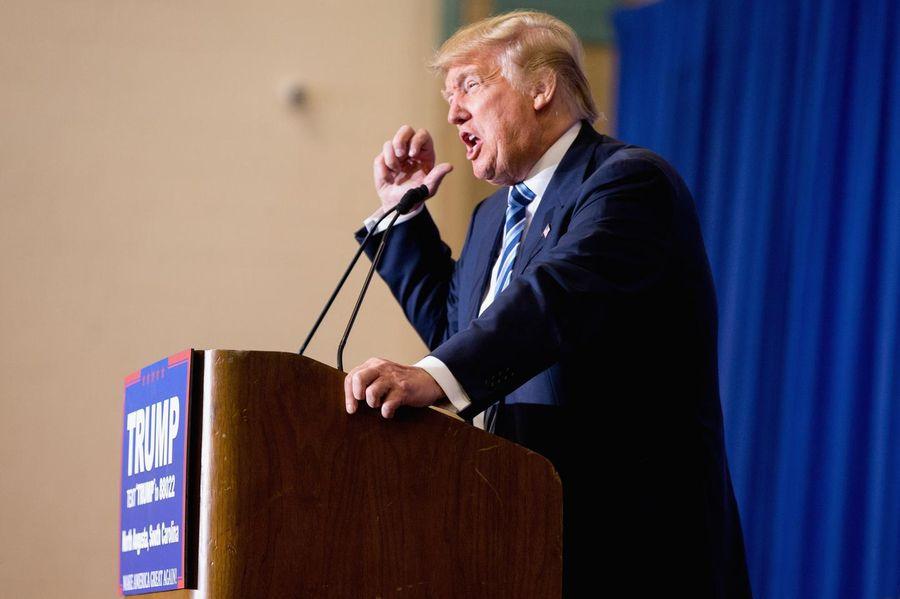
“Civil” and “religious” are rarely used qualifiers for Donald Trump. Pundits, in their quest to fathom the Republican frontrunner’s early success, dissect everything Trump wears, does, and especially what he says. Critics point to every new Trump outrage as the potential gaffe that will finish him. Yet The Donald keeps soaring above it all.
He’s doing so partly on a time-tested formula: he has ridden the populist crest of American civil religion to early success. And he taps into more than just anger.
Scholars, such as sociologist Robert Bellah, have cited civil religion as a critical, yet often overlooked cornerstone of American public life. Civil religion functions as the glue that binds Americans of diverse backgrounds to one another in a unique social contract. It canonizes inaugural addresses, foundational documents, and other noteworthy moments in our Republic’s history to explain why many Americans believe the United States deserves special attention from God, along with a divinely inspired mission in the world and an exceptional destiny.
From Puritan John Winthrop onward, leaders have tapped into this urgent sense of uniqueness. The U.S. president, especially, has always held the informal role of a civic-minded high priest, a wise shepherd who guides Americans through times of crisis with powerful speeches that often cite God, heaven, and the nation’s divine purpose.
Two 21st century addresses by our chief executives highlight this role: President Bush’s national address on 9/11 and President Obama’s memorial eulogy in the wake of the 2011 shootings in Tucson, Ariz. Bush declared that “A great people has been moved to defend a great nation. Terrorist attacks can shake the foundations of our biggest buildings, but they cannot touch the foundation of America.” Obama struck a similar chord in Tucson, decrying the tragedy but also affirming the unique bonds shared by Americans: “Those who died here, those who saved lives here, they help me believe … And I believe that, for all our imperfections, we are full of decency and goodness and that the forces that divide us are not as strong as those that unite us.” Both leaders concluded their addresses with a variation of the benediction, “God Bless America.”
Lies, Assault and Cover-ups Don't Stop Donald Trump
Trump Stands by His Man; Obama on a Health Scourge; Hayden Interview; Reagan's Courage
Analysis: For Trump, Few Limits to Win-At-Any-Cost Approach
What If Clinton Isn't Indicted?
Politicians aspire to the mantle of righteous leadership, and, in presidential elections, the candidate who best articulates the hopes and dreams of everyday Americans in this pastoral style almost invariably wins.
But how does Donald Trump fit into this political-clerical role? His speeches hardly conjure images of Bush striding defiantly to the Oval Office or Obama at the University of Arizona, let alone Abraham Lincoln, Franklin Roosevelt, or John F. Kennedy—or any of the luminaries among the pantheon of American civil religion.
Tea Party rallies have electrified the Republican Party for over a half-decade with the most basic gestures to our foundational narratives. Such events, for example, feature colonially garbed patriots heralding self-professed “constitutional conservatives.” Does Trump seem out of place? Compared to Ted Cruz, sanctified recently by radio talk show host Glenn Beck as the “next George Washington,” Trump might appear antithetical to American civil religion. When he tries to invoke “God talk,” he often falters, such as when he referred to “Two Corinthians,” instead of “Second Corinthians.” This prompted a witty aside from Cruz (“Two Corinthians walk into a bar …”), yet Trump makes canny use of his own political theater.
Despite his coarse persona, he connects the necessary dots. A recent Pensacola, Fla., appearance featured the “U.S.A. Freedom Kids,” a trio who sang Trump’s campaign song with a nod to the World War I anthem “Over There,” and the “Gun Girls for Trump” leading the Pledge of Allegiance. Add in evangelical preachers, and Trump’s shtick makes for the stuff of frontier vaudeville. And it works. Cultural critics overlook this important point. Our task is not to tell you when Trump’s campaign will implode; rather, we want to explain its unlikely success. And the answer is no more complicated than Trump’s message. Trump evokes a “victory culture.”
“We don’t win anymore” is the most important line in his stump speech. Lincoln pled for “malice toward none.” Kennedy urged Americans to aim for the stars. More recent presidents have delivered moving tributes to fallen American heroes, from Reagan and the Challenger Seven, to Clinton and the victims of the Oklahoma City bombing. Trump’s message is neither as eloquent nor evocative, but it appeals to the core components of American civil religion: the sense of divine place, destiny, and “American exceptionalism.”
In Trump’s vision for America, We win again.
He seasons this message with plenty of salty language—perhaps too much for his crowd—but his surrogates blunt his spiciness with the requisite invocations to God and country. Sarah Palin’s recent endorsement was a case in point. The former vice-presidential nominee effused to a large Iowa crowd that “His [Trump’s] power, his passion is the fabric of America, and it’s woven by work ethic and dreams and drive and faith in the Almighty. What a combination.”
Is this enough? We shall see. Lincoln urged cooperation and mercy. Trump’s civil religion, however, is much more aggressive. Screw cooperation and mercy, he seems to be saying. Such values will not help our dealings with the Chinese and Iranians. We need to negotiate better deals, not “go along to get along.” Trump not so subtly adds “The Art of the Deal” to the canons of civil religion. “Thou shalt win!” becomes his most important commandment.
Critics rightly point out his lack of policy specifics, but this is hardly a disqualification if recent campaigns are any guide. Four years ago, Mitt Romney offered an economic plan with 57 components. Obama reprised “Change We Can Believe In.” Guess which one was a more resonant representation of our civil religion?
Trump finished second in Iowa and first in New Hampshire, and the upcoming contests look promising, yet remain highly uncertain. But this much is clear: He is expanding the contours of American civil religion. It remains to be seen, however, whether he is preaching to the masses, or just a particularly raucous choir.
Dr. Glenn W. Shuck is a scholar of American and Central European religion and politics.
James Hitchcock, an assistant editor at RealClearPolitics, recently graduated from Williams College, where he worked closely with Professor Shuck.

Jon Finer’s Old and Dangerous ‘New Approach’ to Israel
Peter Berkowitz • RealClearPolitics
The President Deserves Better
John Ullyot • RealClearPolitics
Congress Doesn’t Need Another Blame Game. It Needs To Find What’s Broken
Jarrod Bernstein • RealClearPolitics
Democrats Won the Midterms. Common Sense Won, Too
Jordanne Kemper • RealClearPolitics
The 120th Congress Shapes Up
Carolina Lumetta • RealClearPolitics
Flooding GOP Primaries With Democrats
Robert Natelson • RealClearPolitics
RCP Today
Top stories on RealClearPolitics
The Takeaway
Polling intelligence and analysis delivered to your inbox
World News
Featuring the latest world news
Policy
Featuring the latest policy news
Support Our Mission
As part of RealClearPolitics, authors aim to provide balanced, non-partisan analysis by presenting top reporting and commentary from all sides of the political spectrum.
Trusted by policymakers and citizens alike since 2000