
Clinton Combined Private, Official Emails for "Convenience"
Published March 10, 2015 • Read time: 7m
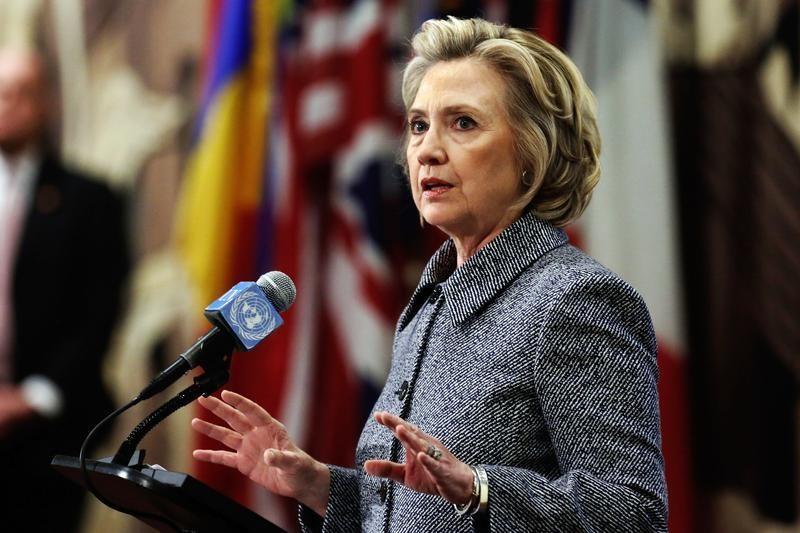
NEW YORK -- Hillary Clinton, who may be weeks away from announcing a presidential bid, attempted Tuesday to quiet a growing chorus of critics with an explanation that “convenience” drove her to comingle work and personal email communications while she was secretary of state.
Her 20-minute discussion while standing in a jammed United Nations hallway included limited details about her emails and a general expression of pride about the Clinton family foundation’s fundraising, another recent target of her critics. Her answers appeared unlikely to settle debates about her judgment, or about the contents of thousands of communications she said she deleted from the Clintons’ personal server because she deemed the messages personal in nature.
Clinton told journalists she provided approximately 30,000 emails to the State Department in response to its request last year to recover materials from her personal accounts. Department officials announced shortly before Clinton’s hastily arranged news conference that her communications eventually will be made public on a special website after clearance by department employees – a process that could take months.
In hindsight, Clinton told reporters, it would have been “smarter” for her to use two separate devices to manage official email through the state.gov system, in combination with her personal, clintonemail.com account, which she said was established for President Clinton when he left office. She said the private server was “secure.”
Breaking her public silence following a March 2 New York Times report that she used a personal email account exclusively while she served in President Obama’s Cabinet, Clinton said she would not authorize an independent review of her server and believed an “independent” examination of her federal communications would not be necessary. "The server contains personal communications from my husband and me, and I believe I have met all of my responsibilities, and the server will remain private,” Clinton said.
Lies, Assault and Cover-ups Don't Stop Donald Trump
Trump Stands by His Man; Obama on a Health Scourge; Hayden Interview; Reagan's Courage
Analysis: For Trump, Few Limits to Win-At-Any-Cost Approach
What If Clinton Isn't Indicted?
She sidestepped two questions from reporters about how the controversy might impact her presumed second bid for the Oval Office, which her backers expect to launch this spring. Her advocates had urged the former first lady to respond to questions about her email as a way to shore up support from nervous Democrats, including campaign donors.
A Rasmussen Reports poll this month found voters most concerned about the security of Clinton’s emails, more than the legality. Assessments were partisan-tinged, with 79 percent of Republican voters saying she was hiding her communications from oversight, and 50 percent of Democrats disagreeing. About 39 percent of unaffiliated voters said they were unsure, according to the survey conducted March 4-5.
Revelations about the former secretary’s email system and her exclusive retention of her communications while in government from 2009 to 2013 have followed investigations conducted during the last Congress and by the House Select Committee on Benghazi, which the majority appointed this year. The panel has issued subpoenas for all the emails in question, and may seek to obtain some form of forensic access to the Clintons’ email server.
Clinton said she complied during her tenure at the department with federal records retention rules and shared no classified material through email, and she refuted the suggestion that there are any national security concerns. She said she took the additional “unprecedented” step of providing her official correspondence to the government in December, along with her invitation this month to make her official communications public.
Among her emails are a number exchanged with President Obama, the White House said Monday. Retention and preservation of presidential communications as the property of the American people fall under the Presidential Records Act, not the Federal Records Act. The PRA can bar public disclosure while a president is in office (and for a dozen years after a president leaves office) through exemptions, including shields for executive advice.
Obama, who boasts of his administration’s transparency and accountability, could waive such protections for his exchanges with Clinton, but his spokesmen have said they will wrestle with that question if it arises.
Obama said over the weekend he was unaware until news accounts this month that Clinton used a private email server and exclusively relied on her personal account while serving as secretary. He was aware of her private email address, but assumed her messages were preserved in the state.gov or other federal records retention systems, White House Press Secretary Josh Earnest said.
“Looking back, it probably would have been smarter to use two devices, but I have absolute confidence that anything that could be connected to work is now in the possession of the State Department,” Clinton told reporters following a speech at the United Nations commemorating an address about women’s rights she delivered there 20 years ago.
When asked Tuesday about foreign contributions accepted by the Clinton foundation, some of which came from countries with records of violence against women, the former secretary said donors were aware of the foundation’s mission and she remained “very proud of the work the foundation does.”
Clinton said she had roughly 60,000 emails on her private account from her period at the department, half of which she considered personal rather than official business. She said she instructed her private counsel to transmit over 30,000 emails, or about half the total, to the government in response to its request a few months ago, and she said she deleted messages that referenced non-work communications, such as wedding plans for her daughter Chelsea.
While serving as secretary, Clinton explained that she emailed State Department officials and others inside the government, which created copies of her communications in federal records systems. Those emails have been in the government’s possession all along, regardless of which email account she used, she said.
At the time she decided to use a personal account for official businesses, “this didn’t seem like an issue,” she added.
Clinton’s responses are unlikely to satisfy Republicans who have called for a third-party investigation.
“Anything short of Hillary Clinton releasing her secret server to an independent arbiter would demonstrate that she’s not interested in being transparent with the American people,” said RNC Chairman Reince Priebus.
Rep. Trey Gowdy, chairman of the House Select Committee on Benghazi, issued a statement saying that without access to Clinton's personal server, there is no way to verify her claims. He said his committee, established last year to investigate the September 11, 2012 attacks on the U.S. Consulate in Libya, will now call Clinton to testify at least twice: once to “clear up her role and resolve issues” about her private email use, and once to publicly answer specific questions regarding the fatal Benghazi attacks.
Clinton may have appeared a bit rusty and tad prickly when she met the press corps at the United Nations, but she’s a veteran of on-camera defenses that followed uncomfortable media scrutiny throughout her public career.
In 2013, she delivered an impassioned retort to a Senate panel investigating terror attacks in Benghazi, Libya: “What difference, at this point, does it make?” she sputtered, her arms raised in evident frustration.
And in 1998, when President Clinton’s lies about sex with a White House intern threatened his removal from office, she came to his defense, telling NBC’s Today Show that a “vast right-wing conspiracy” was responsible.
But perhaps the most memorable such encounter occurred at the White House in 1994. Dressed in a pale pink outfit, the former first lady convened a news conference with just hours’ notice to describe her late-1970s financial gains from commodities trades in Arkansas, following weeks of controversy about her multiple brokerage accounts, unpaid capital gains taxes, and advantageous business ties.
For over an hour, Clinton sat in a Chippendale chair in the East Room and calmly explained to reporters, including NBC’s Andrea Mitchell, who questioned Clinton again Tuesday, how she turned a $1,000 investment into $100,000 in one year under the guidance of a top lawyer for the nation’s largest poultry producer, a company with significant dealings in Arkansas just as her husband was poised to be elected governor.
Clinton explained that Tyson Food’s outside attorney, James Blair, was a family friend who received no benefit in return for his financial advice and placement of her trades. Her interest in trading commodities from 1978 to 1980, she added, had nothing to do with the land deal known as Whitewater, which was under federal investigation and years later led Kenneth Starr to uncover White House intern Monica Lewinsky.
In 1994, not unlike Tuesday’s event, Mrs. Clinton’s sudden decision to respond to questions she had avoided for weeks threw her aides and others in her sphere into a last-minute frenzy.

The Danger Before the Attack
Leslie J. Sullivan • RealClearPolitics
Jon Finer’s Old and Dangerous ‘New Approach’ to Israel
Peter Berkowitz • RealClearPolitics
The President Deserves Better
John Ullyot • RealClearPolitics
Congress Doesn’t Need Another Blame Game. It Needs To Find What’s Broken
Jarrod Bernstein • RealClearPolitics
Democrats Won the Midterms. Common Sense Won, Too
Jordanne Kemper • RealClearPolitics
The 120th Congress Shapes Up
Carolina Lumetta • RealClearPolitics
RCP Today
Top stories on RealClearPolitics
The Takeaway
Polling intelligence and analysis delivered to your inbox
World News
Featuring the latest world news
Policy
Featuring the latest policy news
Support Our Mission
As part of RealClearPolitics, authors aim to provide balanced, non-partisan analysis by presenting top reporting and commentary from all sides of the political spectrum.
Trusted by policymakers and citizens alike since 2000