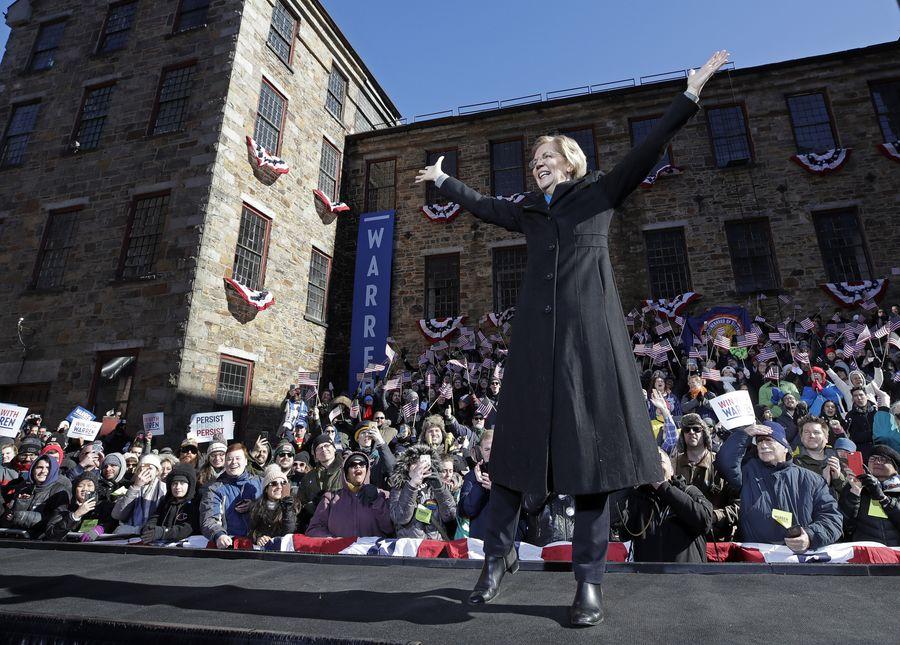
U.S. Sen. Elizabeth Warren, D-Mass., acknowledges cheers as she takes the stage during an event to formally launch her presidential campaign, Saturday, Feb. 9, 2019, in Lawrence, Mass. (AP Photo/Elise Amendola)
Can Warren's Small-Dollar-Donor Strategy Pay Off?
Published Feb. 27, 2019 • Read time: 6m
Sen. Elizabeth Warren is going to lose. She just said as much. Sort of.
“I've made a decision,” the Massachusetts Democrat wrote to her supporters on Monday morning. “My presidential primary campaign will be run on the principle of equal access for anybody who joins it.”
That means no private dinners with deep-pocketed donors, no special photo ops for the wealthy patrons who write the fat checks, no phone calls to say thanks to moneyed elites. It ensures, Warren summarized, “I’m outraised in this race.”
But it is by intentionally losing the big-dollar donors that Warren plans on winning her party’s nomination.
“We’re going to take the time presidential candidates typically reserve for courting wealthy donors and instead use it to build organizing event after organizing event in the early primary states and across the country,” Warren wrote. “If we do this in the primary, we will build the kind of grassroots organization we need to win the general election.”
The move is the most significant effort to separate money from 2020 politics so far, an unmistakable contrast between Warren and every other presidential contender, and it comes at a moment when the small-dollar donor has never been more powerful.
“Major donors are probably less influential than they ever have been in politics,” explains Rufus Gifford, who was the national finance director for the 2012 Obama campaign. For proof, he points to the small-donor/big-dollar hauls of each of the Democratic frontrunners.
--Sen. Bernie Sanders declared his candidacy last Tuesday. By the end of the day, the self-described Democratic socialist had accepted more than 200,000 contributions, setting a new record: $6 million raised in just 24 hours.
Lies, Assault and Cover-ups Don't Stop Donald Trump
Trump Stands by His Man; Obama on a Health Scourge; Hayden Interview; Reagan's Courage
Analysis: For Trump, Few Limits to Win-At-Any-Cost Approach
What If Clinton Isn't Indicted?
--Sen. Kamala Harris had set the record previously, raising $1.5 million in the same amount of time when she announced her presidential bid.
--Sen. Amy Klobuchar also broke the $1 million mark but took 48 hours to pull in the cash.
--Warren brought in less than $300,000 in the same amount of time when she announced her decision to explore a run last year.
This puts the progressive crusader at an early financial disadvantage, a score that will be reflected after the first fundraising period closes on March 31 (and after the numbers become publicly available). Unlike the competition though, Warren can argue her money comes without strings.
Party brass has placed an increased emphasis on the small-dollar donor. The Democratic National Committee announced in February that it would not allow any candidate with fewer than 65,000 donors from at least 20 different states onto the primary debate stage. Grassroots support, not the poll numbers used in years past, will determine who gets a lectern.
This pushes politicians to give more face time to actual voters instead of just the wealthy, says Tara McGowan, founder of the liberal digital firm Acronym. “It means you can’t only rely on high-dollar donors or self-funding,” McGowan tells RCP. “You have to demonstrate that you are connecting with people, that they are raising their hands and telling you to run.”
Can Warren win on small-dollar donors alone? “Honestly, we don’t know,” McGowan admits. “This is new territory.”
One thing is certain: Any candidate who adopts this approach will have to make an extra effort. While donating online is as easy as ordering a package on Amazon, voters need a reason to give and – especially important for candidates like Warren -- to keep on giving.
“Online donors don’t say, 'Oh, it’s a Wednesday. I want to give money to, say, Beto O’Rourke.' It is different. It is because they are asked at a moment that a campaign creates,” explains Gifford, the former Obama fundraiser who later became his ambassador to Denmark.
“If the campaign doesn’t effectively create that event, they probably aren’t going to raise a lot of online money,” he continues. “Those events are hard to come by in 2019 after the launch. ... It’s going to be hard.”
Eleven months away from the Iowa caucuses, Warren has been trying to make as many of those moments happen as possible. Most recently she has been cold-calling small-dollar donors and sharing those conversations on Instagram. “Oh, my God! You actually called,” one woman who donated $5 told Warren in a video posted Monday night. “Thank you. I’m gonna cry.”
While candidates increasingly court these donors, the moneyed set still has significant pull. A cabal of Obama donors met secretly in Washington, D.C., last week to interview potential candidates and debate among themselves whom to anoint financially. Harris and Klobuchar were there to audition, the New York Times reports, as well as Sens. Cory Booker and Sherrod Brown.
The party has tried downplaying these traditional fundraising arrangements, and the entire field, almost to a candidate, has pledged not to accept money from corporate PACs and federal lobbyists. But the wealthy will play a role in 2020 all the same.
“I wish the day of the super PAC was on its way out, but that’s not reality right now,” says Dallas lawyer Marc Stanley. Though the longtime Democratic donor noted that more everyday people are “voting with their pocketbooks,” he told RCP he still sees a role for big-dollar donors. His super group, the Fire Ted Cruz PAC, spent millions in an unsuccessful effort to unseat that Texas Republican last cycle -- despite protests from the Democratic challenger, then-Rep. Beto O’Rourke.
The Warren small-dollar pledge is not airtight either. There is nothing in her new rules that would keep a wealthy donor from attending one of her events, as some observers were quick to note. What’s more, while the candidate says she won’t be making personal calls to thank those high-end contributors, there is nothing to stop her campaign from picking up the phone.
And if Warren wins the nomination, all bets might be off after the convention. “By then we’ll be up against a Republican machine that will be hell-bent on keeping the White House,” she wrote.
“They will have PACs and Super PACs and too many special interest groups to count, and we will do what is necessary to match them financially. That means investing – starting now – in each and every one of our state parties, and in our national party too.”
This would not be unfamiliar territory. Warren admitted to Chris Hayes on MSNBC Monday night that she amassed an $11 million war chest for her Senate re-election through big-ticket events to court top-dollar benefactors.

A RealClear Thanksgiving: Investing in a Better Future
David DesRosiers • RealClearPolitics
Trump’s Newsom Problem: Antagonist-in-Chief
Carolina Lumetta • RealClearPolitics
America’s Free Spirit
John Maxwell Hamilton • RealClearPolitics
The GOP Majority Should Go Out in Glory
Daniel McCarthy • RealClearPolitics
Republican Majorities Could Return Sooner Than Expected
J.T. Young • RealClearPolitics
The Danger Before the Attack
Leslie J. Sullivan • RealClearPolitics
RCP Today
Top stories on RealClearPolitics
The Takeaway
Polling intelligence and analysis delivered to your inbox
World News
Featuring the latest world news
Policy
Featuring the latest policy news
Support Our Mission
As part of RealClearPolitics, authors aim to provide balanced, non-partisan analysis by presenting top reporting and commentary from all sides of the political spectrum.
Trusted by policymakers and citizens alike since 2000