
Can Romney Coast to the GOP Nomination?
Published Nov. 11, 2011 • Read time: 10m
A ceiling is a ceiling until it isn't a ceiling anymore.
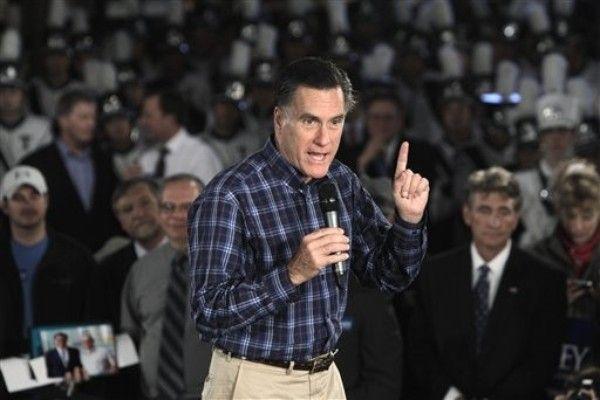
Expect to hear that line with increasing frequency from Mitt Romney's supporters and allies as they point out that although Romney is having a difficult time getting above 25 percent in most national surveys of the GOP presidential field, no one else but the beleaguered Herman Cain is threatening him. You can't beat something with nothing, they say, noting that even though the conservative wing of the Republican Party does not trust Romney, they come up short every time they court an alternative.
And remember this: The New Hampshire primary, the second contest in the GOP nomination fight and where Romney is cruising, is now less than two months away. But the former Massachusetts governor hasn't aired a single TV ad yet -- not one gauzy spot detailing his professional biography and family life that could move the dial further in his direction. He's even further away from spewing attack ads on TV or being the target of those that could puncture him.
The RealClearPolitics polling average puts Cain atop the field nationally with 25.2 percent and shows him beating Romney by 1.9 percentage points. That data, though, was collected through Nov. 6 -- five days ago. Allegations leveled against Cain for sexual harassment have sent his campaign reeling in response all week, and analysts say it may take another week until the allegations begin to show in the polls. (There's a small chance, some suggest, that his support might not budge as his fans rally around him.) The Republican in third place is Newt Gingrich, who may be on the rise, but whose 12.2 percent in RCP's average is still half of the support that Romney enjoys. Rick Perry is next with just 10.2 percent.
Lies, Assault and Cover-ups Don't Stop Donald Trump
Trump Stands by His Man; Obama on a Health Scourge; Hayden Interview; Reagan's Courage
Analysis: For Trump, Few Limits to Win-At-Any-Cost Approach
What If Clinton Isn't Indicted?
The most recent surveys also were completed before Wednesday night's CNBC debate, which featured a devastating moment for Perry when he couldn't remember one of three federal agencies he vowed to eliminate from the government if elected. Even longtime fans of Perry's have started to admit that his window to improve is closing fast, and they openly vented their frustrations to reporters.
"Unfortunately, after the other debate letdowns, he could not afford the brain freeze," one prominent Republican strategist who has been a vocal Perry supporter for months said in an e-mail. "Right now, it's all about the money. We will see what happens at the next few fundraisers. If the checkbooks slam closed, then as they say in Texas, 'You can piss on the campfire and call it a night.' "
Since Perry entered the race back in August, the Romney campaign has focused its opposition research and negative press releases almost entirely on the Texas governor, whom they have long believed to be the lone candidate with the staying power to challenge the former Massachusetts governor for the Republican nomination.
But after Wednesday night's debate performance, the Boston brain trust finds itself in the enviable, if uncertain, position of wondering whether there is enough time before voting begins for anyone in the field to emerge as a viable alternative.
It's not just in Boston. After the debate, Washington's chattering class, the Democratic Party, and a host of former Romney supporters who had defected after his failed 2008 run concluded that Romney will be President Obama's opponent next year. As one prominent Democrat put it, "This goose is cooked."
The mainstream media have begun to laugh at themselves for feeding the frenzy of Romney alternatives, and pundits are poking fun at themselves for buying into the idea that Newt Gingrich or Jon Huntsman could be the next to rise -- though those two certainly will benefit from an increased level of coverage as they try. Republican strategists in New Hampshire watching the race closely say Gingrich and Huntsman will get another look but that neither one can get the nomination due to their obvious flaws.
Nevertheless, the right wing refuses to fall in line quietly behind Romney. Conservative blogger Erick Erickson, who made a splash bashing establishment Republicans in 2010 Senate primaries, smacked Romney in a post this week and suggested that Huntsman might be more faithful to conservative principles. The problem for Huntsman, though, is that he has failed to catch on in any meaningful way, and it remains to be seen how much Erickson's interest will help at this late date.
The former ambassador to China is pinning his hopes to the Granite State, where Romney is polling 34 points ahead of him, according to RCP's polling average of surveys there. The former Utah governor is tied in fourth place with Gingrich at 6 percent, behind Cain's 18 percent and Ron Paul's 11.3 percent.
To move support his way, Huntsman's campaign released a series of widely praised Web ads that have challenged Romney directly over the GOP front-runner's biggest weakness: the perception that he lacks core convictions and will say anything to try to get elected.
Huntsman may yet have a shot of making the Granite State -- and thus, the primary process -- more competitive if he can tighten up his message and better define himself as the sole alternative to Romney who can beat Obama next November. The problem is that he lacks the financial means to launch even a minimal television advertising blitz, although the multimillionaire son of a billionaire has not ruled out putting in more of his family's cash into the effort.
Instead, the candidate who appears likeliest to benefit most if the Perry and Cain campaigns fade precipitously appears to be Gingrich, who notched another solid debate performance on Wednesday night and has risen toward the top tier in the polls in recent weeks.
The former House speaker's aides cite an influx of encouraging signs from Republicans who had previously backed other candidates -- a trend that they say reached its highest level yet after Perry's debate flubs.
Gingrich is in the midst of a two-day swing through New Hampshire and has boosted his travel to the early voting states after appearing to be primarily interested in hawking his books and movies during the early stages of the campaign.
"My sense that I have is we're not there yet, but if things keep moving in the direction they're moving, we're definitely in a position to make it happen," said Gingrich's state director, Andrew Hemingway. "If we don't have a candidate who can beat Obama in a debate, it's going to make winning a lot harder. It's obvious that Newt is the guy who's been doing it in debates."
Though cash may finally be pouring in, Gingrich's severe financial disadvantage this late in the game figures to remain a major concern, as are the underlining problems related to electability and the former Speaker's well-documented tendency to trip over his own feet. Specifically, can Gingrich benefit from a Cain flameout given the subject matter: Gingrich himself infamously carried on an extramarital affair years ago.
With all of the other candidates' problems, then, does Romney have to do anything -- anything at all -- to close the deal?
There are a few considerations to keep in mind.
First, now that he is the clear leader in the race (assuming Cain begins to fade in the polls as a result of his troubles), strategists in other camps say attacks are nigh. And they'll come at a time when voters are paying the closest attention -- just before the primaries.
Second, Romney hasn't done much campaigning yet, though no one has. Strategists and activists in Iowa, New Hampshire and South Carolina are dispirited by the lack of traditional retail politicking that has gone on in the early-state contests thus far. As his former New Hampshire political director, Jamie Burnett, put it, "Romney is campaigning sufficiently. There is no strong competition for him. The rest of the field has not broken through." But if other candidates pick it up, will Romney? Can he afford not to? Most of the candidates this cycle have proved that they are gaffe-prone on the campaign trail, and Romney is no exception. Will a final burst of energy in the diners of Des Moines and Manchester in the last two months change voter impressions much? And in that regard, Burnett pointed out that going forward, "Cain barely has any infrastructure. He's not equipped to win a national campaign against Romney."
Third, Romney's not likely to get an overwhelming show of support from the most prominent GOP figures to help him over the edge. South Carolina Sen. Jim DeMint, a critical figure in the party, has suggested he won't be issuing an endorsement. Iowa Rep. Steve King has indicated the same thing. A source close to Indiana Gov. Mitch Daniels said it's unlikely the favorite of the conservative elite will a pick his own favorite, either. So if Romney goes the distance, it may still be that his brethren aren't necessarily jumping for joy.
And fourth, conservative groups and Tea Party types aren't jazzed about Romney, either.
The influential Club for Growth, for instance, is far more interested in the economic plans Perry and Cain put forward. Spokesman Barney Keller said in an interview, "Governor Romney's jobs plan is OK. It's not the bold, fundamental change that we would like to see out of the next president. . . . We're excited about plans offered by Herman Cain and Rick Perry because they are bold." He added that Cain's "9-9-9" plan and Perry's flat tax option of 20 percent are pro-growth, while Romney's plan just trims at the edges.
Of course, that interest in Perry and Cain doesn't necessarily help the next two candidates who could be in line for the spotlight, Huntsman and Gingrich. And the Club finds Huntsman's record as Utah governor distasteful for having enlarged the state government and spending every new dollar of revenue raised.
Still, Keller complained, Romney's level of support in the polls seems to take into account that much of the base "understands the warts Romney has." Nevertheless, he said, "no one [in the GOP field] has gone after him for using class warfare," complaining that Romney uses the same rhetoric of helping the middle class that President Obama does. He also said it's "baffling that no one attacked him in the Bloomberg debate for supporting TARP. He re-endorsed TARP and there was dead silence from his competitors."
Keller went on: "We don't like to be people's finance committees. We can't tell these other presidential campaigns what they can and can't be doing. But Romney offers the chance for other Republicans to make an excellent contrast between their visions."
It just remains to be seen whether any Republican will take that chance and contrast himself or herself with Romney in a way that will make an impact before votes are cast.
And so, the last, lingering questions are these: As candidates begin to drop out after finding themselves in the back of the pack after the contests in Iowa, New Hampshire and South Carolina, will there be anyone with the staying power to tap the three-quarters of the GOP electorate that has remained so reluctant to back Romney? Can anyone actually bypass his tepid level of support?

Jon Finer’s Old and Dangerous ‘New Approach’ to Israel
Peter Berkowitz • RealClearPolitics
The President Deserves Better
John Ullyot • RealClearPolitics
Congress Doesn’t Need Another Blame Game. It Needs To Find What’s Broken
Jarrod Bernstein • RealClearPolitics
Democrats Won the Midterms. Common Sense Won, Too
Jordanne Kemper • RealClearPolitics
The 120th Congress Shapes Up
Carolina Lumetta • RealClearPolitics
Flooding GOP Primaries With Democrats
Robert Natelson • RealClearPolitics
RCP Today
Top stories on RealClearPolitics
The Takeaway
Polling intelligence and analysis delivered to your inbox
World News
Featuring the latest world news
Policy
Featuring the latest policy news
Support Our Mission
As part of RealClearPolitics, authors aim to provide balanced, non-partisan analysis by presenting top reporting and commentary from all sides of the political spectrum.
Trusted by policymakers and citizens alike since 2000