
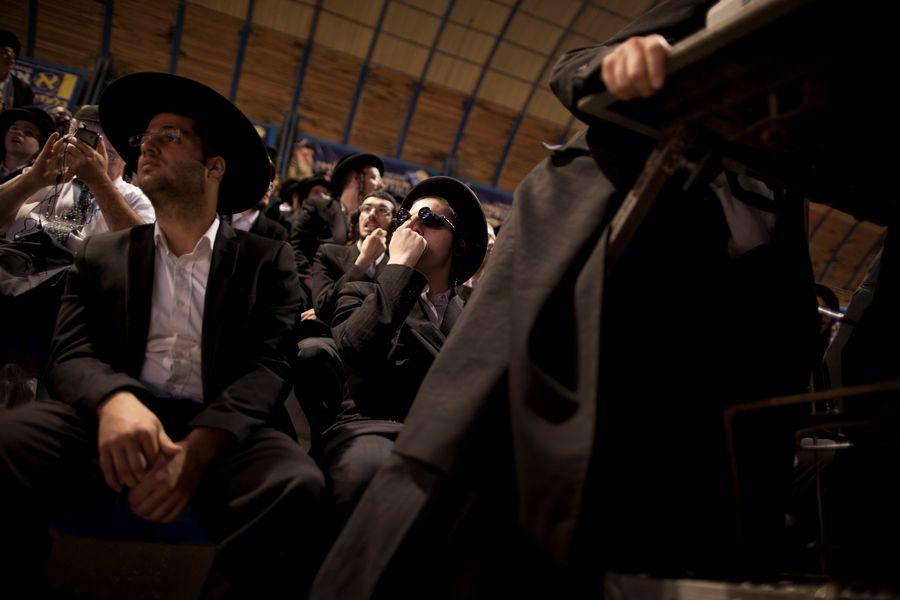
Mideast Israel Siyum Ha'Shas
The Ultra-Orthodox Challenge in Israel
COMMENTARY
Published May 28, 2023 • Read time: 8m
Join the Conversation
0It is easy to understand why the controversy over the 2023-2024 budget passed in the early hours last Wednesday by Prime Minister Benjamin Netanyahu’s government has not received the attention it deserves. Five months of unprecedented protests sparked by the judicial reforms proposed by the governing coalition in early January combined with the Israel Defense Forces’ deftly executed five-day, early-May Gaza operation, known as Shield and Arrow, preoccupied the nation and foreign observers. Yet the budget’s extraordinary outlays for Israel’s ultra-Orthodox community intensify the fears not only of Tel Aviv’s largely secular elites but also of Israelis of diverse political affiliations and religious orientations who believe that the coalition’s policies endanger freedom, democracy and prosperity in the Jewish state.
According to an analysis in The Jerusalem Post, the budget contains good and bad as well as the ugly. On the positive side of the ledger, the budget includes a massive infrastructure bill that reduces bureaucracy and regulation, measures to increase municipalities’ incentives to build residential housing, a plan to remove costly regulations on food and toiletries, steps to streamline health insurance and lower its cost, and reform of small-business taxation. On the negative side, the budget high-handedly transfers municipal taxes from more prosperous cities to less prosperous ones (which tend to vote for coalition members) while excluding Arab cities from the benefits; waters down, in apparent response to lobbyists’ exertions, measures originally proposed to reduce the price of food and toiletries; and is forecast to increase the deficit.
Nuclear Jihad: The Threats Are Inside Our Tent
Israel's "Sorrow of the Left"
Signs of Progress Against Extremists in Syria
The World Is Getting Worse, But This Time America Won't Save It
The ugly aspect stems from the substantial transfer of wealth to the ultra-Orthodox, a transfer that increases incentives for the community to cut itself off from the larger Israeli society and to persist in its poverty. After the approximately $270 billion budget passed last week, the Times of Israel reported that “NIS 3.7 billion [approximately $995 million] will go to increasing the budget for stipends for full-time Haredi [ultra-Orthodox] yeshiva students who receive exemptions from military service.” In addition, “NIS 1.2 billion [approximately $323 million] is budgeted for private, non-supervised Haredi educational institutions, many of which do not teach core subjects such as math and English, while additional funds will go to the official Haredi education system, and for construction of buildings for religious purposes and supporting Haredi culture and identity.” In other words, the new budget empowers a community – in which families average 6.6 children, most young people neither serve in the army nor complete national service, and half the adult men devote themselves to the study of sacred Jewish texts rather than to gainful employment – to evade the basic education that would enable them to participate in, and shoulder their fair share of responsibilities for, maintaining and defending Israel.
In his column one weekend ago in the Hebrew-language daily Maariv, my friend Shmuel Rosner clarified with characteristic fair-mindedness and incisiveness the dangers embedded in the state subsidies and exemptions long provided to the ultra-Orthodox and further entrenched by the new budget. “Israel’s Central Bureau of Statistics,” according to Rosner, “determined that the proportion of ultra-Orthodox in Israel will reach a third of the population by the middle of the 2060s.” But the demographic situation is actually worse, he maintains. That’s because the statistics overlook the likelihood that the rapid growth of the ultra-Orthodox – which would bring about greater political power that would further expand and cement their subsidies and exemptions – would prompt a non-ultra-Orthodox flight from Israel. “The Israelis who stare at the process that is unfolding in front of their eyes,” writes Rosner, “are pale, impotent, angry, dispirited, and gripped by the widespread feeling of erosion and retreat throughout the liberal West.”
Rosner identifies four informal schools of thought in Israel concerning the ultra-Orthodox challenge. The first school sees no problem because it favors a more ultra-Orthodox and generally more religious Israel. The second, typical of the non-ultra-Orthodox right, maintains that “it will be okay” because slowly but surely the ultra-Orthodox will change and increasingly take part in defending the country and participating in the economy. The third, common from the center-right to the center-left, declares that action must be taken swiftly because a catastrophic undermining of Israel’s free and democratic character is imminent. The fourth, a counsel of despair increasingly heard on the hard left, insists that freedom and democracy in Israel have already been routed and cannot be restored.
Rosner argues that in the present circumstances the future of liberal democracy in the Jewish state depends on the second and third schools – the non-ultra-Orthodox right who believe that time will moderate the ultra-Orthodox and gradually bring about their incorporation into the Israeli mainstream, and the center-right to center-left who advocate decisive action to avert disaster. The first and fourth schools – those who look forward to a future dominated by the ultra-Orthodox and those who believe that all is lost – lack motivation to undertake the arduous work of democratic politics: coalition building, policy analysis, legal reform and constitutional design.
Nevertheless, emphasizes Rosner, the “it will be okay” optimism of the non-ultra-Orthodox right poses a major obstacle to a potential alliance with those spanning the center-right to center-left and their catastrophe-is-imminent sense of urgency. Because of their sympathy for the ultra-Orthodox communities and perception of them as enduring political partners, the non-ultra-Orthodox right have a strong interest in avoiding a showdown with the ultra-Orthodox. Moreover, the non-ultra-Orthodox right think that a showdown is unnecessary. They contend that thanks to the cellphones in which the ultra-Orthodox indulge, the digital world will leave its mark on the community, inevitably fostering greater openness to Israeli society and the wider world. These salutary developments will be amplified by what the non-ultra-Orthodox right believe are difficult-to-discern but “deep currents of change” flowing through the ultra-Orthodox community.
Rosner remains unconvinced. After all, claims have been put forward for at least 20 years about the transformative effects of “deep currents of change” with little detectable impact on ultra-Orthodox political demands.
Unlike many critics, Rosner insists that the ultra-Orthodox are not the problem. They pursue their interests as they understand them through the democratic process, he soberly observes. Nor does Rosner fault the dispirited hard left who are immobilized by their despair. And he welcomes those stretching from the center-right to the center-left who have taken to the streets in the tens of thousands weekend after weekend since January to demonstrate in opposition to the government’s proposed judicial overhaul. The problem, he maintains, is the non-ultra-Orthodox right who provide the crucial votes for the state subsidies and exemptions that enable the ultra-Orthodox to shirk the normal responsibilities of citizenship in a free and democratic nation.
At the same time, Rosner especially likes and admires the non-ultra-Orthodox right. “This is the camp of good men and women, the nicest, most patriotic, and most sympathetic camp,” he writes. “But in this matter, they are a camp of messianic fools.” Rosner stresses his unsparing assessment: “‘It will be okay’ is not policy, ‘it will be okay’ is messianism. Especially when it is impossible to find a hint of evidence that it will be okay.” Indeed, according to Rosner, the evidence points in the opposite direction: “After all, the ultra-Orthodox, having obtained a little power and sitting comfortably in the coalition, could apply pressure on the government to receive what they want. Did they restrain their demands? Did they compromise on their requirements? Did they reveal sensitivity to their rivals’ worries?” The answers are no.
Such self-serving conduct, reminds Rosner, does not distinguish the ultra-Orthodox. In eschewing restraint, declining to compromise and disregarding their rivals’ sensitivities, the ultra-Orthodox use their increasing influence – as do many other interest groups in democratic politics – to fortify their preferred way of life. It is the non-ultra-Orthodox right, Rosner contends, who must change. Addressing them in particular, he argues that as the ultra-Orthodox continue to grow in numbers and power, “they apparently will not change in the direction you thought but rather in the opposite direction. They will change, and change Israel in accordance with their vision.”
That vision is not sustainable over the long run. Israel’s vibrant high-tech sector and its powerful and valiant military enable the country to flourish in a hostile and unforgiving neighborhood. But Israel’s innovators and producers along with its warriors – in many cases they are one and the same – will be increasingly reluctant to lend their ingenuity and resources to the economy of, and put their limbs and lives on the line for, a country that retreats from the basic requirements of freedom and democracy.
Accordingly, it is also in the long-term interest of the non-ultra-Orthodox right, others who wish to see the ultra-Orthodox way of life flourish in Israel, and Israel’s ultra-Orthodox themselves to support laws and policies that secure individual rights, shared responsibilities, and democratic self-government in the Jewish state.

The Danger Before the Attack
Leslie J. Sullivan • RealClearPolitics
Jon Finer’s Old and Dangerous ‘New Approach’ to Israel
Peter Berkowitz • RealClearPolitics
The President Deserves Better
John Ullyot • RealClearPolitics
Congress Doesn’t Need Another Blame Game. It Needs To Find What’s Broken
Jarrod Bernstein • RealClearPolitics
Democrats Won the Midterms. Common Sense Won, Too
Jordanne Kemper • RealClearPolitics
The 120th Congress Shapes Up
Carolina Lumetta • RealClearPolitics
RCP Today
Top stories on RealClearPolitics
The Takeaway
Polling intelligence and analysis delivered to your inbox
World News
Featuring the latest world news
Policy
Featuring the latest policy news
Support Our Mission
As part of RealClearPolitics, authors aim to provide balanced, non-partisan analysis by presenting top reporting and commentary from all sides of the political spectrum.
Trusted by policymakers and citizens alike since 2000