
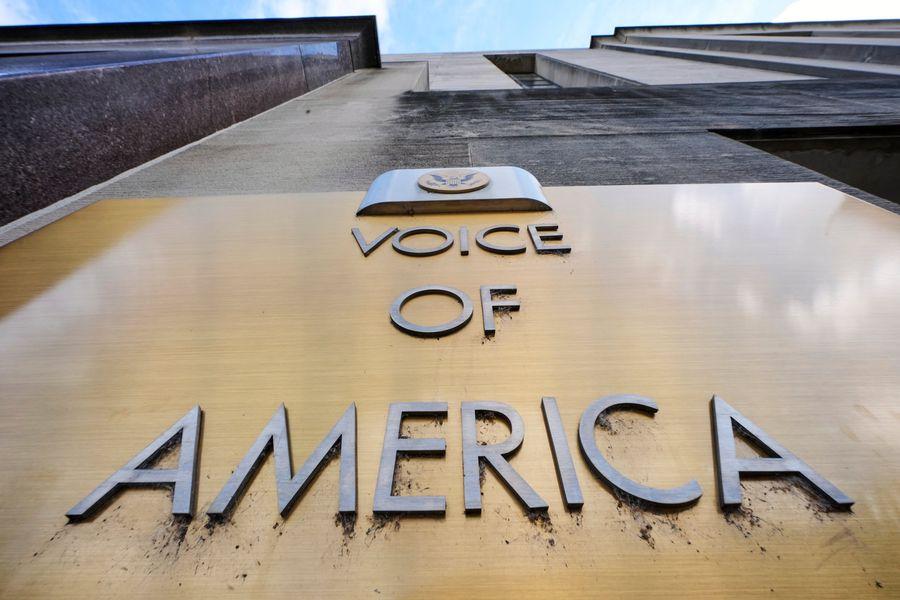
Voice of America Building
Telling America's Story in the Middle East: New 'Just-In-Time' Policy
Published June 17, 2025 • Read time: 6m
On Friday, as Iran and Israel traded both blows and words in a conflagration that marks a new and even more dangerous era in the Middle East, 75 Voice of America employees who were cooling their heels at home, no doubt polishing up their resumes in anticipation of their employer’s elimination, received an urgent missive: “Effective immediately, you are recalled from administrative leave,” reads the email. “You are expected to report to your duty station immediately.”
The majority of those called back were journalists within the VOA’s Persian news division. Presumably, somewhere at the State Department, someone woke up on Friday and said, “The Middle East is ablaze, and we need to get on top of this story – let’s get the word out!” To which some underling had to reply, “Well chief, we’d like to, but we sent those folks away a few months ago. We didn’t think we needed them.”
Kari Lake, who at one time was to head the VOA and now serves as “senior advisor” to the US Agency for Global Media (USAGM) is the spokesperson if not the architect of the shut-down plan. She explained the recall of VOA staff to Fox Digital on Friday. “History is being made, and VOA Persian news service is rising to the occasion to cover it. Everyone who is being called back has been on paid administrative leave, so they are simply being called back into the office to cover this historic moment in Iran.”
Apparently, this is America’s new public diplomacy strategy – the information equivalent of the just-in-time inventory system that came into fashion in U.S. manufacturing in the 1970s. No need to maintain resources in advance of their deployment; simply order them up when the situation demands. It is admirably DOGE-like – although it relies on a ready and willing force of public diplomacy ninjas ready to spring into action when regional crises arise.
Nuclear Jihad: The Threats Are Inside Our Tent
Israel's "Sorrow of the Left"
Signs of Progress Against Extremists in Syria
The World Is Getting Worse, But This Time America Won't Save It
Of course, no such strategy actually exists – it appears to be an ad-hoc reaction fashioned in the wake of a larger strategy that was simply this: Shutter the institutions upon which the foundation of U.S. public diplomacy rested since the end of World War II with no thought or plan as to what replaces them. The Trump position when it comes to “telling America’s story abroad,” according to one Republican House staffer, is simply this: “Burn it all down.”
The Trump administration not only dismantled VOA’s Farsi department just as the Middle East was reaching the boiling point, they reduced the entire Voice of America to less than a skeletal crew. (If you go to VOA’s official website, it is forever March 15 – the day work was ordered stopped. The lead story on the front page involves British Prime Minister Keir Starmer on a Zoom call with his European counterparts – presumably an important event three months ago, now forever trapped in the amber of the Internet.)
Additionally, The Middle East Broadcasting Networks – a USAGM grantee organization chartered by Congress in the wake of 9/11 with a weekly audience of 33.5 million in the Middle East and North Africa – is running on fumes as it battles to restore congressionally approved funds withheld by the Trump administration. MBN president and CEO Jeffrey Gedmin has cut 90% of the staff in order to husband resources and keep the lights on, in hopes that if and when Congress or the administration come to their senses, there is at least some remaining scaffolding upon which to rebuild the service.
Even with greatly diminished resources, MBN continues its work – refuting, for example, the false claim by Tehran that popular Iranian singer-songwriter Andranik Madadian had been detained by the National Guard in Los Angeles, as well as presenting interviews with a range of experts providing an American perspective on the conflict. The region’s audience is responding: MBN reports that video views are up 600% since Israel launched its attacks last Thursday.
It might seem sensible for State to reach out to MBN at this critical juncture, but Gedmin says he’s heard nothing from Foggy Bottom, though he stands ready to help.
“My phone is always open,” says Gedmin. “The crusade against VOA and MBN has been a gift to Hamas, Hezbollah, the Houthis, and the Iranian regime. But we’ll keep fighting. We simply cannot leave an open field in the war of ideas to America’s worst enemies.”
This week’s events – and the fitful reignition of VOA’s Farsi service – is a wakeup call and may signal a return to a more thoughtful approach to directing America’s “soft power.”
Earlier this month, Kari Lake sent her initial plan for USAGM to the Senate Foreign Relations Committee. It is beyond draconian. In it, she promises to reduce the entire VOA to a staff of just 18. The Farsi, China, and Afghan broadcast services are to be operated by just two persons each, presumably trading off twelve-hour shifts. But not to worry: An additional two staffers would be assigned to handle the engineering and transmission for all of the U.S. government’s global networks. As Lake told the Washington Post on May 15, her aim is to “continue to scale back the bloat and make an archaic dinosaur into something worth being funded by hardworking Americans. Buckle up,” she added. “There’s more to come.” We now know at least some of what she may or may not have anticipated – that when the world is on fire, the higher-ups at the State Department believe America needs to be able to speak with a coherent voice.
Lake is scheduled to appear before the House on June 25 in a much-anticipated hearing where she will articulate a more in-depth overview of her strategy. We’ll soon see if a just-in-time response is what she has in mind, or whether something sturdier and more coherent is in the works.
Mark me as skeptical that just-in-time public diplomacy is sufficient to the task at hand. And I will go out on a limb and suggest that explaining U.S. policy in the Middle East – even in the most placid of times – requires more than a two-person staff, no matter how skilled the ninjas.
The Danger Before the Attack
Leslie J. Sullivan • RealClearPolitics
Jon Finer’s Old and Dangerous ‘New Approach’ to Israel
Peter Berkowitz • RealClearPolitics
The President Deserves Better
John Ullyot • RealClearPolitics
Congress Doesn’t Need Another Blame Game. It Needs To Find What’s Broken
Jarrod Bernstein • RealClearPolitics
Democrats Won the Midterms. Common Sense Won, Too
Jordanne Kemper • RealClearPolitics
The 120th Congress Shapes Up
Carolina Lumetta • RealClearPolitics
RCP Today
Top stories on RealClearPolitics
The Takeaway
Polling intelligence and analysis delivered to your inbox
World News
Featuring the latest world news
Policy
Featuring the latest policy news
Support Our Mission
As part of RealClearPolitics, authors aim to provide balanced, non-partisan analysis by presenting top reporting and commentary from all sides of the political spectrum.
Trusted by policymakers and citizens alike since 2000