
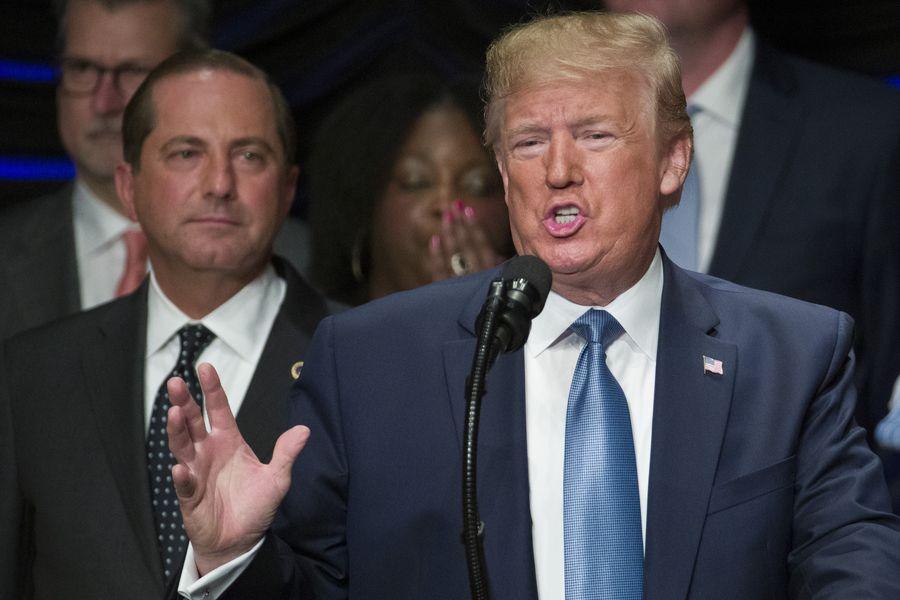
President Donald Trump speaks about kidney health at the Ronald Reagan Building and International Trade Center, accompanied by Health and Human Services Secretary Alex Azar, left, Wednesday, July 10, 2019, in Washington. (AP Photo/Alex Brandon)
Reagan, Trump Have More in Common Than Attacks on Gadhafi, Soleimani
COMMENTARY
Published Jan. 15, 2020 • Read time: 4m
Last week’s successful attack on Qassem Soleimani, the head of Iran’s Quds Force and a major international terrorist, has produced a number of comparisons between President Trump’s policy in attacking Soleimani and a similar action in 1986 by President Reagan. In April of that year, Reagan sent bombers from England to attack Libyan leader Moammar Gadhafi’s residence and various Libyan military targets after that nation’s agents had planted a bomb in a German discotheque, killing two American soldiers. Gadhafi escaped, but one of his daughters was killed.
Indeed, there is a similarity between Reagan’s and Trump’s policies but it goes well beyond the muscular use of American power — largely because both were elected by the same voter coalition. Reagan won in 1980 by adding blue-collar voters in the upper Midwest to conservative Southerners, culturally conservative “values” voters, and free market conservatives who oppose the growth of government, new taxes and regulation. Trump assembled virtually the same coalition in 2016.
Thus, in his three years in office, most of Trump’s significant domestic and foreign policies match up quite closely with Reagan’s: tax cuts to stimulate economic growth; continuing efforts to reduce regulation; substantial increases in defense spending; nominating conservative judges to the Supreme Court and the lower federal courts; appointing officials who reversed the FCC’s net neutrality regulation and who began taming the Consumer Financial Protection Bureau; pressing forward with oil pipelines previously stalled by opposition demonstrations; confronting Russia by imposing tight economic sanctions, increasing U.S. oil production and exports, and insisting on increased European member contributions to NATO; destroying the ISIS caliphate; withdrawing from the Intermediate-Range Nuclear Forces Treaty with Russia; and imposing tight economic sanctions on both Iran and North Korea. Trump’s court appointments and views on abortion and gun control appear, like Reagan’s, to have won over the large evangelical community and rural voters who strongly favor gun rights. Both formed the bedrock of Reagan’s coalition and now hold a similar position in Trump’s.
Nuclear Jihad: The Threats Are Inside Our Tent
Israel's "Sorrow of the Left"
Signs of Progress Against Extremists in Syria
The World Is Getting Worse, But This Time America Won't Save It
There are also current Trump policies that Reagan probably would have adopted if he had been elected president in 2016 instead of 1980: moving the U.S. Embassy in Israel from Tel Aviv to Jerusalem; imposing tariffs on Chinese products as a way to bring China to the trade negotiating table; withdrawing from the Joint Comprehensive Plan of Action nuclear treaty with Iran; withdrawing from the Paris climate agreement; and killing Abu Bakr al-Baghdadi, the head of ISIS.
What is most remarkable about Trump’s 2016 victory is that his political agenda was never entirely clear during his presidential campaign. He had contributed to Democrats as well as Republicans in the past, did not have a grounding in the conservative philosophy and economic policies that Reagan had developed before his presidency, had no experience with military or foreign policy, and unlike Reagan did not bring into government with him any longtime associates who had discernible policy leanings. Other than highlighting immigration, a wall on the southern border, an “America First” slogan, and a promise not to meddle with Social Security, Trump’s 2016 campaign did not enlarge on the policies he would pursue as president. Yet blue-collar and values voters somehow understood that if Trump became president he would follow policies that were likely to be indistinguishable from Reagan’s. That is exactly what Trump has done.
Democrats and liberals, including of course virtually the entire media commentariat, delight in saying that the GOP is now “Trump’s party,” a transparent effort to tie all Republicans to the controversial and often troubling pronouncements and behavior of President Trump.
The weakness in this claim, however, is that the two American political parties are not assembled around personalities or candidates; they are assembled around ideas, policies and interests, which presidential candidates represent. That’s why the Democratic and Republican parties, as Michael Barone has pointed out, are two of the three oldest political parties in the world. They are temporary coalitions that are constantly aligning and realigning as the policy interests of major groups change over time.
In 1980, Reagan brought about a powerful new political realignment by bringing into the GOP groups that had previously been part of the Democratic coalition — particularly blue-collar voters in the upper Midwest. Trump somehow reformed the same coalition in 2016, and is following in Reagan’s footsteps in 2020.
What this means is not that the GOP is Trump’s party, but that Trump has brought the powerful policy coalition initially built by Ronald Reagan back into being. In that sense, if the GOP is anyone’s party, it is Reagan’s.

The Danger Before the Attack
Leslie J. Sullivan • RealClearPolitics
Jon Finer’s Old and Dangerous ‘New Approach’ to Israel
Peter Berkowitz • RealClearPolitics
The President Deserves Better
John Ullyot • RealClearPolitics
Congress Doesn’t Need Another Blame Game. It Needs To Find What’s Broken
Jarrod Bernstein • RealClearPolitics
Democrats Won the Midterms. Common Sense Won, Too
Jordanne Kemper • RealClearPolitics
The 120th Congress Shapes Up
Carolina Lumetta • RealClearPolitics
RCP Today
Top stories on RealClearPolitics
The Takeaway
Polling intelligence and analysis delivered to your inbox
World News
Featuring the latest world news
Policy
Featuring the latest policy news
Support Our Mission
As part of RealClearPolitics, authors aim to provide balanced, non-partisan analysis by presenting top reporting and commentary from all sides of the political spectrum.
Trusted by policymakers and citizens alike since 2000