
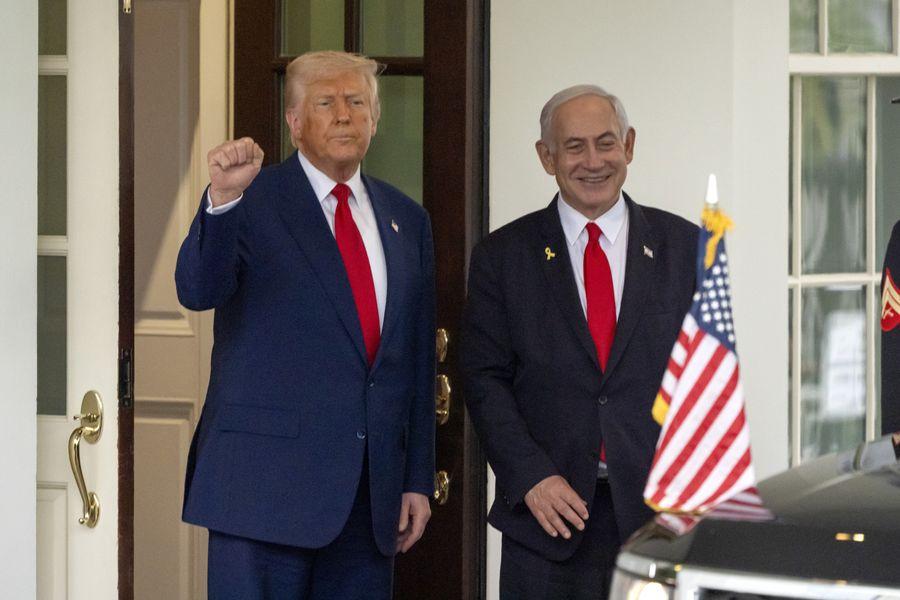
Israel US Trump Netanyahu Trial
Netanyahu's Long Reign Faces New Risks as U.S. Support for Israel Falters
Published June 27, 2025 • Read time: 6m
Israeli Prime Minister Benjamin Netanyahu has been in and out of power for nearly three decades. With a tally of 17 years at Israel’s helm, he is the longest-serving prime minister in the nation’s history. In that time, the Jewish state has enjoyed overwhelming support from U.S. voters and lawmakers on both sides of the aisle despite Netanyahu’s often rocky relations with American presidents.
Public support for Israel is now waning in the U.S. thanks to growing disdain within the Democratic Party for Israel’s war in Gaza, to a generational shift against the Jewish state among voting Americans, and – to a lesser but notable degree – a surge of isolationism on the right. This means that Netanyahu may have lost the luxury of irritating American presidents without consequence.
“I’m not happy with Israel,” President Trump said Tuesday, accusing it of breaking the ceasefire he had declared between Israel and Iran. “I’m not happy with Iran either,” Trump continued. “We basically have two countries that have been fighting so long and so hard that they don’t know what the f**k they’re doing.”
It’s not the first time an American president let out an f-bomb while complaining about Netanyahu. After Netanyahu’s first visit to the White House in 1996, President Bill Clinton felt he had been lectured by the Israeli prime minister. “Who the f**k does he think he is?” Clinton reportedly vented to staffers in private. “Who’s the f**king superpower here?”
Out of power during the early 2000s, Netanyahu never had a showdown with George W. Bush, but Netanyahu’s return to power in 2009 coincided with Barack Obama’s accession to the presidency. The two men clashed, sometimes openly.
Nuclear Jihad: The Threats Are Inside Our Tent
Israel's "Sorrow of the Left"
Signs of Progress Against Extremists in Syria
The World Is Getting Worse, But This Time America Won't Save It
Determined to reach a two-state solution, Obama urged Netanyahu to freeze or temporarily halt settlement construction in the West Bank. Netanyahu accepted a temporary pause but ultimately refused to accept a “peace based on illusions.” Negotiations stalled and construction of settlements continued.
Netanyahu later opposed Obama’s nuclear deal with Iran, calling it a “historic mistake” before a joint meeting of Congress in 2015 that was coordinated by Republicans without White House input. Obama, who refused to meet with Netanyahu during his visit and did not attend the speech, said he looked over the transcript and saw “nothing new.” Netanyahu failed to provide “viable alternatives,” Obama claimed.
The prickly relationship ended with an exclamation point just days before Obama left office when the White House abstained from voting on a United Nations Security Council resolution that demanded Israel stop settlement construction on occupied Palestinian territory. Netanyahu, who wanted the U.S. to veto the resolution, said that “the Obama administration carried out a shameful anti-Israel ploy at the UN.”
Despite these tensions, U.S. aid and arms shipments kept flowing to Israel throughout the Obama years.
Donald Trump took office in 2017 and, to Netanyahu’s delight, formally recognized Jerusalem as Israel’s capital and pulled out of Obama’s nuclear deal with Iran. It was a series of wins for the prime minister, but Trump expressed annoyance when Netanyahu congratulated Joe Biden on his 2020 election victory in a video post.
“It was early. OK? Let’s put it this way – he greeted him very early. Earlier than most world leaders. I’ve not spoken to him since. F**k him,” Trump said in 2021. “There was no one who did more for Netanyahu than me … And the first person to run to greet Joe Biden was Netanyahu.”
Biden, a self-proclaimed Zionist, believed in Israel’s right to defend itself. After Hamas attacked Israel on Oct. 7, 2023, he flew to Tel Aviv to embrace Netanyahu and demonstrate his support for the Israeli people. But Biden condemned Israel’s ensuing attacks on civilian areas in Gaza and threatened to stop sending bombs and artillery shells to Israel if it launched a major invasion of Rafah. When Israel moved forward in Rafah anyway, the U.S. paused an arms shipment. This proved only a minor hiccup for Netanyahu. Despite Biden’s misgivings with Israel’s approach to the war, American munitions mostly flowed to Israel as usual.
Trump returned to power and Netanyahu was quick to laud him as “the greatest friend that Israel has ever had in the White House.” But things got off to a strange start. Days before retaking office, Trump shared a video clip on Truth Social of economist Jeffrey Sachs calling Netanyahu a “deep, dark son of a b**ch” who manipulates the U.S. to wage “endless wars” in the Middle East.
Sachs’ view did not dissuade Trump, however, from ordering the bombing of Iranian uranium enrichment sites, a move Netanyahu had pushed for. When announcing the strikes, Trump said, “I want to thank and congratulate Prime Minister Bibi Netanyahu. We worked as a team like perhaps no team has ever worked before.”
Days later, Trump railed against Israel for breaking its recently-installed ceasefire agreement (which Iran also broke). “Israel, as soon as we made the deal, they came out and they dropped a load of bombs, the likes of which I’ve never seen before, the biggest load that we’ve seen. I’m not happy with Israel,” Trump told reporters on the South Lawn before traveling to the Netherlands for a NATO summit.
The president has since changed his tone, commending Netanyahu’s “LOVE for the incredible Holy Land” and calling it a “TRAVESTY OF ‘JUSTICE’” that Netanyahu faces trial on Monday on longstanding corruption charges.
So how long will Trump’s favor endure? And has Netanyahu’s safety net eroded?
The prime minister could afford to insult Bill Clinton, antagonize Barack Obama, and dismiss Joe Biden without facing serious pushback. The precedent of American support for Israel was strong and stable. But that’s changing.
More than half of U.S. adults (53%) now express an unfavorable opinion of Israel, up from 42% in March 2022, according to Pew Research Center, and it’s not just Democrats changing their minds. Between 2022 and 2025, the proportion of Republicans who said they had unfavorable views of Israel rose from 27% to 37%. (Younger Republicans, aged under 49, drove most of that change.)
Trump’s personal brand of politics is volatile. If a neat end to the conflict with Iran falls apart and tensions escalate in the Middle East, Trump may ultimately adhere to the counsel of Steve Bannon by reverting to isolationism, leaving Netanyahu and Israel on an island without the beating drum of American public support to override the president’s whims.
Netanyahu is in the clear with Trump – for now. But between an unpredictable American president and a disapproving American public, Israel’s longest-tenured prime minister seems to be skating on ever-thinning ice.

Democrats Won the Midterms. Common Sense Won, Too
Jordanne Kemper • RealClearPolitics
The 120th Congress Shapes Up
Carolina Lumetta • RealClearPolitics
Flooding GOP Primaries With Democrats
Robert Natelson • RealClearPolitics
Washington Keeps Rewarding Oracle—Veterans Keep Paying the Price
Darin Gaub • RealClearPolitics
The Seeds of Unrestricted Warfare
John Teichert • RealClearPolitics
The Primary System Is Losing the Next Generation
Sean Trende • RealClearPolitics
RCP Today
Top stories on RealClearPolitics
The Takeaway
Polling intelligence and analysis delivered to your inbox
World News
Featuring the latest world news
Policy
Featuring the latest policy news
Support Our Mission
As part of RealClearPolitics, authors aim to provide balanced, non-partisan analysis by presenting top reporting and commentary from all sides of the political spectrum.
Trusted by policymakers and citizens alike since 2000