Israel politics
Israel Puts Netanyahu's Conservative Zionism to the Test
COMMENTARY
Published Nov. 27, 2022 • Read time: 8m
Join the Conversation
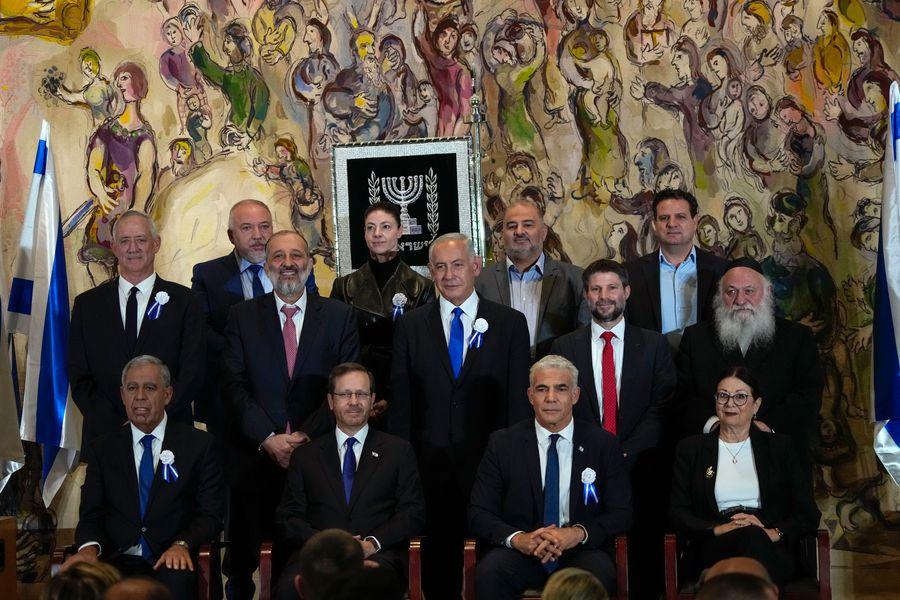
0TEL AVIV—After five elections in three and a half years, former Israeli Prime Minister Benjamin Netanyahu has assembled a substantial coalition. On Nov. 1, Netanyahu’s Likud garnered 32 seats, making it the largest party by far in the 120-member Knesset. Voters gave his bloc, the most right-wing in Israel’s history, a relatively comfortable 64 seats. Negotiations with coalition members could lead to the swearing in of a new government any day now. The question is whether Netanyahu – loved by many on the right and loathed by many on the left – will provide Israel the security, stability, and prosperity that he promises or will prove poison, as his detractors firmly believe, to a troubled body politic.
Netanyahu ran hard to the right. He galvanized his base while buttressing his support with ultra-nationalists seeking to maintain Israeli control over Judea and Samaria, and ultra-Orthodox keen to retain their exemptions from military service and sizeable state subsidies for their religious schools.
On a few noteworthy occasions since the election, Netanyahu has moderated his tone. Late at night after the polls closed on Nov. 1, even as he proclaimed to a boisterous crowd that he would create a stable right-wing government, he offered conciliatory remarks: “I intend to be prime minister of all citizens of Israel, Jews and non-Jews alike. I care about everybody.” On Nov. 13, after formally receiving the mandate to form a government from Israeli President Isaac Herzog, Netanyahu reiterated his unifying intentions: “I intend to be a prime minister for everyone – for those who voted for me, and for those who did not vote for me.”
Nuclear Jihad: The Threats Are Inside Our Tent
Israel's "Sorrow of the Left"
Signs of Progress Against Extremists in Syria
The World Is Getting Worse, But This Time America Won't Save It
For veteran New York Times columnist Thomas Friedman, Netanyahu’s mollifying words count for nothing. Three days after the election in “The Israel We Knew Is Gone,” Friedman pronounced anathema on Netanyahu and his coalition. Touting his 40 years covering the Middle East – but regurgitating progressive conventional wisdom – Friedman decried the incoming Netanyahu government as a “nightmare” and a “previously unthinkable reality.” Among the members of Netanyahu’s coalition, Friedman singled out Itamar Ben Gvir, a leader of the Jewish Power party, and Bezalel Smotrich, head of the Religious Zionist party. The former “was convicted by an Israeli court in 2007 of incitement to racism and supporting a Jewish terrorist organization.” The latter “has long advocated outright Israeli annexation of the West Bank and argued that there is ‘no such thing as Jewish terrorism’ when it comes to settlers retaliating on their own against Palestinian violence.”
Friedman’s apocalyptic pronouncements spring from understandable apprehensions, but he too hastily concludes that Netanyahu is bound to acquiesce to his coalition partners’ worst excesses. For cooler heads and more incisive analysis, it is useful to turn to the Hebrew language newspaper, Makor Rishon.
Affiliated with religious Zionism and right-wing nationalism, Makor Rishon has since Netanyahu’s victory published two excellent assessments of his signal achievements, his costly shortcomings, and the fateful crossroads at which he now stands. On Nov. 11, weekly columnist Ari Shavit, bestselling author of “My Promised Land: The Triumph and Tragedy of Israel,” illuminated key chapters in Netanyahu’s previous turns at prime minister. In a long feature published the day before – a review of Netanyahu’s recently released memoir, “Bibi: My Story” – Micah Goodman, bestselling author of “Catch-67: The Left, the Right, and the Legacy of the Six Day War,” examined ideas that since Netanyahu’s youth have dominated his thinking about Zionism and Israel. Shavit and Goodman display the rare ability to write about both right and left in Israel with sympathy and understanding while also drawing conclusions and reaching judgments. Their post-election commentary throws into sharp relief Netanyahu’s great opportunity as well as the snares and delusions that he must overcome to govern Israel responsibly.
In “The Big Question: Who Will Be the Fourth Netanyahu?” Shavit identifies the first Netanyahu as Israel’s prime minister from 1996 to 1999. The young, ambitious, “national-pragmatic leader” accepted the 1993 Oslo Accords, which established the Palestinian Authority, returned Yasser Arafat in 1994 as the PA’s first president, and promised Israel’s gradual withdrawal from Judea and Samaria and the Gaza Strip. However, Netanyahu “slowed considerably the process of withdrawal, reduced terrorism, and stabilized Israel.”
The second Netanyahu regained the prime minister’s office in 2009 and endured for six years. He cunningly created a military option to attack Tehran’s nuclear program, Shavit argues, the real purpose of which was to impel then-President Obama to take a tougher stance toward Tehran. The plan partially worked, buying Israel time. Although the United States adopted strong sanctions against Iran and imposed a “political-economic blockade,” President Obama’s 2015 Iran deal was a “terrible missed opportunity.”
The third Netanyahu emerged in 2015. “The tumultuous victory in the 2015 election, the criminal investigations opened against him shortly after, and the rise of Donald Trump fundamentally changed Bibi,” writes Shavit. “Persecuted and monarchical,” Netanyahu “abandoned the pragmatic nationalism and shed the patrician elegance” that had characterized him since he entered Israeli politics. The criminal investigations issued in indictments in 2019 and then, in 2020, trial for breach of trust, accepting bribes, and fraud. He remained in power through three inconclusive elections beginning in April 2019 and continuing until spring 2021 when he was unseated in a fourth election by a coalition led by conservative Naftali Bennet and centrist Yair Lapid and which included left-wing parties and an Arab party. While signing in 2020 the historic Abraham Accords, “the recent years of his government have been wrapped in flames of faction, invective, and brotherly hatred.”
Shavit does not pretend to know who will emerge as the fourth Netanyahu. The once and future prime minister will want to focus on Iran, which requires progress in normalizing relations with Saudi Arabia, and on the economy. But given the incoming government’s dependence on ultra-nationalists and ultra-Orthodox who demand sweeping changes, along with the burdens of defending himself in court, Shavit wonders whether Netanyahu can “unite anew a divided and quarrelsome people.”
Netanyahu can’t rely on the center and left, which lie in tatters because of his decisive electoral victory, to provide balance, restraint, and moderation. “Now, Netanyahu’s only balancer, restrainer, and moderator is Netanyahu himself,” writes Shavit. “He will decide how history will judge the fourth – and final – Netanyahu.”
The same Netanyahu who has repeatedly resorted to vulgar demagoguery and has presided over growing factionalism, maintains Goodman in “The Paradox of Netanyahu,” also has consistently exercised a distinctive form of moderation. A “double caution” – toward conducting peace negotiations and toward deploying the army – marks the career of Israel’s longest serving prime minister, Goodman observes. “His critics were not always aware that Netanyahu’s double caution is not a sacrifice of his beliefs but rather their full realization.”
A brand of political realism, Goodman shows, circumscribes Netanyahu’s Zionism. For Bibi, “the sole guarantee of the continuation of the Jewish people is the transformation of Israel into a state possessing exceptional abilities and powers,” Goodman writes. “And this is Netanyahu’s formula for building Israeli power: Economic success will enable the building of military capabilities and the mixture of economic and military power will in turn produce political and diplomatic power.”
Other forms of Zionism have pursued lofty goals. Left-wing secular Zionists envisage Israel as a model socialist society. Right-wing religious Zionists dream of a state that reflects the Jewish spirit and honors Jewish law. In contrast, Goodman maintains, Netanyahu regards Israel’s goal as the state of Israel itself. According to Netanyahu’s Zionism, the state’s overriding purpose is to assure the Jewish people’s survival in a dangerous world that is, and always has been, especially dangerous for the Jewish people.
The paradox, according to Goodman, is that while no one has contributed more to polarization in Israel than Netanyahu, no one has given more effective expression to the “hidden agreement” that has crystalized among Israelis that the state exists to provide security against the hostile forces arrayed against the Jewish people.
Netanyahu’s thinking is, Goodman asserts, “conservative in the most literal sense of the word.” That’s correct inasmuch as self-preservation is the prerequisite to every other human experience and achievement. Yet accepting Netanyahu’s sober conviction that after the establishment of the state of Israel Zionism’s proper aim is to preserve the nation, the inspiring fact remains that Israel, as its Declaration of Independence affirms, is constituted in part by commitment to a Jewish state that secures freedom, justice, and peace, and the rights shared by all its citizens.
To preserve the nation, then, Netanyahu must conserve the full range of principles on which Israel is based. That is crucial to fostering across Israel’s many factions and fault lines the political cohesiveness essential to the security, stability, and prosperity that he promises.

A RealClear Thanksgiving: Investing in a Better Future
David DesRosiers • RealClearPolitics
Trump’s Newsom Problem: Antagonist-in-Chief
Carolina Lumetta • RealClearPolitics
America’s Free Spirit
John Maxwell Hamilton • RealClearPolitics
The GOP Majority Should Go Out in Glory
Daniel McCarthy • RealClearPolitics
Republican Majorities Could Return Sooner Than Expected
J.T. Young • RealClearPolitics
The Danger Before the Attack
Leslie J. Sullivan • RealClearPolitics
RCP Today
Top stories on RealClearPolitics
The Takeaway
Polling intelligence and analysis delivered to your inbox
World News
Featuring the latest world news
Policy
Featuring the latest policy news
Support Our Mission
As part of RealClearPolitics, authors aim to provide balanced, non-partisan analysis by presenting top reporting and commentary from all sides of the political spectrum.
Trusted by policymakers and citizens alike since 2000