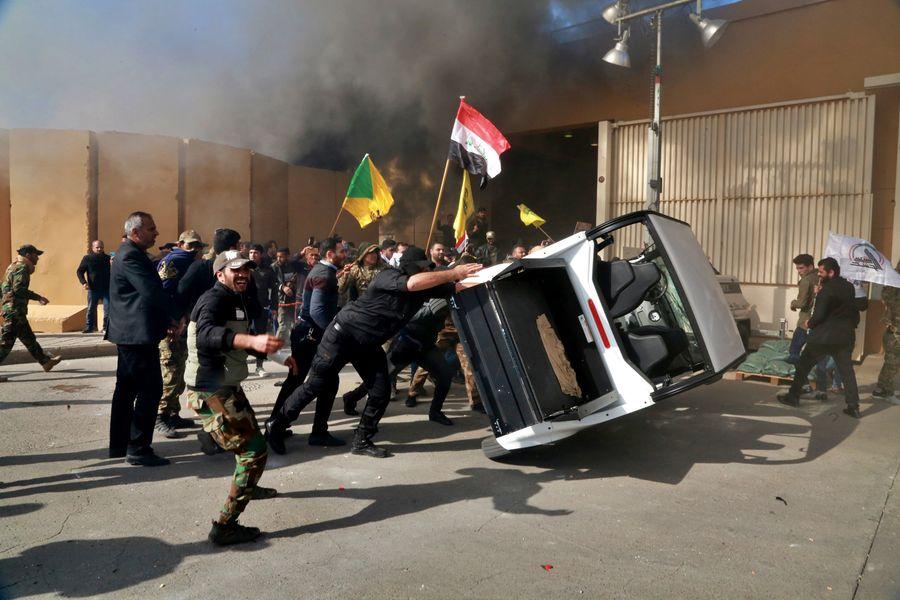
Protesters damage property inside the U.S. embassy compound, in Baghdad, Iraq, Tuesday, Dec 31, 2019. Dozens of angry Iraqi Shiite militia supporters broke into the U.S. Embassy compound in Baghdad on Tuesday after smashing a main door and setting fire to a reception area, prompting tear gas and sounds of gunfire. (AP Photo/Khalid Mohammed)
Iraq Back in 2020 Spotlight After Trump Orders Airstrikes
Published Dec. 31, 2019 • Read time: 6m
The decision to go to war in Iraq and efforts to end that conflict have dragged down the last two U.S. presidents’ foreign policy legacies.
For three years, President Trump managed to avoid getting stuck in this foreign policy tar pit, but critics say he did so only by ignoring Iran’s increasing control over northern Iraq and its influence over Baghdad’s top officials even as he relied on sanctions to curb Iranian behavior.
Now, just as his 2020 reelection campaign revs up, Iraq has again become a powder keg, sparking another fierce national debate about whether U.S. military intervention there makes America more secure or far less so by exacerbating regional tensions and turning the United States into a targeted common enemy.
Trump’s decision to launch military strikes against Iran-backed militias in Iraq and Syria over the weekend is receiving new scrutiny after Iraqi protesters broke into the Green Zone compound surrounding the U.S. Embassy in Baghdad on Tuesday, setting fires and shouting "Death to America!" They demanded that the U.S. withdraw its forces from Iraq.
The president assailed Iran for "orchestrating" the protests, and reports indicated that the same Iran-supported militias targeted in the airstrikes were behind the turmultuous scene outside the embassy.
The turmoil in Iraq is also creating trouble for Joe Biden as his Democratic opponents take aim at his Senate vote in favor of the 2003 U.S. invasion.
Trump administration officials over the last two days delivered conflicting messages about the significance of the airstrikes against Kataib Hezbollah, which two days earlier attacked an Iraqi military base near Kirkuk, killing a U.S. contractor and wounding U.S. and Iraqi troops.
Nuclear Jihad: The Threats Are Inside Our Tent
Israel's "Sorrow of the Left"
Signs of Progress Against Extremists in Syria
The World Is Getting Worse, But This Time America Won't Save It
Secretary of State Mike Pompeo on Sunday said the airstrikes were a “defensive action” designed to protect American forces and American citizens in Iraq, implying that it was an isolated step, not the beginning of more robust use of military force in the region. Yet, on a conference call with reporters Monday, two senior State Department officials muddied those waters.
When asked directly if this was a one-time strike or part of a more concerted U.S. military effort to counter Iran’s influence in Iraq and Syria, one official declined to “preview future military actions” but pointedly referred to the 14,000 U.S. troops sent to the region since May and strengthened U.S. “intelligence and reconnaissance assets” there.
“You’ve had 11 attacks against Iraqi bases that host coalition forces in just the last two months — it’s very important that we don’t tolerate that behavior because it invites further aggression,” the official said.
“We’re not returning to the front in the Middle East – we never left,” another remarked.
Those statements undercut Trump’s 2016 campaign promise to pull the U.S. out of “forever wars” and are stoking new criticism from anti-interventionists on the right.
“Whenever I hear people talk about the U.S. having disengaged in the region, I have to laugh,” Christopher Preble, the Cato Institute’s vice president for defense and foreign policy studies, told RealClearPolitics. “There are at least 14,000 more troops in the Middle East than when Donald Trump took office.”
“This speaks to the much broader problem of the [Trump administration’s] maximum pressure campaign on Iran and the belief that pressure on the Iranians will result in them capitulating to Secretary Pompeo’s 12 demands,” he said. “The Iranians have a range of responses … and we have seen it play out very dramatically and tragically over the last year with a number of violent incidents that is not in keeping with the claim that the maximum pressure campaign is working.”
The airstrikes and potential escalation are placing the U.S. role in Iraq in the spotlight once again and making it more likely that foreign policy will play a greater role in the presidential contest than previously anticipated.
The military action exacerbated tensions between the U.S. and Iraqi officials, with Prime Minister Adel Abdul Mahdi condemning the attack as an “unacceptable vicious assault” and predicting it will have “dangerous consequences.”
Foreign policy hawks, meanwhile, are applauding Trump’s decision to launch the strikes, arguing that Iraqi government officials condemning the retaliatory action are bowing to Iranian pressure after allowing Iranian proxies to operate in the country unfettered.
“Finally, after multiple attacks on U.S. bases and allies, Trump approved a military response against Iranian-allied militias in Iraq and Syria,” tweeted Mark Dubowitz, CEO of the Foundation for Defense of Democracies, a conservative think tank. “Trump has to be prepared to do more if the Iranians decide to escalate.”
The Wall Street Journal’s editorial board on Sunday ran a piece headlined: “Trump Finally Fires Back at Iran.” The article argued that Iran’s proxies will keep attacking “if they sense weakness” – and have increased their assaults on Iraqi bases where U.S. forces operate after Trump called off a retaliatory strike at the last minute after Iran shot down a U.S. drone in June.
The WSJ predicted that any U.S. reluctance to respond to Iranian aggression only emboldens adversaries to test the president’s resolve, especially in an election year.
While Trump must grapple with GOP divisions over military interventions, Democrats are already beginning to dust off their Iraq War talking points. South Bend, Ind., Mayor Pete Buttigieg, a Navy veteran who served in Afghanistan, on Sunday blasted Biden for his vote to approve the U.S. invasion of Iraq in 2003.
“He supported the worst foreign policy decision by the United States in my lifetime,” Buttigieg told Iowa Public Television.
“This is an example of why years in Washington is not always the same thing as judgment,” he added.
Sen. Bernie Sanders, the self-described democratic socialist, has repeatedly criticized Biden for his vote to authorize the war. Sanders, who was a House member at the time, voted against the invasion.
In an interview with the Los Angeles Times last week, Sanders predicted that Trump will “eat Biden’s lunch” over his war vote.
While the Biden campaign has yet to respond to Buttigieg’s criticism or to comment publicly on the weekend airstrikes, the candidate pushed back at Sanders’ remarks last week.
“Tell him to come and I’ll give him dessert at the White House,” Biden told reporters on the campaign trail.
Biden, who served as chairman of the Senate Foreign Relations Committee at the time of the Iraq War vote, has tried to push back by arguing that he later opposed efforts to expand the U.S. troop presence in Iraq. While vice president, Biden reportedly urged President Obama’s national security team against increasing the number of troops in Afghanistan, and he led the administration’s effort to withdrawal all U.S. forces from Iraq, a decision that left a security vacuum, which the Islamic State exploited.
While Biden will undoubtedly feel the heat over his 2003 vote, his record during the Obama administration was strongly in favor of pulling troops out of the Middle East and South Asia, Preble argues.
“He was quite skeptical of expanding the mission in Afghanistan during President Obama’s first term and the use of force in Libya in Obama’s second term,” Preble said. “There’s more recent evidence that Vice President Biden has learned something in the process.”

A RealClear Thanksgiving: Investing in a Better Future
David DesRosiers • RealClearPolitics
Trump’s Newsom Problem: Antagonist-in-Chief
Carolina Lumetta • RealClearPolitics
America’s Free Spirit
John Maxwell Hamilton • RealClearPolitics
The GOP Majority Should Go Out in Glory
Daniel McCarthy • RealClearPolitics
Republican Majorities Could Return Sooner Than Expected
J.T. Young • RealClearPolitics
The Danger Before the Attack
Leslie J. Sullivan • RealClearPolitics
RCP Today
Top stories on RealClearPolitics
The Takeaway
Polling intelligence and analysis delivered to your inbox
World News
Featuring the latest world news
Policy
Featuring the latest policy news
Support Our Mission
As part of RealClearPolitics, authors aim to provide balanced, non-partisan analysis by presenting top reporting and commentary from all sides of the political spectrum.
Trusted by policymakers and citizens alike since 2000