
Egypt Goes From Bad to Worse
Published Aug. 23, 2013 • Read time: 4m
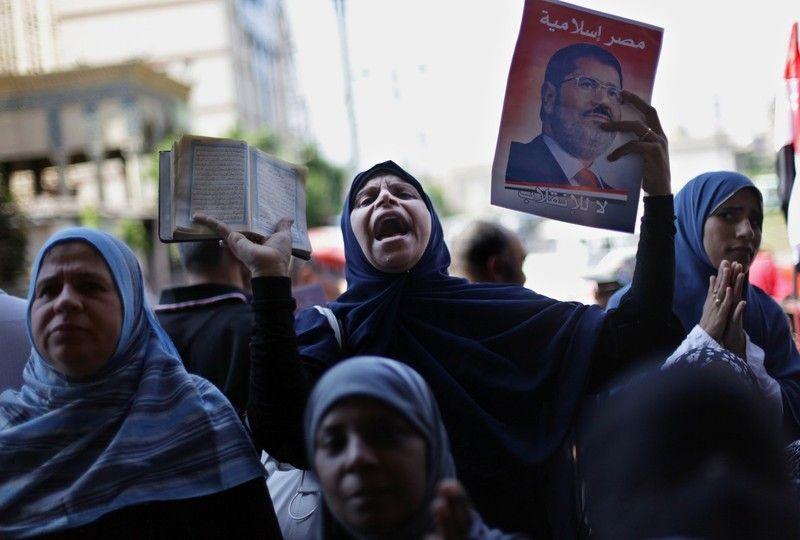
The Egyptian military has overthrown the country’s first elected President, held him incommunicado and without benefit of legal proceedings, killed over a thousand of its people, labeled as terrorists the political party that received more than half the votes in parliamentary and presidential elections, and have declared a state of emergency, authorizing use of deadly force against civilians. They have suspended judicial oversight, arrested hundreds of Muslim Brotherhood leaders, killed Brotherhood prisoners in captivity, released former President Mubarak showing the courts to be subservient to the regime, and is considering outlawing a political movement to which roughly a third of Egyptians belong. General al-Sisi exhorted Egyptians into the streets to show their support, a dictator’s gambit.
These actions have been justified — including by Egypt’s so-called liberals — on the basis of concern about the authoritarian inclinations of the Muslim Brotherhood in power. And there were good reasons to be concerned about the Brotherhood. Serious people argue the only difference between moderate Islamists and extremists is their timeline for imposing a caliphate.
After strong showings in parliamentary elections, the Brotherhood broke their promise not to stand a candidate for President. Barely elected over a Mubarak man, Morsi proceeded to govern as through he had a sweeping mandate. He used a military bungle in the Sinai to replace its leadership. He attempted to peremptorily retire judges. He promulgated a draft constitution that frightened liberals and rushed a referendum campaign they believed left opponents too little time to organize. His cabinet was narrow, partisan and inexperienced. He appointed governors that rankled, including for tourist-dependent Giza someone who’d participated in a terrorist attack there.
Nuclear Jihad: The Threats Are Inside Our Tent
Israel's "Sorrow of the Left"
Signs of Progress Against Extremists in Syria
The World Is Getting Worse, But This Time America Won't Save It
Morsi himself was an inadept politician, thrust onto the ballot only after the courts had disallowed the Brotherhood’s leading men — he was ridiculed as a “spare tire” during the campaign. He alienated liberals, made no effort to build consensus, and explained himself poorly. His and the Brotherhood’s popularity declined sharply as they proved ineffective at governing, especially on the economic front; it would be easy to imagine the Brotherhood tacking toward “one man, one vote, one time” to preserve its hold on power.
But many of the ominous complications during Morsi’s tenure were not of his making. The courts disbanded the upper house of parliament on the basis of an election law that predated him. Legislation was impossible until the constitution had been revamped. He controlled neither the military nor police. Shadowy remnants of the Mubarak regime run the economy — including the military, whose businesses comprise nearly a third of GDP. Parliamentary elections loomed in which the Brotherhood was very likely to have lost control of the legislature.
The Muslim Brotherhood in power committed none of the atrocities underway by the Egyptian military and its “liberal” apologists. Unlike the junta now in power, the Morsi government did not fill the prisons or commit violence against their political opponents. It subjected its decisions to public referenda and judicial review — when the courts struck down Morsi’s decisions, he abided by the rulings.
Recall, too, how the Brotherhood gained such public credence: forty years of providing public services the Egyptian government would not, bearing witness to government excess, establishing religious courts as an alternative to the pervasive corruption in the government legal system. They had forsworn violence. Support for the Brotherhood grew in proportion to the Mubarak government’s failings; it is likely to be sustained by the al-Sisi government’s reassertion of Mubarak policies.
With at least thirty million adherents, the Muslim Brotherhood is not going to be vanquished from Egyptian life. Their suppression will necessitate a level of repression that will restore their reputation. They now have a new generation of martyrs in the sons and daughters of its aging leaders that were shot down in Cairo. They will almost surely revert to violence. Executions of police and attacks on military installations are already occurring. Efforts to exhort them to participate in politics are laughable after elections have proven meaningless; joining in the political process now would discredit any Brotherhood leader. Other Islamists are likewise moving away from participation.
Most worrisome for the United States, the argument made by al Qaeda and other jihadists has been supported: violence is the only way to advance Islam.
Read more: http://dailycaller.com/2013/08/22/egypt-goes-from-bad-to-worse/#ixzz2coCheExX
This article is reprinted from the Daily Caller with permission from the Hoover Institution.
Jon Finer’s Old and Dangerous ‘New Approach’ to Israel
Peter Berkowitz • RealClearPolitics
The President Deserves Better
John Ullyot • RealClearPolitics
Congress Doesn’t Need Another Blame Game. It Needs To Find What’s Broken
Jarrod Bernstein • RealClearPolitics
Democrats Won the Midterms. Common Sense Won, Too
Jordanne Kemper • RealClearPolitics
The 120th Congress Shapes Up
Carolina Lumetta • RealClearPolitics
Flooding GOP Primaries With Democrats
Robert Natelson • RealClearPolitics
RCP Today
Top stories on RealClearPolitics
The Takeaway
Polling intelligence and analysis delivered to your inbox
World News
Featuring the latest world news
Policy
Featuring the latest policy news
Support Our Mission
As part of RealClearPolitics, authors aim to provide balanced, non-partisan analysis by presenting top reporting and commentary from all sides of the political spectrum.
Trusted by policymakers and citizens alike since 2000