In New Hampshire, A Political Drama in Three Acts
Published Oct. 7, 2014 • Read time: 4m
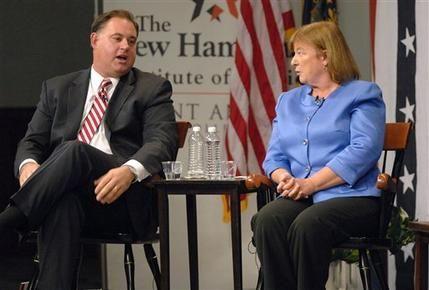
MERRIMACK, N.H. (AP) -- Co-stars in a long-running New Hampshire political drama, Democratic Rep. Carol Shea-Porter and Republican former Rep. Frank Guinta need no introduction.
To each other.
"I know what she's going to say, and I'm sure she knows what I'm going to say," says Guinta, who defeated Shea-Porter in a Republican wave election of 2010, lost the seat back to her two years ago when President Barack Obama swept the state, and hopes to take it away again this fall.
"It's not like I asked him to come back," jokes Shea-Porter, eliciting knowing chuckles from her audience at a recent Chamber of Commerce meeting in Portsmouth.
With Republicans widely expected to hold their U.S. House majority this fall, the rekindling of the Shea-Porter-Guinta rivalry in New Hampshire is part of a national struggle of a far different sort than the fierce battle for control of the Senate. In scattered competitive races, the GOP is working to pad its majority, while Democrats struggle to retain as many seats as possible and hope for better times in the 2016 presidential campaign. Republicans currently hold a 233-199 majority, with three vacancies.
The two parties agree the seat is worth fighting for. It is one of about three dozen races out of 435 this year in which both parties are likely to air television advertising independent of candidates' ads.
The Democratic Congressional Campaign Committee struck first, with a commercial that relies on a years-old controversy to question Guinta's personal ethics.
Poll: Rahm Ahead, But Facing Possible Runoff
More Keystone Delays; Are Iowa Caucuses Un-Iowan? How Blizzards Bury and Boost Politicians
Have No Gun, Will Sheriff
The Fate of Mirkarimi
He "gave $245,000 to his campaign from a personal account that had never before shown up on any personal financial disclosure. Guinta announced that - oops - he had forgotten to list a large bank account," says the announcer.
"Who forgets they have a quarter of a million dollars?"
The Republican counterpart committee is expected to launch its own television commercial soon.
The two candidates share a congressional district that includes the New Hampshire seacoast as well as parts of the White Mountains and portions of the state's largest city. Yet Shea-Porter, 62, and Guinta, 44, who is a former mayor of Manchester, have little in common apart from opposition to the decision to fund and arm rebels opposing the Islamic State group in the Middle East.
Guinta voted for Republican budgets in his term in the House, and Shea-Porter's most recent commercial says her rival is "funded by the billionaire Koch brothers and sided with big oil and the wealthiest every time, shifting the tax burden onto us."
She says she is a friend of the middle class, adding she "fought for moral budgets that invest in jobs, education and infrastructure."
More recently, she launched an ad that accused Guinta of voting to allow the government "to snoop on our private calls and to let the government take our library records, without a warrant."
The emphasis on budget and middle-class economic concerns is standard this year.
The decision to try to capitalize on privacy concerns is relatively rare at a time when the country is struggling anew with the threat of terrorism, and appears designed to appeal to a slice of the electorate in a state where the motto is "Live Free Or Die."
Guinta's own ad is an attempt to reassure female residents of the district whose votes he will need to win.
"As working mothers we understand the challenges families face," says his mother, Ginny. "From my breast cancer, his dad's heart disease and a family member's mental illness, Frank has always been there for us."
Guinta's wife, Morgan, adds, "And he'll be there for you."
In an interview, Guinta says he won't say anything bad about his opponent. He does observe, though, that she is "tied at the hip" to Rep. Nancy Pelosi, the House Democratic leader, and to Obama, whose popularity is not high in the district.
As for pocketbook issues, he said, "After six years people don't feel the economy has improved."
If they disagree on budget priorities and privacy, the two rivals part company most noticeably on environmental issues.
Speaking to a group of voters recently in a private home, Guinta said of climate change: "I think the science is not complete on this issue. I see different studies that say different things."
That is not Shea-Porter's view. Two years ago, campaigning to win back the seat she had lost in 2010, she criticized "climate change deniers in Congress."
She also defends earmarks, the practice of influential lawmakers directing federal funds back to their districts for local projects.
It's a time-honored tradition that Guinta's Republicans banned in Congress when they won a majority in 2010.
And one more long-lasting difference between rivals locked in a struggle that seems without end.
© 2014 The Associated Press. All rights reserved.

A RealClear Thanksgiving: Investing in a Better Future
David DesRosiers • RealClearPolitics
Trump’s Newsom Problem: Antagonist-in-Chief
Carolina Lumetta • RealClearPolitics
America’s Free Spirit
John Maxwell Hamilton • RealClearPolitics
The GOP Majority Should Go Out in Glory
Daniel McCarthy • RealClearPolitics
Republican Majorities Could Return Sooner Than Expected
J.T. Young • RealClearPolitics
The Danger Before the Attack
Leslie J. Sullivan • RealClearPolitics
RCP Today
Top stories on RealClearPolitics
The Takeaway
Polling intelligence and analysis delivered to your inbox
World News
Featuring the latest world news
Policy
Featuring the latest policy news
Support Our Mission
As part of RealClearPolitics, authors aim to provide balanced, non-partisan analysis by presenting top reporting and commentary from all sides of the political spectrum.
Trusted by policymakers and citizens alike since 2000