Congress Child Tax Credit
There Are Ways to Address Manchin's BBB Complaints
COMMENTARY
Published Dec. 20, 2021 • Read time: 5m
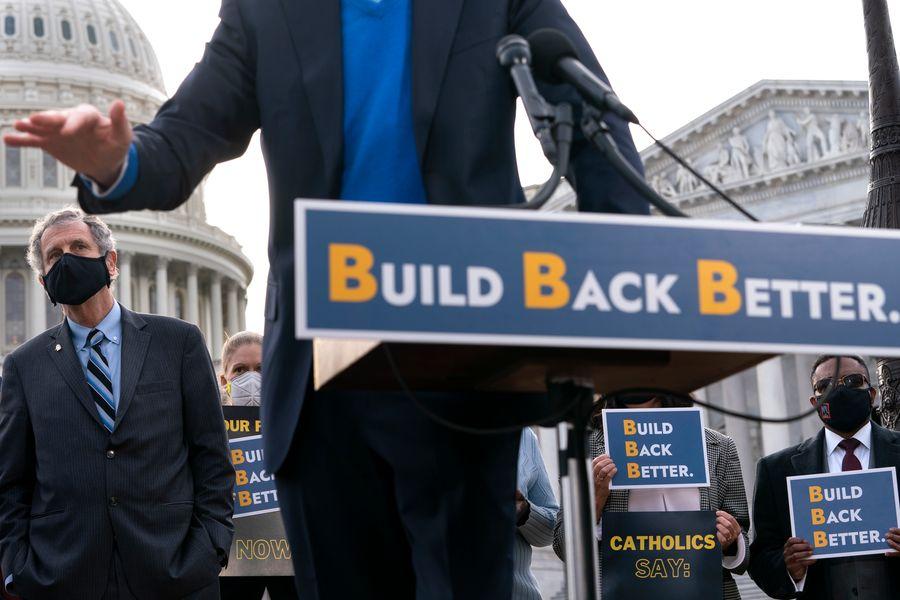
Sen. Joe Manchin yesterday said he won’t support the House-passed Build Back Better legislation because he believes the true cost of the bill is masked with budget gimmickry. One particularly glaring and seemingly expensive problem is the bill’s one-year extension of the expanded child tax credit. But this problem should be solvable.
First, we need to understand the history of the child tax credit, which was first signed in 1997 by Bill Clinton at an amount of $500 per child. In 2001, under George W. Bush, the amount doubled to $1,000, and was made partially “refundable” — which means even if you didn’t earn enough money to pay net federal income taxes, but you have dependent children, you still get part of the credit as a tax refund. That’s why refundability helps extend the program’s benefits to the poor.
Donald Trump’s 2017 tax reform bill set the per child amount at $2,000, but capped the potential “refundable” amount at $1,400. Importantly, Trump’s changes to the child tax credit expire in 2025.
Joe Biden, as part of the American Rescue Plan Act, further increased the per child amount: to $3,600 for children under 6 years of age, and to $3,000 for those 6 and up. Biden also made two other big changes. Families get the child tax credit benefit up front, in the form of monthly checks, so they don’t have to wait until filing their tax returns to receive the cash. And the credit was made fully refundable; even if you don’t pay net federal income taxes, you still get the full amount.
Gavin Newsom's Misguided Redistricting Initiative
A Warning Against the Overuse of Sanctions
Open The Books on the California State Checkbook
Senate Passes Bill Addressing Heroin, Opioid Crisis
Democrats touted the expansion as a signature achievement of Biden’s that has already slashed child poverty by nearly half. However, the expansion expires at the end of this year, unless Democrats can pass an extension.
The Build Back Better measure that passed the House extends the higher child tax credit amounts for one more year, even though the bill’s tax increases span 10 years. When Biden first proposed that one-year extension last month, Manchin scoffed, “What I see are shell games — budget gimmicks that make the real cost of the so-called $1.75 trillion bill estimated to be almost twice that amount ... if you extended it permanently.” And last week, according to The Hill, Manchin “appeared to nod his head affirmatively when asked whether [the child tax credit’s] projected cost over ten years, assuming that it’s likely to be renewed by Congress, should be reflected in the official Congressional Budget Office score for Build Back Better.”
In other words, the West Virginia Democrat believes that if the expanded credit is going to be in the bill, it should be budgeted for 10 years, not one.
As the CBO made clear last week, a 10-year expanded credit strains the federal budget. The one-year extension spends about $100 billion in 2022. A 10-year extension costs $1.6 trillion. (Because the Trump increases expire in 2025, to keep the program at Biden’s levels costs more per year after 2025 than before.) Since Manchin wants the entire 10-year cost of the bill capped at around $1.75 trillion, you can’t do a 10-year expanded child tax credit and also do much of anything else.
Can Biden compromise on the credit in a way that satisfies Manchin’s stated concerns but still reduces child poverty? Yes, and it’s simple.
I neglected to mention a key element of Build Back Better’s treatment of the child tax credit. While the House bill extends Biden’s higher per child amounts for just one year, it makes the benefit’s full refundability permanent. As the Jain Family Institute has calculated, the expanded child tax credit lifts 4 million children out of poverty, but if we fall back to the Trump amount of $2,000 per child while keeping Biden’s full refundability, we still lift 2 million children out of poverty. And we do it at far less cost: instead of $100 billion a year, just $17 billion.
Spending $17 billion instead of $100 billion addresses another one of Manchin’s big concerns: inflation. Government spending not offset by taxes can contribute to inflation. While Biden stresses that Build Back Better doesn’t increase the deficit, that’s only true when calculating the 10-year cost (and when you incorporate the White House’s estimated revenue from aggressive tax collection). For 2022, the CBO estimates $155 billion in deficit spending, which will rub you the wrong way if, like Manchin, you are worried about high inflation continuing next year.
About $100 billion of that $155 billion in Build Back Better’s 2022 deficit spending comes from the expanded child tax credit. But if we don’t extend Biden’s higher amounts, and only extend full refundability, we cut the amount of Build Back Better’s 2022 deficit spending by more than half.
But why, when we could be helping 4 million child escape poverty instead of 2 million, should Biden so willingly give up on the higher child tax credit amounts? Here’s the cold political reality: The one-year extension in the House bill is akin to surrender. Manchin is worried a one-year extension is going to end up being a budget-busting 10 years, but in this case, the more likely outcome is that the Democrats lose at least one chamber of Congress in the 2022 midterms, and then Republicans deny Biden another extension in 2023.
If a one-year extension is likely to really be just a one-year extension, Biden need not cling to it at the expense of striking a deal with Manchin. It doesn’t make much difference whether we revert back to the Trump levels in 2023 or 2022. And if permanent full refundability isn’t locked in now, that could get lost in 2022 and beyond. Instead of saving 2 million kids from poverty, we would save zero.
With a $2,000 fully refundable tax credit, which can still be distributed via monthly check, we can cut child poverty without risking inflation or resorting to gimmickry. That deal is hiding in plain sight. Manchin shouldn’t cut off talks before exploring it.

A RealClear Thanksgiving: Investing in a Better Future
David DesRosiers • RealClearPolitics
Trump’s Newsom Problem: Antagonist-in-Chief
Carolina Lumetta • RealClearPolitics
America’s Free Spirit
John Maxwell Hamilton • RealClearPolitics
The GOP Majority Should Go Out in Glory
Daniel McCarthy • RealClearPolitics
Republican Majorities Could Return Sooner Than Expected
J.T. Young • RealClearPolitics
The Danger Before the Attack
Leslie J. Sullivan • RealClearPolitics
RCP Today
Top stories on RealClearPolitics
The Takeaway
Polling intelligence and analysis delivered to your inbox
World News
Featuring the latest world news
Policy
Featuring the latest policy news
Support Our Mission
As part of RealClearPolitics, authors aim to provide balanced, non-partisan analysis by presenting top reporting and commentary from all sides of the political spectrum.
Trusted by policymakers and citizens alike since 2000