
Immigration
Reconciliation Overload
COMMENTARY
Published Dec. 22, 2021 • Read time: 8m
Central to the fight over President Biden’s Build Back Better bill has been the use – or misuse – of budget reconciliation to advance the package. Attention has been focused on the cost and politics of the package, but it is also important to take stock of the process. What is budget reconciliation, and how has it changed?
When Congress passed the Budget and Impoundment Control Act of 1974, it established a process by which it budgeted and spent money. The act contained a number of important provisions. It replaced presidential impoundment – refusal to spend appropriated funds – with more limited mechanisms of rescission and deferral requiring congressional assent. New budget committees would draft an all-encompassing budget resolution tying together spending and revenue lines and outlining an overall deficit or surplus. The Congressional Budget Office would serve as Congress’s own resource for budget information and analysis, independent from the president’s Office of Management and Budget. (The importance of this provision became clear again last week, when the CBO released an estimate that Build Back Better was likely to cost significantly more than what Biden claimed over a space of 10 years.)
Another feature of the Budget and Impoundment Control Act that has ballooned in importance since 1974: the budget-reconciliation process. Reconciliation was designed to make it easier to enforce the spending or revenue decisions contained in the budget resolution, which was, in theory, binding, but was hardly self-executing. In other words, reconciliation would be a fast-track instrument by which Congress would “reconcile” its actual spending and taxing decisions with the outline provided by the budget resolution. It would do this by allowing enforcement provisions to bypass the authorizing committees, which might have a vested interest in defending the status quo, and by allowing passage in the Senate by a simple majority. The reconciliation process was to be used sparingly – a maximum of once or twice a year.
Gavin Newsom's Misguided Redistricting Initiative
A Warning Against the Overuse of Sanctions
Open The Books on the California State Checkbook
Senate Passes Bill Addressing Heroin, Opioid Crisis
The process came into its own in 1981. For the first time, reconciliation was used to advance a major economic program. Ronald Reagan came to the White House determined to reduce the rate of growth of federal domestic spending; one of his first acts was to propose a budget that included a variety of cuts in discretionary appropriations and that changed eligibility requirements and benefit levels in various entitlement programs. In total, Reagan proposed about $42 billion in spending reductions from projected spending levels. Congress passed a budget resolution largely in line with his request.
To execute the budget resolution, the 1981 Omnibus Budget Reconciliation Act contained $38 billion in cuts and included changes in entitlement and other programs. Affected programs included Social Security and other federal retirement programs; food stamps; energy assistance; Medicare, Medicaid, and other health programs; Community Development Block Grants; legal services; and education, transportation, and housing programs. Though wide in its scope, OBRA was focused on cutting spending. Some provisions not only reduced but also restructured spending, in keeping with other Reagan priorities. Many education and social services programs were consolidated into more flexible block grants consistent with Reagan’s desire to return power to states. After considerable salesmanship, negotiation, and debate, OBRA passed the House and Senate. Reconciliation was not necessary for evading the Senate filibuster as much as for providing Congress with a means to address the budget “big picture” without proposed changes being smothered piece by piece by particularistic committees.
The next major transformation of reconciliation came with the Omnibus Budget Reconciliation Act of 1990. By then, the Senate had adopted the Byrd rule, allowing points of order to be raised against non-budget-related “extraneous” provisions or provisions increasing the deficit without a 10-year sunset provision. Resulting from negotiations between George H.W. Bush and the Democratic Congress, OBRA 1990 included spending-restraint measures, such as caps in defense, international, and discretionary domestic spending enforced by automatic cuts if the caps were breached. Unlike OBRA 1981, the 1990 version also included a substantial tax increase in both excise taxes and income taxes for upper-income taxpayers. Now reconciliation was being used for politically hazardous fiscal steps of all sorts – cutting spending and raising taxes – and evasion of a Senate filibuster was an important consideration.
OBRA 1993, Bill Clinton’s deficit-reduction bill, contained both spending restraints and a large tax increase in an environment of a closely divided Congress. OBRA 1993 passed 218-216 in the House and 51-50 in the Senate, with Vice President Al Gore casting the tie-breaking vote. If a filibuster had been possible, Clinton’s budget plan would have died in the upper chamber, as his proposed stimulus package had done earlier in the year. Once Republicans gained control of Congress in the 1994 elections, reconciliation continued to be used for deficit-reduction measures until the budget was balanced. In those years, even when Republicans proposed tax cuts through reconciliation, they were outweighed by spending cuts.
A third stage was reached in 2001, when George W. Bush used the reconciliation process to enact his $1.3 trillion, 10-year tax cut. Reagan had used reconciliation to pass difficult spending cuts but had advanced his 1981 tax cut through normal legislative procedures. Subsequent tax measures enacted through reconciliation were all tax increases. The Republican Congress passed net tax cuts in 1999 and 2000 through reconciliation, but both were vetoed by Clinton. Not until 2001 was reconciliation used successfully to reduce taxes and projected revenue. It was used that way again to process Bush’s 2003 tax cut and Donald Trump’s 2017 tax cut. Reconciliation had become a means to advance controversial tax-cut policy that would otherwise have been filibustered due to hardening Democratic opposition.
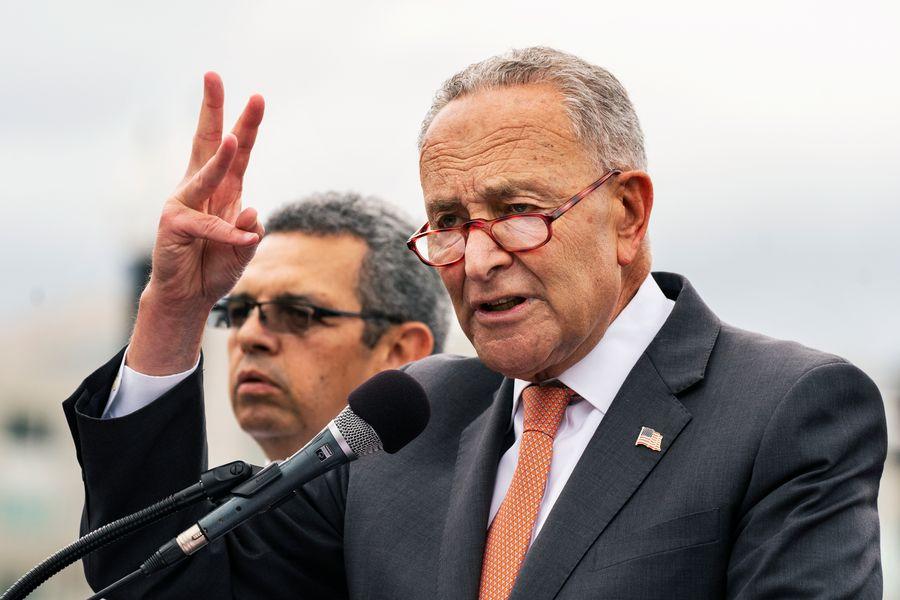
Under the leadership of President Biden, and that of Chuck Schumer and Nancy Pelosi in Congress, we have reached a new stage in the development of the reconciliation process. Under both the American Rescue Plan passed last spring and the Build Back Better bill under consideration (though suffering an apparently fatal blow Sunday from Joe Manchin), reconciliation has for the first time been the mechanism to move gigantic spending bills that contained major social policy changes, including the creation of presumably permanent new entitlements. These bills were so overloaded with social policy innovations that the Senate parliamentarian ruled portions of each of them out of bounds. A provision of the American Rescue Plan including a minimum-wage increase was ruled out of order, and more than one version of an amnesty for illegal immigrants proposed in Build Back Better sufferedthe same fate.
Manchin has announced that he cannot vote for Build Back Better, at least in its current form. His objections have largely focused on the cost of the measure, but the West Virginia Democrat has also indicated that he believed some programs in the bill, such as paid family and medical leave, are not appropriately dealt with through reconciliation. The House-passed BBB also includes other programs such as free universal preschool, home health care, a 300,000-person Civilian Climate Corps, and $100 billion toward immigration. The big “temporary” child tax credit in the American Rescue Plan would be made essentially permanent in the BBB, while Medicare, Medicaid, and Obamacare subsidies would all expand significantly.
By comparison, under Barack Obama, both the 2009 stimulus package and the 2010 Affordable Care Act were essentially passed through regular processes, though to obtain passage of the ACA in the House, the Senate had to agree to make some final adjustments through reconciliation. President Biden is attempting to use a mechanism that was long used to enforce budget discipline on Congress to facilitate passage of the greatest expansion of domestic government since Lyndon Johnson’s Great Society. The sole purpose of reconciliation in 2021 has been to evade the Senate filibuster in order to enact a long wish list of progressive priorities without the extended deliberation and compromise that would normally be required.
This latest development raises a fiscal red flag. Ill-conceived tax cuts can be undone by tax increases, and ill-conceived tax increases by tax cuts. Nearly every administration for the last four decades has engaged in this back-and-forth. But spending programs are forever, and the spending baseline, once established, has proven very difficult (if not quite impossible) to bend downward more than marginally. If reconciliation becomes a standard means of pushing through a multitude of new programs and multitrillion-dollar spending every time proponents have a favorable president, bare control of the House, and 51 co-partisans in the Senate, our fiscal condition, already troubled, could become unrecoverable and political divisions in our society unbridgeable. Manchin’s turn against BBB may have averted a fiscal and political calamity, but the reconciliation precedent set by the ARP and BBB will linger in the air, an ongoing temptation for policymakers.

Democrats Won the Midterms. Common Sense Won, Too
Jordanne Kemper • RealClearPolitics
The 120th Congress Shapes Up
Carolina Lumetta • RealClearPolitics
Flooding GOP Primaries With Democrats
Robert Natelson • RealClearPolitics
Washington Keeps Rewarding Oracle—Veterans Keep Paying the Price
Darin Gaub • RealClearPolitics
The Seeds of Unrestricted Warfare
John Teichert • RealClearPolitics
The Primary System Is Losing the Next Generation
Sean Trende • RealClearPolitics
RCP Today
Top stories on RealClearPolitics
The Takeaway
Polling intelligence and analysis delivered to your inbox
World News
Featuring the latest world news
Policy
Featuring the latest policy news
Support Our Mission
As part of RealClearPolitics, authors aim to provide balanced, non-partisan analysis by presenting top reporting and commentary from all sides of the political spectrum.
Trusted by policymakers and citizens alike since 2000