
SAVE Act
Reconciliation Is the Strategy To Pass the SAVE America Act
COMMENTARY
Published March 20, 2026 • Read time: 6m
Americans have been clear. They want secure elections, consistent standards, and confidence that only citizens are voting in federal elections. That mandate was not subtle in 2024. It was decisive.
President Donald Trump has made election integrity a cornerstone of his agenda, and the Safeguard American Voter Eligibility Act, the SAVE America Act, is central to delivering on that promise. The bill requires proof of citizenship for federal voter registration and ensures that states verify eligibility using existing federal databases. It is a practical reform grounded in a simple principle: American elections should be decided by American citizens.
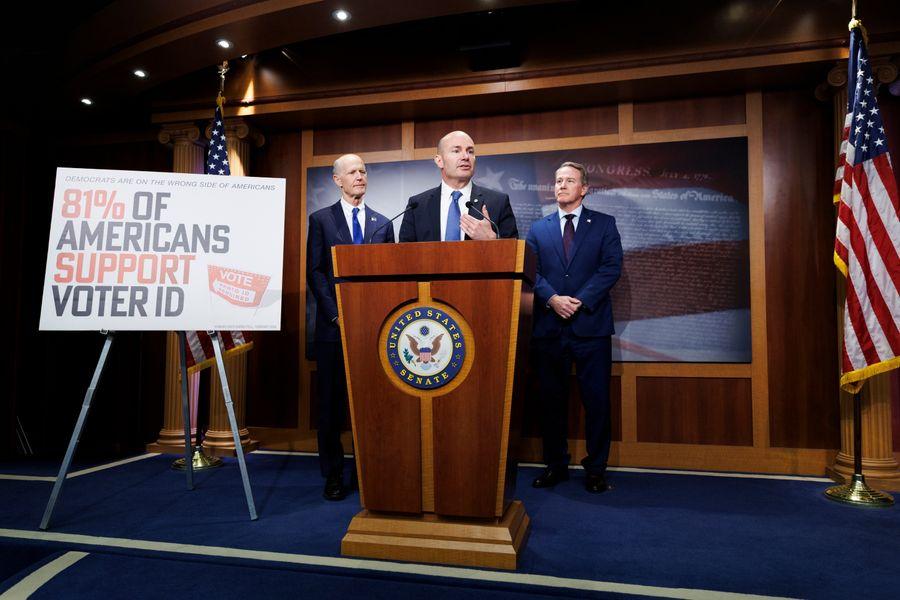
It is also consistent with what most states already require. Some form of voter identification is required in 38 states. Of the 12 that don’t require it, ten are solidly Democratic states: California, Illinois, Maine, Maryland, Massachusetts, Minnesota, New Jersey, New Mexico, New York, and Vermont. The remaining states without voter ID requirements are Pennsylvania and Nevada. The SAVE Act does not create a new concept. It brings federal elections in line with the commonsense standards already adopted across most of the country.
The House has already acted. The question now is whether the Senate intends to pass the bill or simply debate it and then make excuses for why it didn’t pass. Under current Senate rules, most legislation requires 60 votes to advance. Those votes are not there. Senate leadership has indicated the bill will receive a vote, but absent a change in strategy, the outcome is predictable. The legislation will fall short, and the Senate will move on.
Gavin Newsom's Misguided Redistricting Initiative
A Warning Against the Overuse of Sanctions
Open The Books on the California State Checkbook
Senate Passes Bill Addressing Heroin, Opioid Crisis
There has been discussion of a talking filibuster to force the issue. That would require sustained effort and a willingness to confront the opposition directly on the Senate floor. It remains a viable option, but at this point, it does not appear the Senate is prepared to take that step. Instead, we are approaching a vote that is unlikely to produce a result. That may serve a messaging purpose, but it does not fulfill the mandate voters delivered.
President Trump has been clear that Republicans should use every available tool to pass the SAVE Act. If the Senate is not prepared to force passage through a talking filibuster and does not have 60 votes for cloture, then it should turn to a tool specifically designed for moments like this.
That tool is budget reconciliation.
Reconciliation allows Congress to pass legislation affecting federal spending and revenues with a simple majority vote. Debate is limited, and the 60-vote threshold does not apply. It is a standard part of the congressional process that both parties have used when priorities demand action.
Democrats used reconciliation to finalize key provisions of the Affordable Care Act. Republicans used it to pass the Tax Cuts and Jobs Act. The precedent is clear and well established.
Republican leaders have long recognized its value. Congressman Gary Palmer, former chairman of the House Republican Policy Committee, has emphasized reconciliation as one of the most effective tools for enacting policy when a governing majority exists but procedural barriers stand in the way. Congressman Ralph Norman said, “Reconciliation seems to be the only way to go at this point to pass the SAVE Act, and I support doing this.” Sen. John Kennedy has echoed that view, noting that when legislation cannot reach 60 votes, reconciliation provides a lawful and appropriate path to pass it with a simple majority.
The SAVE Act fits squarely within that framework.
The path forward is both practical and achievable. Congress should incorporate the SAVE Act into a reconciliation package by including a defined federal funding component tied directly to implementation. For example, the legislation could authorize $500 million annually for five years, totaling $2.5 billion, in election integrity grants to the states.
These funds would support modernization of voter registration systems, integration with federal databases, enhanced cybersecurity protections, and regular audits of voter rolls to ensure accuracy and integrity.
A portion of these funds should also be used to promote lawful voter participation and public awareness. Some critics argue that stronger verification standards could reduce turnout. Congress can address that concern directly by funding voter education initiatives that help eligible citizens understand the requirements and successfully complete the registration process. Secure elections and strong participation are not competing goals.
Critically, the SAVE Act can be structured to comply with reconciliation rules by framing its verification requirements as terms and conditions under which federal outlays are made. Under the Senate’s Byrd Rule, provisions that govern how federal funds are distributed are explicitly permissible within reconciliation legislation. By tying state eligibility for these grants to implementation of citizenship verification standards, the policy becomes directly connected to federal spending and qualifies for reconciliation consideration.
The legislative pathway is clear. The House Budget Committee should include reconciliation instructions in the budget resolution directing committees of jurisdiction to produce legislation strengthening election integrity through this grant program. Those instructions would establish spending levels and provide the framework for incorporating the SAVE Act into a broader fiscal package.
The bill would pass the House by a simple majority and move to the Senate under reconciliation procedures, where debate is limited and a filibuster cannot block final passage.
This is not a procedural workaround. It is how Congress governs when it chooses to act.
If the Senate proceeds on its current path, the SAVE Act will receive a vote and fail to reach the 60-vote threshold. That outcome would leave a central component of President Trump’s agenda unfulfilled and send a signal that even with a governing majority, Congress is unwilling to use the tools available to it.
The question is no longer whether the Senate can vote. It is whether the Senate intends to pass the legislation.
Reconciliation provides the answer.
The House must lead. The Budget Committee has a clear opportunity to include election integrity funding in the next budget resolution and put the SAVE Act on a viable path to passage.
President Trump has provided the direction. It is time for Congress to use the tools at its disposal, including reconciliation, to pass the SAVE Act and secure American elections.
The path forward is clear. Pass the SAVE Act. Deliver on the mandate.
Support Our Mission
The Internet provides an endless stream of content. Not all of it is worth your time. That's why, every day, RealClearPolitics curates the most essential news and information—from all sides and across mediums. The links, videos, and podcasts curated here are the product of human judgment, not algorithms or AI. Please help power our mission of presenting a thoughtful, balanced public discourse through a tax-deductible donation.
Would you consider supporting us today?

Democrats Won the Midterms. Common Sense Won, Too
Jordanne Kemper • RealClearPolitics
The 120th Congress Shapes Up
Carolina Lumetta • RealClearPolitics
Flooding GOP Primaries With Democrats
Robert Natelson • RealClearPolitics
Washington Keeps Rewarding Oracle—Veterans Keep Paying the Price
Darin Gaub • RealClearPolitics
The Seeds of Unrestricted Warfare
John Teichert • RealClearPolitics
The Primary System Is Losing the Next Generation
Sean Trende • RealClearPolitics
RCP Today
Top stories on RealClearPolitics
The Takeaway
Polling intelligence and analysis delivered to your inbox
World News
Featuring the latest world news
Policy
Featuring the latest policy news
Support Our Mission
As part of RealClearPolitics, authors aim to provide balanced, non-partisan analysis by presenting top reporting and commentary from all sides of the political spectrum.
Trusted by policymakers and citizens alike since 2000