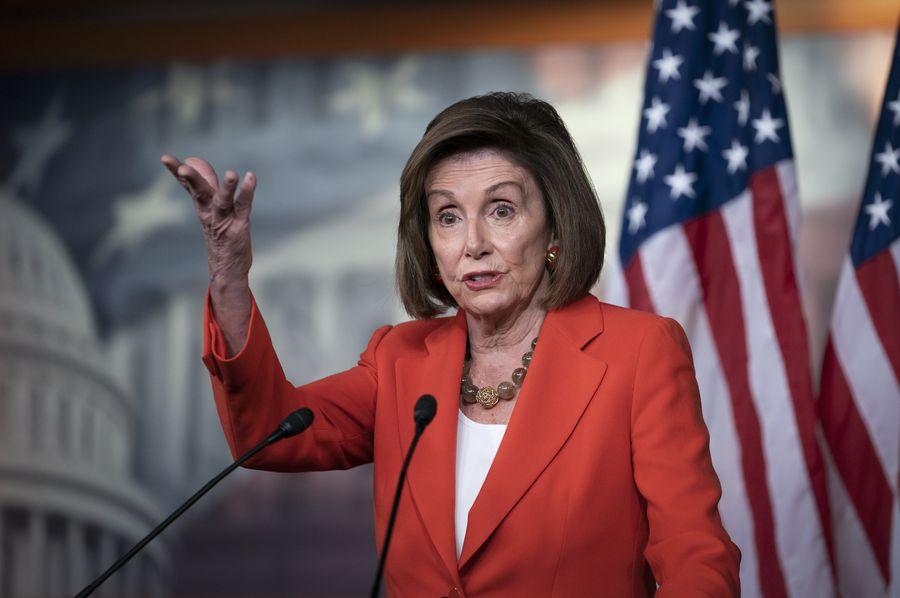
Speaker of the House Nancy Pelosi, D-Calif., talks to reporters just before the House vote on a resolution to formalize the impeachment investigation of President Donald Trump, in Washington, Thursday, Oct. 31, 2019. (AP Photo/J. Scott Applewhite)
Impeachment Inquiry Vote: How It Came to This
ANALYSIS
Published Oct. 31, 2019 • Read time: 5m
The vote was scheduled for Thursday. Rep. Katie Porter dressed like Batman.
The masked California Democrat wore a leather suit and cape, complete with thigh-high boots and yellow utility belt, on the morning that the House voted to formalize an impeachment inquiry of President Trump.
The costume was occasioned by Halloween and the vote triggered by allegations that the president abused public office for personal political gain. “The Greatest Witch Hunt in American History!” Trump tweeted when the votes were counted.
All of this, minus the dress-up, had seemed inevitable -- paperwork for the Impeach Trump Leadership PAC was filed less than a month after his inauguration. It also represents an evolution; the same Democrats who insisted earlier in the year that impeachment be bipartisan plunged headlong into that process with a vote almost strictly along party lines.
All but two Democrats voted for the resolution that lays the ground rules for the impeachment probe and finally begins the public phase of those proceedings. Republicans uniformly opposed it. The tally: 232-196.
Standing on the House floor next to a poster of the American flag, Speaker Nancy Pelosi chided her colleagues on the right, saying, “I don’t know why Republicans are afraid of the truth.”
“Every member should support the American people hearing the facts for themselves,” she continued. “That is what this vote is about. It’s about the truth. And what is at stake in all of this is nothing less than our democracy.”
The stakes are high. If the probe is ultimately successful after all the hearings and the subpoenas and the debates, Trump would become just the third president in U.S. history to be impeached by the House. Aware of the gravity of the situation, Pelosi said that the coming process would be “solemn,” even “prayerful.” It should not be, she continued, “cause for any glee or comfort.”
Gavin Newsom's Misguided Redistricting Initiative
A Warning Against the Overuse of Sanctions
Open The Books on the California State Checkbook
Senate Passes Bill Addressing Heroin, Opioid Crisis
But the Democratic leadership is notably less cautious than they were in the recent past.
“Impeachment is so divisive to the country that unless there’s something so compelling and overwhelming and bipartisan, I don’t think we should go down that path, because it divides the country,” Pelosi said in March.
“If the evidence isn’t sufficient to win bipartisan support for this, putting the country through a failed impeachment isn’t a good idea,” concluded House Intelligence Committee Chairman Adam Schiff that same month.
“You have to be in a situation to undertake impeachment where you believe that once all the evidence is public, not a majority but a good fraction of the opposition voters who supported the president would say, 'Well, they had to do it. It was the right thing to do,’” echoed House Judiciary Committee Chairman Jerry Nadler.
The next month, Special Counsel Robert Mueller released the much-anticipated report on his examination of Russian meddling in the 2016 election. It ran 448 pages and included four appendices, but that investigation into alleged collusion involving the president and possible obstruction of justice did not provide the political impetus needed to start impeachment. Then the president called his counterpart in Ukraine.
It was July 25 when Trump asked Ukrainian President Volodymyr Zelenskiy to “look into” the business dealings of the son of former Vice President Joe Biden in that country.
The president would later describe the conversation as “a perfect call.” An unnamed whistleblower -- a CIA analyst detailed to the White House in the first year of Trump’s presidency -- filed a complaint with the Justice Department, alleging that the president may have violated campaign finance law and even engaged in a quid pro quo by withholding congressionally approved foreign aid unless the Ukrainians dug up dirt on the Bidens.
The White House released a transcript of that call in September and continues to argue that the president did nothing wrong. Behind the closed doors of the Intelligence Committee, key witnesses alternatively confirm and rebut that line.
While those hearings continued in secret, a debate erupted publicly over their legitimacy. Republicans griped that they were being denied their rights as the minority party, most significantly the power to subpoena witnesses. White House counsel Pat Cipollone was similarly outraged, writing to Pelosi on Oct. 8 that the inquiry “violates fundamental fairness and constitutionally mandated due process.”
The White House complained that Pelosi was moving forward with impeachment without a floor vote, something that had been afforded the previously impeached presidents. The administration also grumbled that it was denied access to evidence and the ability to cross-examine witnesses.
And for the last month, the debate has been over the nitty-gritty parliamentary procedures driving impeachment. Finally, Pelosi decided to give Republicans what they wanted: a floor vote.
Now adopted, the resolution directs the Intelligence, Foreign Affairs, Financial Services, Judiciary, and Ways & Means committees to “continue their ongoing investigations as part of the existing House of Representatives inquiry into whether sufficient grounds exist” for the chamber to “exercise its constitutional power to impeach Donald John Trump.”
Going forward, Republicans will have subpoena power, albeit subject to the concurrence of the committee chairmen. The minority party quickly bemoaned that condition while the majority insisted the resolution is identical to the one used during the impeachment of Bill Clinton.
Republicans bandied about words like “coup” and “cult” and “corrupt.” All of it, according to Minority Leader Kevin McCarthy, amounts to “a disaster for democracy.” And after the floor vote, the California Republican shifted the process argument: Democrats should not just guarantee the subpoena rights of the Republicans; they should put impeachment on hold and try their chances “at the ballot box.”
“To my colleagues on the other side, I say this: Give the people back their power,” McCarthy said. “Let them choose the next leader of the free world. Follow the principles of our Constitution. And do not dilute our democracy by interfering in elections from Washington.”
Democrats won’t take his advice.
Formalized impeachment -- the nightmare scenario of the current administration -- began on Halloween. It will continue into 2020, and its shadow will loom over the coming general election, whether the president remains in office or is removed from it.

A RealClear Thanksgiving: Investing in a Better Future
David DesRosiers • RealClearPolitics
Trump’s Newsom Problem: Antagonist-in-Chief
Carolina Lumetta • RealClearPolitics
America’s Free Spirit
John Maxwell Hamilton • RealClearPolitics
The GOP Majority Should Go Out in Glory
Daniel McCarthy • RealClearPolitics
Republican Majorities Could Return Sooner Than Expected
J.T. Young • RealClearPolitics
The Danger Before the Attack
Leslie J. Sullivan • RealClearPolitics
RCP Today
Top stories on RealClearPolitics
The Takeaway
Polling intelligence and analysis delivered to your inbox
World News
Featuring the latest world news
Policy
Featuring the latest policy news
Support Our Mission
As part of RealClearPolitics, authors aim to provide balanced, non-partisan analysis by presenting top reporting and commentary from all sides of the political spectrum.
Trusted by policymakers and citizens alike since 2000