
Congress Budget
Funding Showdown Is a Warning: America Nears 'Cascade'-Style Collapse
COMMENTARY
Published March 18, 2025 • Read time: 6m
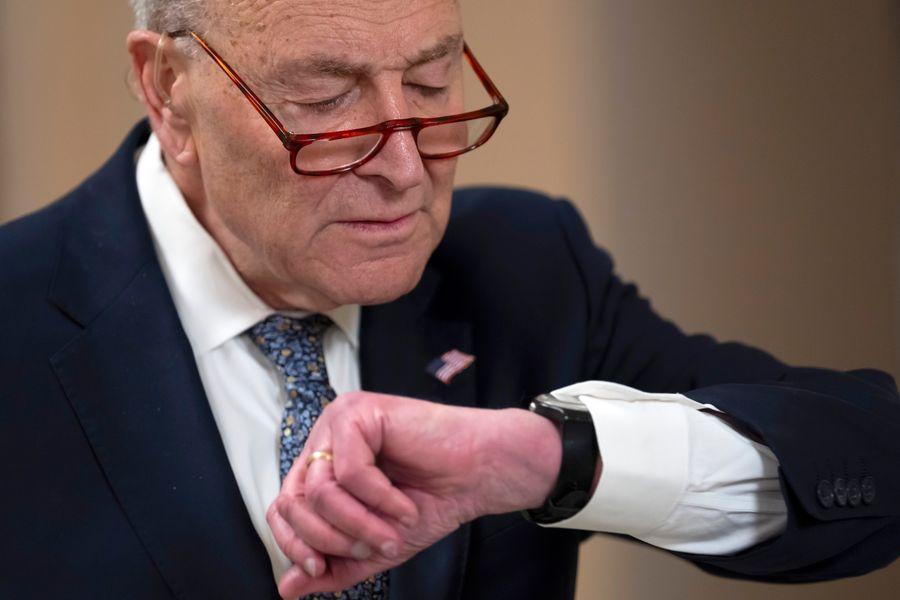
Americans just faced the prospect of another government shutdown until a fragile deal emerged. House Republicans passed a stopgap bill Senate Democrats decried as overreach but voted for anyway, under the theory that it was the lesser of two evils. When the GOP left Washington, expecting compliance, Senate Minority Leader Chuck Schumer reluctantly accepted a six-month funding extension that passed 85-11. Federal workers will see paychecks and airports will function, for now. Yet the debt ceiling, unsuspended since Jan. 1, casts a lengthening shadow. Treasury Secretary Scott Bessent faces a summer deadline as “extraordinary measures” begun in January dwindle, inching us toward default. This creaking system teeters perilously close to collapse.
“Cascades,” a book by one of the co-authors of this column, charted how small triggers spark sweeping change, uniting isolated frustrations into a force that reshapes nations. Hurricane Katrina laid bare failures beyond New Orleans, unraveling trust in governance and ending a political era. George Floyd’s murder fused scattered grievances into a resounding demand for justice. We are nearing another such moment, as the strains on our political system tighten. The Gallup polling organization measured congressional approval at 16% last year, but that level of disaffection is merely an indicator. Trust in almost all major American institutions is eroding – with good reason. Courts divide along partisan lines, states resist federal mandates, and misinformation clouds reality. DOGE’s sweeping cuts have sent thousands of government workers home, including those who worked at the Department of Education, Voice of America, and the United States Agency for International Development. The system seems to be fraying at its seams.
Gavin Newsom's Misguided Redistricting Initiative
A Warning Against the Overuse of Sanctions
Open The Books on the California State Checkbook
Senate Passes Bill Addressing Heroin, Opioid Crisis
The Department of Defense, the latest to be targeted by Elon Musk’s “efficiency” department, faces the prospect of furloughing 40% of its 800,000 civilian workers per Pentagon estimates, leaving bases vulnerable and intelligence gaps unchecked. “This is not just a failure of leadership. It’s a failure of imagination,” Fareed Zakaria wrote in The Washington Post. “When a government cannot agree to keep its own lights on, it signals to the world it cannot be trusted to manage anything else.”
Schumer’s pivot – favoring a six-month plan over a shorter bipartisan solution – leaves the debt ceiling question unresolved. This shutdown scare portends a system on the brink, amplifying the risk of a cascade-triggering event – a concept from Greg Satell’s book, “Cascades: How To Create a Movement That Drives Transformational Change.” In it, Greg documents how isolated pockets of frustration become connected into a unified outcry demanding action for change.
We’ve seen this before. Hurricane Katrina crystalized frustrations with the war in Iraq and the Bush administration’s incompetence. Before you could say, “Heckuva job, Brownie,” the Republican Party’s “permanent majority” turned into years in exile. In a similar vein, the murder of George Floyd catalyzed disparate clusters of discontent into universal calls for action, upending both major political parties.
Cascades are impossible to predict. No one saw the “color revolutions’ coming in the early 2000s, but they changed the face of Europe. And their impact continues to reverberate today – not only in Ukraine’s staunch and unified defiance against Russian aggression, but in the massive protests we are seeing daily in Georgia, Slovakia, and Serbia.
History has shown that when a cascade is imminent, we can prepare and set the stage for positive change. During his lifetime, Nelson Mandela was accused of many things. He was called an extremist, a radical, an anarchist, and a communist. He always answered these insults the same way: “No one has to guess what I believe, because it was all written down in 1955.” It was called the “Freedom Charter,” a statement of core principles for the future of South Africa, which became a key asset in the effort to end apartheid. Elon Musk knows it remains an important document in that country to this day.
In a similar vein, during the Nashville sit-ins of 1960, word reached the protestors that racist thugs intended to disrupt the next day’s protest. John Lewis and Bernard Lafayette had “10 Rules of Conduct” printed out and distributed to both guide the protestors and signal to the general public what their values were. Today they are proudly displayed in the Civil Rights Room of the Nashville Public Library.
After Slobodan Milošević was able to divide the Zajedno coalition in Serbia to maintain his power, the activist group Otpor created a “Contract with the People” to bind the opposition parties together and shape the future of the country. Within two years, the regime was overthrown and Milošević was on the way to the Hague, where he would die in his prison cell.
Russia’s 1999 apartment bombings gave Vladimir Putin his opening to crush dissent and build an autocracy in one swift move. “Cascades” explains it: Frustrations build quietly until a trigger tips the system, and energies are directed into action.
That’s why we back the Committee to Restore America’s Future Together: CRAFT. It’s not a campaign or a protest. We’re about promoting our shared values as a shield against the impending cascade. Our plan has three pillars. First, the “Contract To Restore America’s Future,” a citizen-made pact, forged by people, scholars, and leaders, rooting us in opportunity, fairness, and democracy, like Mandela’s Charter. Second, activist training, similar to that which made the color revolutions and the Arab Spring successful. CRAFT will train volunteers to counter DOGE and Trump’s moves with ideas. Third, a collaboration platform linking unions, businesses, faith groups, and civil society organizations to advocate for and solve problems of mutual interest.
The storm is here – shutdowns averted by fragile deals, a debt ceiling ticking like a bomb, and a system buckling under mistrust. Abraham Lincoln, in his December 1862 message to Congress, declared, “The dogmas of the quiet past are inadequate to the stormy present,” urging bold action as he prepared the Emancipation Proclamation to meet a nation’s breaking point. Now, as faith in governance crumbles, CRAFT’s plan, its contract, training, and coalitions, reject yesterday’s complacency for today’s reality. Like Lincoln, we must discard what’s obsolete and build anew, turning this cascade’s chaos into a chance for rebirth.

Democrats Won the Midterms. Common Sense Won, Too
Jordanne Kemper • RealClearPolitics
The 120th Congress Shapes Up
Carolina Lumetta • RealClearPolitics
Flooding GOP Primaries With Democrats
Robert Natelson • RealClearPolitics
Washington Keeps Rewarding Oracle—Veterans Keep Paying the Price
Darin Gaub • RealClearPolitics
The Seeds of Unrestricted Warfare
John Teichert • RealClearPolitics
The Primary System Is Losing the Next Generation
Sean Trende • RealClearPolitics
RCP Today
Top stories on RealClearPolitics
The Takeaway
Polling intelligence and analysis delivered to your inbox
World News
Featuring the latest world news
Policy
Featuring the latest policy news
Support Our Mission
As part of RealClearPolitics, authors aim to provide balanced, non-partisan analysis by presenting top reporting and commentary from all sides of the political spectrum.
Trusted by policymakers and citizens alike since 2000