
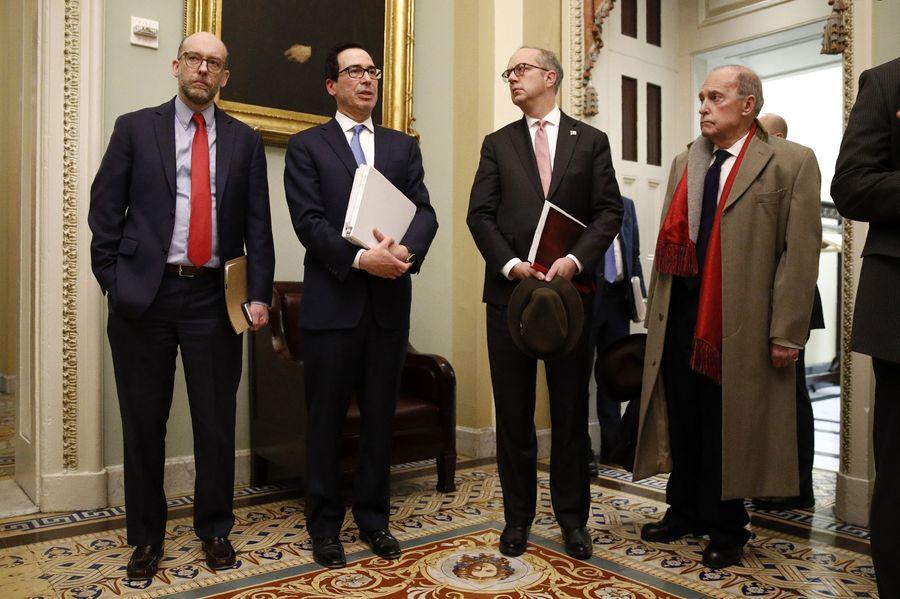
Treasury Secretary Steve Mnuchin, second from left, speaks with members of the media as he departs a meeting with Senate Republicans on an economic lifeline for Americans affected by the coronavirus outbreak. on Capitol Hill in Washington, Monday, March 16, 2020. Standing with Mnuchin is White House chief economic adviser Larry Kudlow, right. (AP Photo/Patrick Semansky)
Federal Rescue Should Be in the Form of Loans, Not Bailouts
COMMENTARY
Published March 20, 2020 • Read time: 4m
As the federal government determines how to save important American industries from possible collapse, it is important that we simultaneously protect workers and taxpayers. And above all, whatever Congress does, it should first and foremost follow the Hippocratic Oath and “DO NO HARM.”
This is why Club for Growth has put together a series of policies to consider in combatting the economic fallout of the coronavirus. Taken together, they are bold, free market steps that our elected officials can take to encourage a speedy recovery.
Any financial rescue of industry should be in the form of a government loan, even if the interest is zero, and not as a grant or bailout. And unlike TARP, no business should be required to take a loan.
Additionally, small business mandates should not be used to provide relief. Instead we should use the existing unemployment insurance structure to provide funds to workers, and we should make temporary enhancements to the system such as including salaried workers.
Rather than having to lay off employees to become eligible for this temporary expanded unemployment insurance, workers will become eligible if employers provide up to six weeks leave of absence due to the virus.
Using the enhanced unemployment benefit system is better for small businesses and employees for several reasons. First, the mandate will drive many small businesses at the margin to file for bankruptcy. Second, the unemployment programs are already in place and employees who take a leave of absence can be assured that they will get paid. Third, the mandate creates severe cash flow problems for small businesses that have to wait for the government payments before they are reimbursed for wages. Since these employees are not working, the businesses have no revenue to pay their salaries. So, it is likely the mandate will actually accelerate permanent layoffs.
Gavin Newsom's Misguided Redistricting Initiative
A Warning Against the Overuse of Sanctions
Open The Books on the California State Checkbook
Senate Passes Bill Addressing Heroin, Opioid Crisis
Similarly, Congress should not ask employers to rely upon a refundable tax credit or advanced cash through the Treasury; this policy will not stop massive layoffs as employers see unemployment insurance as a more viable alternative than employing workers to whom it cannot immediately pay wages or salary. Moreover, many small businesses have already taken steps to relieve payroll stress by laying off workers.
Some have embraced cash stipends for families so they can afford to buy food and pay bills, but relief for families should be provided through existing government welfare programs and an enhanced unemployment insurance program.
The government can also expand SBA loan authority by freeing up capital for entrepreneurs. This will allow for a more stable workforce and give job creators the ability to be more flexible with their workers than they could be otherwise.
The tax burden on job creators should also be decreased by further reducing the C-corp rate from 21% to 15%, and Congress should bring tax rate parity between corporations and pass-through entities with a maximum tax rate of 15%, and eliminate payroll taxes for a minimum of three months through June 15. These provide much better stimulus for businesses to continue to operate during the economic downturn and will dramatically speed up the recovery once the virus has been dealt with.
President Trump’s successful deregulation effort should be redoubled to provide further economic relief to all sectors, especially in energy, transportation, and tourism. Upon approval by the president, such regulations shall be suspended until he or Congress determines that the suspension is no longer needed.
We could also ensure that universities reimburse students and families for room and board/tuition when the schools send students home. Many have large endowments that can offset some expenses, rather than creating a complicated reimbursement process.
President Trump should also move to unilaterally end all tariffs, which are taxes on U.S. consumers. It is especially important to remove tariffs on raw materials and equipment that is used by businesses to produce products in the United States.
Congress should also provide funding to ensure that, at a minimum, every county in America has a mobile testing site; counties with more than 250,000 people will receive additional funding to ensure the accommodation of larger populations.
The federal government can and should take bold action to economically recover from the effect of the coronavirus, but it must ensure those policies are effective rather than some of the counterproductive approaches being discussed.

The Danger Before the Attack
Leslie J. Sullivan • RealClearPolitics
Jon Finer’s Old and Dangerous ‘New Approach’ to Israel
Peter Berkowitz • RealClearPolitics
The President Deserves Better
John Ullyot • RealClearPolitics
Congress Doesn’t Need Another Blame Game. It Needs To Find What’s Broken
Jarrod Bernstein • RealClearPolitics
Democrats Won the Midterms. Common Sense Won, Too
Jordanne Kemper • RealClearPolitics
The 120th Congress Shapes Up
Carolina Lumetta • RealClearPolitics
RCP Today
Top stories on RealClearPolitics
The Takeaway
Polling intelligence and analysis delivered to your inbox
World News
Featuring the latest world news
Policy
Featuring the latest policy news
Support Our Mission
As part of RealClearPolitics, authors aim to provide balanced, non-partisan analysis by presenting top reporting and commentary from all sides of the political spectrum.
Trusted by policymakers and citizens alike since 2000