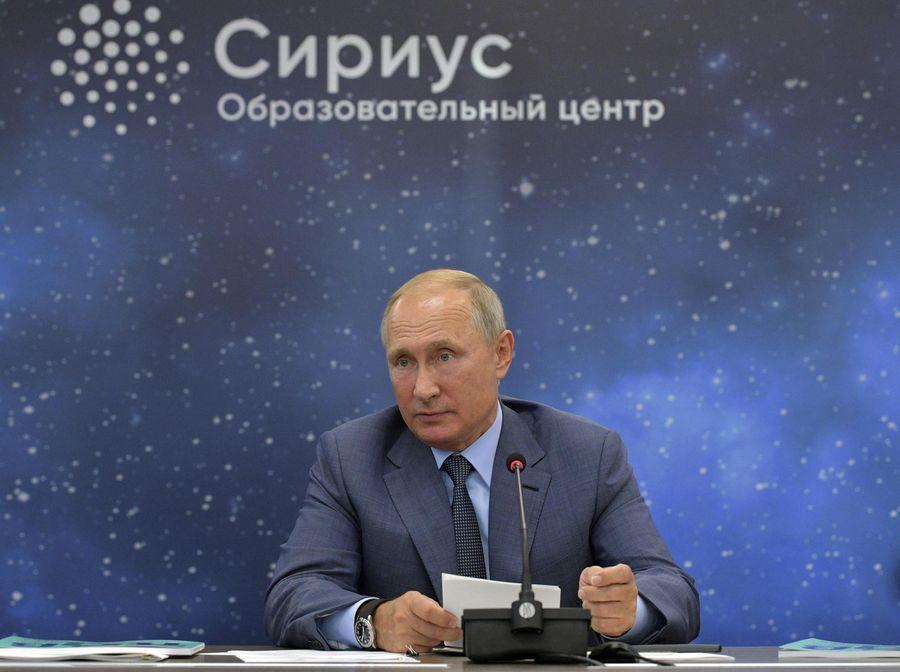
Russian President Vladimir Putin speaks as he meets with the students while visiting the Sirius Educational Centre for Gifted Children during the traditional opening of the school year known as the
Election-Meddling Sanctions Bills Penalize the Innocent
Published Sept. 7, 2018 • Read time: 4m
Lawmakers on both sides of the aisle in Washington have rightly been incensed about foreign interference in the 2016 election cycle and other acts of Russian aggression, leading some to author legislation that would implement penalties against foreign actors who do so again in the future. One such bill, the Countering America’s Adversaries Through Sanctions Act, passed with near-unanimous support last year.
However, CAATSA required a major rewrite before its passage, as the initial draft of the bill included mandatory penalties on foreign interference that would have done real harm to the U.S. economy. Now, two more bills risk repeating the same mistakes that were narrowly avoided in the final version of CAATSA.
The first, co-authored by Sens. Chris Van Hollen (D-Md.) and Marco Rubio (R-Fla.), is the Defending Elections from Threats by Establishing Redlines Act, known as DETER. Another, called the Defending American Security from Kremlin Aggression Act of 2018, or DASKAA, is sponsored by six senators led by Lindsey Graham (R-S.C.).
One of the main goals of sanctions drafting is to avoid doing more harm to your own side than to the target. Unfortunately, both the DETER Act and DASKAA fall short.
The DETER Act requires the director of national intelligence to report on whether foreign countries attempted to sway a federal election within 30 days. If the intelligence assessment concludes that interference took place, it would trigger a requirement that the president and secretary of the Treasury act swiftly to impose harsh economic sanctions on the interfering government. These sanctions would be required to remain in effect for two presidential election cycles, or eight years, before the president could opt to remove them.
Gavin Newsom's Misguided Redistricting Initiative
A Warning Against the Overuse of Sanctions
Open The Books on the California State Checkbook
Senate Passes Bill Addressing Heroin, Opioid Crisis
While requiring an assessment of foreign interference and punishment for those that intrude on our elections has merit, the penalties specified in the bill are counterproductive. The reality is that the DETER Act’s effects would have damaging repercussions on the U.S. economy and our allies. In particular, the DETER Act lays out a special set of sanctions, explicitly naming several Russian banks and energy companies that must be targeted, along with railroads and other industries, that are necessary partners for many U.S. and European businesses operating in the region.
DASKAA would enact sanctions “on transactions related to investment in energy projects supported by Russian state-owned or parastatal entities,” a stipulation that concerns many U.S. companies with exposure to the global energy sector. The DETER Act would similarly prohibit U.S. companies from engaging in joint ventures with Russian state-owned energy companies if they hold more than a small stake, forcing U.S. businesses to walk away from existing enterprises.
For example, the DETER Act would make it nearly impossible for companies to do business in Central Asia and the Caspian Sea region by limiting access to crucial Russian-owned rail and pipeline networks. Why should American companies be shut out of lucrative, multibillion-dollar developing economies like Kazakhstan or Mongolia because of Russian wrongdoing? In the long run, the only certain outcome in these regions would be to rob countries of other options, inevitably pushing them closer to Russia.
Anywhere that Russian businesses pop up – even in countries friendly to the United States – American businesses would be forced to retreat because of DASKAA or DETER. Russian firms and their backers in the Kremlin would be quick to realize the grand strategic potential of this.
If Russia wanted American competitors out of the picture anywhere in the world, having its energy companies buy in as a minority owner would unilaterally force the U.S. partners out. Unfriendly third-party countries like Venezuela could force U.S. companies to give up long-established projects and hand over infrastructure just by inviting Russian companies in.
There are better ways to punish those who seek to unravel the fabric of democracy. The DETER Act and DASKAA do include many viable penalties for those who would undermine our elections and targeting sovereign debt and shadowy real estate deals is a step in the right direction.
But in their present form, these bills would cause more pain for everyday Americans than for billionaire Kremlin oligarchs. The Senate should ensure that its sanctions are squarely targeted at malicious foreign actors, and not our own countrymen.

A RealClear Thanksgiving: Investing in a Better Future
David DesRosiers • RealClearPolitics
Trump’s Newsom Problem: Antagonist-in-Chief
Carolina Lumetta • RealClearPolitics
America’s Free Spirit
John Maxwell Hamilton • RealClearPolitics
The GOP Majority Should Go Out in Glory
Daniel McCarthy • RealClearPolitics
Republican Majorities Could Return Sooner Than Expected
J.T. Young • RealClearPolitics
The Danger Before the Attack
Leslie J. Sullivan • RealClearPolitics
RCP Today
Top stories on RealClearPolitics
The Takeaway
Polling intelligence and analysis delivered to your inbox
World News
Featuring the latest world news
Policy
Featuring the latest policy news
Support Our Mission
As part of RealClearPolitics, authors aim to provide balanced, non-partisan analysis by presenting top reporting and commentary from all sides of the political spectrum.
Trusted by policymakers and citizens alike since 2000