
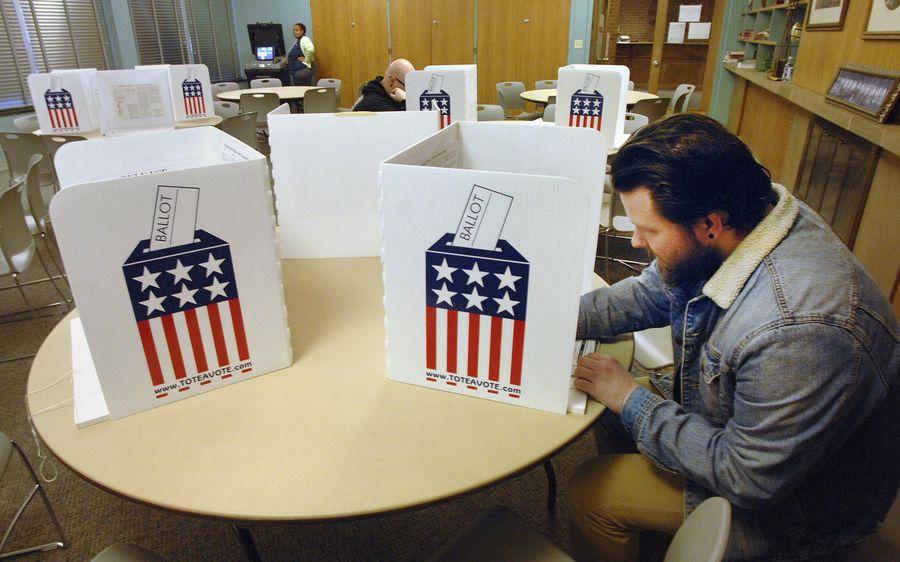
Kevin Dean marks his ballot during the Illinois primary at Polling Place No. 3 in Wesley United Methodist Church, Tuesday, March 17, 2020 in Bloomington, Ill. Voters across the state are getting the chance to decide competitive primary races for the U.S. House and the Illinois Supreme Court, with concerns about the coronavirus looming large. Election officials have been promoting voting early and casting ballots by mail in an attempt to control crowds and curb the spread. The vast majority of people recover from the new coronavirus. According to the World Health Organization, most people recover in about two to six weeks, depending on the severity of the illness.(David Proeber/The Pantagraph via AP)
COVID-19 Crisis Makes Reformers All In for Vote-by-Mail
Published March 30, 2020 • Read time: 6m
The political reform movement -- large, growing and increasingly successful -- was poised to wage dozens of new state campaigns in 2020 to outlaw gerrymandering, expand use of ranked-choice voting and temper the influence of big money in politics.
Then came the COVID-19 crisis, upending such plans along with those of virtually every citizen, business, health facility and government entity. Many movement plans relied on passing voter initiatives, but the virus outbreak made petition-gathering impossible.
So a swift change in strategy is underway, elevating one longstanding movement aim — voting by mail (also called “Vote at Home”) — to the top of the agenda.
The leading national reform group, Represent.us, has joined with other large groups -- NYU Law’s Brennan Center, Unite America, the National Association of Non-Partisan Reformers, Public Citizen and Common Cause — to mount a multimillion-dollar campaign to spread VAH nationwide, not just for the possibly virus-endangered 2020 election, but permanently.
This coalition is planning to mobilize thousands of activists previously dedicated to other reform projects to join organizations such as the National Vote at Home Institute and the Center for Secure and Modern Elections to focus on VAH.
And movement leaders hope that the momentum gained will lead to wider adoption of two other reforms -- automatic voter registration (whereby any interaction with a state agency leads to registration) and ranked-choice voting.
VAH was a movement objective before COVID because it makes voting more convenient than standing in long lines at polling places and increases turnout. In the states conducting all elections by mail — Colorado, Hawaii, Oregon, Utah, Washington, plus most counties in North Dakota — turnout averaged 10% higher in 2018 than the country as a whole — above 60% in some states vs. less than 45% in states like Mississippi, Louisiana and Arkansas, which require a written excuse to obtain an absentee ballot.
Gavin Newsom's Misguided Redistricting Initiative
A Warning Against the Overuse of Sanctions
Open The Books on the California State Checkbook
Senate Passes Bill Addressing Heroin, Opioid Crisis
VAH also saves states money they’d otherwise spend on voting machines and polling place rentals, though some states may pay a one-time cost to acquire paper ballot reading machines. Net, however, jurisdictions save about $6 per voter -- $29 million for Orange County, Calif., in 2020.
The system is also more secure than use of hackable electronic voting and counting. In Colorado and other VAH states, ballots are automatically mailed to voters’ registered residences and can’t be forwarded.
The mail-outs occur weeks before Election Day, giving voters time to think about the candidates. When mailed back — postmarked by Election Day -- voters must sign a bar-coded outside mailing envelope and signatures are matched with registration forms.
Colorado also has secure “vote centers -- polling places where voters living anywhere in the state can drop off their mail-in ballots, register and cast ballots in person early or on Election Day. VoteatHome CEO Amber McReynolds says, “COVID has exposed a vulnerability in our voting system. We’re trying to make sure everyone can vote.”
The issue definitely has gained traction amid the pandemic crisis as various states (14 as of last weekend) delay their primary elections to avoid the virus’s spreading at polling places or because poll workers, often seniors, decline to appear. Nevada and Georgia will send absentee ballots out to all registered voters. Wisconsin, slated to hold a primary April 7, is having a furious partisan battle over the issue.
In Congress, Sens. Amy Klobuchar and Ron Wyden, along with more than a dozen fellow Democrats, have introduced a bill to have absentee ballots delivered to all voters and expand in-person early voting for the 2020 general election. The House Democratic coronavirus bill, besides skewing its $2 trillion-plus relief more to workers than corporations, contained provisions mandating early and absentee voting.
Republicans have long objected to nationalizing election rules, and Senate Majority Leader Mitch McConnell initially opposed any elections aid in the bailout bill, but it ended up containing $400 million to states to help with managing elections during the crisis -- without specifying how. Reformers hope -- and many conservatives fear -- that the money will be spent to spread voting by mail and absentee voting.
That will require special sessions for some legislatures or emergency decrees from governors -- both of which the movement plans to support with large grassroots-organizing, lobbying and digital media campaigns. The movement then plans to push legislation in 2021 to make VAH permanent in as many states as possible.
Conservatives contend that making it easier to vote is a liberal Trojan Horse devised to increase Democratic turnout by using such tricks-of-trade as the controversial “vote harvesting” methods employed to partisan advantage in California and other places. Meanwhile Democrats regularly accuse Republicans of voter suppression. President Trump has repeatedly claimed that voting by mail and absentee voting enable vote fraud, notwithstanding the fact that he himself has applied for an absentee ballot in his new home state of Florida.
But there are reasons to believe that if it were practiced uniformly, making it easier to vote helps Republicans as well as Democrats. Bright-red Utah is a VAH state, and North Dakota virtually is. And Republicans depend more than Democrats on older voters, among those most inconvenienced by stand-in-line voting -- and most in danger from coronavirus in 2020.
Represent.us CEO Josh Silver says that he hopes to recruit conservatives and Republicans to help lead the VAH campaign, but he acknowledges that so far the conservatives who favor it tend to be “Never Trumpers.” Silver said the movement will push adoption of Colorado-style all-mail voting, although Amber McReynolds, principal designer of that system, counts it as progress when a state merely stops requiring an excuse before issuing absentee ballots or when it sends out absentee ballots automatically every election.
Silver acknowledges that a drawback of mail-in voting is that voters who send ballots back early may “waste” their votes on candidates who drop out before Election Day. Millions did so this year in Democratic primaries.
Reformers are hoping that mail-in voting will open voters’ minds to the utility of ranked-choice voting. Under that system -- used in Australia and New Zealand, several U.S. cities and Maine (plus other states for primaries and overseas and military ballots) -- voters rank the candidates on their ballots. If no candidate has a majority, those with the least votes are dropped in the counting and voters’ second (or third) choices are distributed until one does have a majority.
The system, which reformers plan to make a priority in 2021, improves chances for independent candidates (who can’t be judged “spoilers”) and discourages negative campaigning and extremes because candidates want to be voters’ second choice if they can’t be their first.
As Silver said in a conference call last week, COVID-19 tossed lemons at the reform movement, but its groups will work hard this year to produce lemonade.

Jon Finer’s Old and Dangerous ‘New Approach’ to Israel
Peter Berkowitz • RealClearPolitics
The President Deserves Better
John Ullyot • RealClearPolitics
Congress Doesn’t Need Another Blame Game. It Needs To Find What’s Broken
Jarrod Bernstein • RealClearPolitics
Democrats Won the Midterms. Common Sense Won, Too
Jordanne Kemper • RealClearPolitics
The 120th Congress Shapes Up
Carolina Lumetta • RealClearPolitics
Flooding GOP Primaries With Democrats
Robert Natelson • RealClearPolitics
RCP Today
Top stories on RealClearPolitics
The Takeaway
Polling intelligence and analysis delivered to your inbox
World News
Featuring the latest world news
Policy
Featuring the latest policy news
Support Our Mission
As part of RealClearPolitics, authors aim to provide balanced, non-partisan analysis by presenting top reporting and commentary from all sides of the political spectrum.
Trusted by policymakers and citizens alike since 2000