
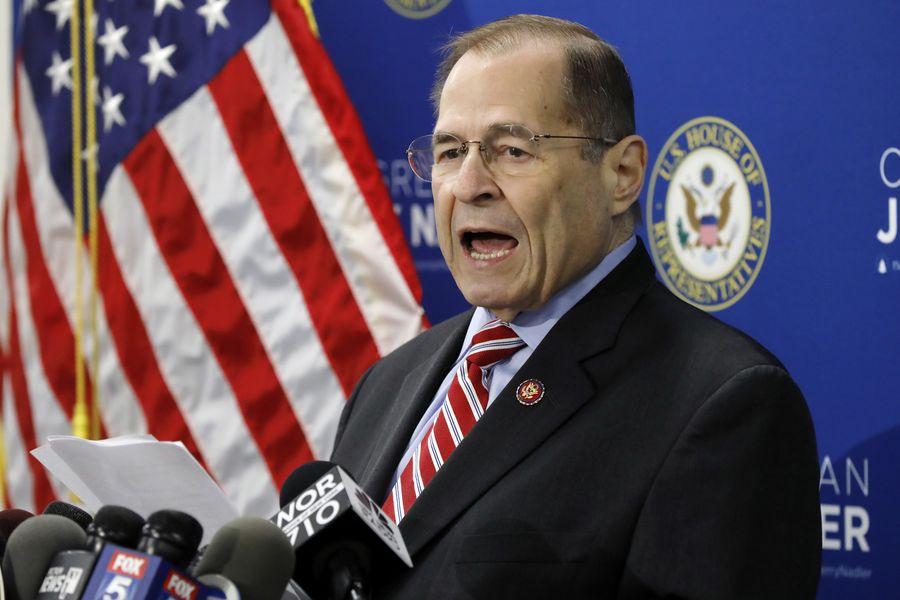
U.S. Rep. Jerrold Nadler, D-NY, Chairman of the House Judiciary Committee, speaks during a news conference, in New York, Wednesday, May 29, 2019. (AP Photo/Richard Drew)
Constitutional Oversight? Or Unconstitutional Overreach?
COMMENTARY
Published June 10, 2019 • Read time: 6m
Ronald Reagan often said, “The trouble with our liberal friends is not that they're ignorant; it's just that they know so much that isn't so.”
That seems to be the case — in spades — when it comes to their own importance. Unfortunately, as I’ve pointed out before, conservatives often accept liberal untruths without the proper level of scrutiny and skepticism.
Witness the current “accepted truth” that Congress has constitutional authority to exercise “oversight” on President Trump and his administration. Everyone says it and, in fact, the courts have granted Congress such oversight powers, but they are not found in the Constitution.
The fact of the matter is that under our constitutional system of checks and balances, the presidency has a certain independence from the Congress, just as Congress has a certain amount of independence from the president. Presidential independence is usually called executive privilege.
In the current confrontation, Congress has issued numerous subpoenas to either force testimony from executive office employees (including the president’s former lawyer Don McGahn) or to obtain documents such as the private tax returns of citizen Donald Trump or the underlying evidence that Special Counsel Mueller obtained in his two-year investigation. There is substantial reason to believe that most if not all of those subpoenas violate executive privilege, yet Democrats have publicly declared that the president’s legal defense of his privacy and his presidency amounts to a coverup.
Gavin Newsom's Misguided Redistricting Initiative
A Warning Against the Overuse of Sanctions
Open The Books on the California State Checkbook
Senate Passes Bill Addressing Heroin, Opioid Crisis
As one of many egregious examples, here was former Obama chief of staff Leon Panetta on the May 21 episode of “Hardball With Chris Matthews”:
”I can’t help but think that the president and the White House are just pushing themselves toward an impeachment by the way that they’re behaving. To take a blanket approach to absolutely no cooperation with the Congress when the Constitution makes clear that the Congress has oversight responsibility here and does have the right to look at the presidency to make sure that the presidency is abiding by the law of the land — to take a position that you’re not going to cooperate on any front is a slap in the face to our whole Constitution and its system of checks and balances.”
Sorry, Mr. Panetta, but the Constitution does not make clear anything about oversight responsibility. The theory of oversight responsibility in entirely the creation of the judicial branch and is not found anywhere within the four corners of the Constitution. Article I, Section 8, of the Constitution spells out the affirmative powers of Congress, mostly in rather restrictive, finite terms. Congress can borrow money. Congress can establish Post Offices. Congress can punish piracy. Congress can declare war. That sort of stuff. Nothing remotely close to oversight.
That’s because oversight is a so-called “implied” power — not to be confused with an “imaginary” power. It derives, we are told, from the “necessary and proper” clause included at the end of Article I, Section 8. That is also called the “elastic clause” because it has been stretched every which way to expand the power of Congress beyond recognition. Here is the full foundation on which the “oversight powers” of Congress rests:
“To make all Laws which shall be necessary and proper for carrying into Execution the foregoing Powers, and all other Powers vested by this Constitution in the Government of the United States, or in any Department or Officer thereof.”
Search as you will through the “foregoing powers,” however, you will not find any reference to anything remotely like oversight of the executive branch. As a matter of fact, there is absolutely no reference to the executive branch or the president in any of the preceding 17 clauses. Therefore, it cannot be “necessary and proper” for Congress to exercise oversight, nor ultimately does the power “to make all laws” needed to enforce congressional authority have any relevance to the desire of Congress to investigate the president’s private life and business.
If you are surprised that the Congress has such limited powers as spelled out in the Constitution, you may be relieved to know that under Article II, the president has even less to do. Although he is exclusively granted “executive power,” his constitutional role is limited to being commander in chief (but not declaring war), making treaties (but not without the concurrence of two-thirds of the Senate), appointing justices (but not without the consent of a Senate majority) and not much more. One of the few undiluted constitutional powers granted to the president, oddly enough, is the power of the pardon — the use of which by Trump has made Democrats furious. Again, you have to wonder whether any of them have even read the Constitution.
Take as one last example the Democrats’ attempt to criminalize the president’s private life prior to his election. In response to Matthews’ question about whether Trump could use executive privilege to block Congress from obtaining his tax returns, Panetta said that was a novel approach.
“I’m sure they’re going to try to figure out whatever excuse they can find not to reveal those tax returns. He’s obviously been trying to hide those for the last number of years. He’s going to continue to do it and he’ll find whatever excuse he can to fight it, but I think in the end this is one where the courts have a pretty clear path here in terms of the right of the Congress to get a copy of those tax returns.”
Yes, there is a law that says the chairman of the House Ways and Means Committee can confiscate the tax returns of any citizen without any showing of cause. But that does not, cannot and should not override the protections offered by the Constitution. In particular, the Fourth Amendment guarantees “the right of the people to be secure in their persons, houses, papers, and effects, against unreasonable searches and seizures.” Yet congressional committees have issued warrants to seize the banking, business and tax records of President Trump from his period as a private citizen. Under what pretense of “probable cause” could they possibly do so?
What is even more disturbing is that they have not even attempted to establish a probable cause. For a fishing expedition, you see, the only cause needed is that there might be fish in the water.

The Danger Before the Attack
Leslie J. Sullivan • RealClearPolitics
Jon Finer’s Old and Dangerous ‘New Approach’ to Israel
Peter Berkowitz • RealClearPolitics
The President Deserves Better
John Ullyot • RealClearPolitics
Congress Doesn’t Need Another Blame Game. It Needs To Find What’s Broken
Jarrod Bernstein • RealClearPolitics
Democrats Won the Midterms. Common Sense Won, Too
Jordanne Kemper • RealClearPolitics
The 120th Congress Shapes Up
Carolina Lumetta • RealClearPolitics
RCP Today
Top stories on RealClearPolitics
The Takeaway
Polling intelligence and analysis delivered to your inbox
World News
Featuring the latest world news
Policy
Featuring the latest policy news
Support Our Mission
As part of RealClearPolitics, authors aim to provide balanced, non-partisan analysis by presenting top reporting and commentary from all sides of the political spectrum.
Trusted by policymakers and citizens alike since 2000