
Pocketbook Issues Seen as Key to Middle-Class Voters
Published July 27, 2016 • Read time: 3m
PHILADELPHIA – With Hillary Clinton and Donald Trump both vying for the middle-class vote in November, one Democratic senator pointed Wednesday to four main concerns of that socioeconomic group that the candidates must address: wages, health care, education, and retirement.
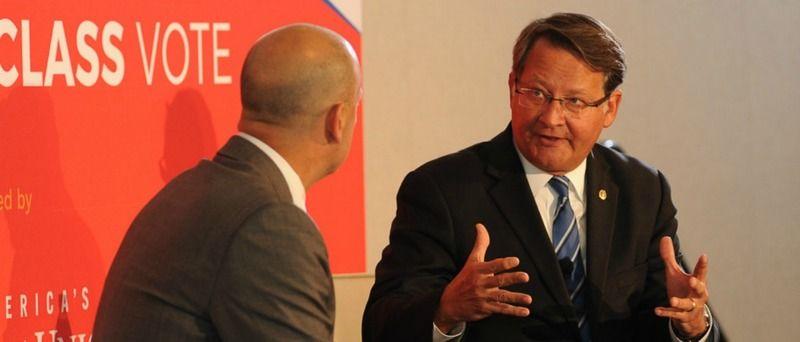
Michigan Sen. Gary Peters, speaking at a RealClearPolitics-sponsored event here, distilled a central issue for voters: “If you’re working hard, if you have a decent job,” you expect to be paid a “decent wage.”
Echoing this point was John Anzalone, a Democratic-aligned pollster who worked for Barack Obama during the 2008 and 2012 campaigns. “Most people go into that voting booth and vote their pocketbook,” he said, noting that “people don’t feel like there is upward mobility. They feel like they’re settling for jobs.”
“There’s a feeling that employers are not taking care of their employees,” Anzalone elaborated, “that [employees] are working harder than ever but their earnings are not going up.”
The event, titled “Decoding 2016: The Middle Class Vote,” also featured a panel discussion that included RCP associate editor and columnist A.B. Stoddard and senior elections analyst Sean Trende. It was moderated by RCP Executive Editor and Washington Bureau Chief Carl Cannon.
Jim Kessler, the third member of the panel and senior vice president for policy at Third Way, described the thinking of many in the middle class as “I’m not sure there’s a place for me in this economy. I might be doing okay right now, but I just don’t see a great future out there.”
The Empty Promises of Trump and Sanders
Good News for Discouraged Workers
A Vote for Trump Is a Vote Against American Consumers
First Lady Honors Pioneering Female Air Force Officer
“I think a lot of elected officials aren’t sure what to do,” Kessler said. “So, they’re going to fight [each other] and do nothing.”
Anzalone said the Clinton campaign will be “fleshing out of the solutions she has. But, quite frankly, I think you’re going to see more exposing of Trump’s” proposed solutions.
“His economic plans, the small ones that we know of, like his tax plan, are bad for the economy and bad for working people,” he said.
All participants also discussed the United States’ trade deals, including the Trans-Pacific Partnership and NAFTA, both of which have received sharp criticism from Trump. Clinton has denounced the TPP, although she was secretary of state during the initial stages of the deal’s negotiation and spoke highly of it at the time.
Peters is also opposed to the TPP, citing “serious concerns” that include the possibility of currency manipulation.
Kessler asserted that “the pro-trade [deal] side is losing,” adding that “what was hoped for from NAFTA didn’t quite materialize.”

The Danger Before the Attack
Leslie J. Sullivan • RealClearPolitics
Jon Finer’s Old and Dangerous ‘New Approach’ to Israel
Peter Berkowitz • RealClearPolitics
The President Deserves Better
John Ullyot • RealClearPolitics
Congress Doesn’t Need Another Blame Game. It Needs To Find What’s Broken
Jarrod Bernstein • RealClearPolitics
Democrats Won the Midterms. Common Sense Won, Too
Jordanne Kemper • RealClearPolitics
The 120th Congress Shapes Up
Carolina Lumetta • RealClearPolitics
RCP Today
Top stories on RealClearPolitics
The Takeaway
Polling intelligence and analysis delivered to your inbox
World News
Featuring the latest world news
Policy
Featuring the latest policy news
Support Our Mission
As part of RealClearPolitics, authors aim to provide balanced, non-partisan analysis by presenting top reporting and commentary from all sides of the political spectrum.
Trusted by policymakers and citizens alike since 2000