Forum: Addressing Cyber Deficiencies Would Fuel Job Growth
Published May 31, 2018 • Read time: 4m
Our technology seems to be slipping out of our hands. We are increasingly unable to anticipate its dangers and guard against its misuses. In 2016, we failed to keep our elections and political institutions safe from Russian hacking and disinformation. Our once-shining tech companies can no longer be trusted with our personal data or our attention. And China, with its long-term plan to conquer emerging technologies like artificial intelligence, threatens to steal America’s entrepreneurial birthright.
Many of these problems seem to stem from ignorance and incompetence. From Congress’s risible grasp of tech during Mark Zuckerberg’s Capitol Hill testimony this spring to a dearth of skilled workers needed to fill tech jobs in the public and private sectors, we are often blind to risks and ill-prepared for opportunities.
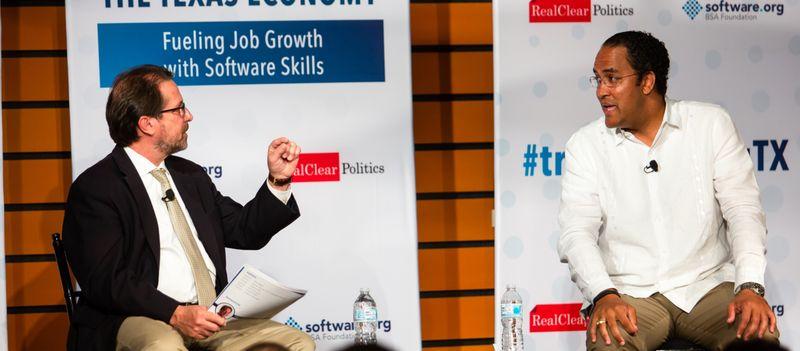
To address these problems, suggested Rep. Will Hurd at a forum Wednesday hosted by RealClearPolitics, the first thing we may need to do is reset our routers. The Texas Republican was warning attendees at the San Antonio event of a malware attack that emerged out of Russia over the Memorial Day weekend.
The theme of the gathering was both narrower and broader than that. Titled “Transforming the Texas Economy: Fueling Job Growth With Software Skills,” the forum explored how to take to advantage of the opportunities, and avoid the risks, presented by new technology, especially in San Antonio itself, a growing tech and cybersecurity hub. Hurd’s conversation with RCP Washington Bureau Chief Carl Cannon was part of a program that also included a panel featuring local leaders in the tech and education fields.
The Empty Promises of Trump and Sanders
Good News for Discouraged Workers
A Vote for Trump Is a Vote Against American Consumers
First Lady Honors Pioneering Female Air Force Officer
A former CIA agent (and one of just four members of Congress with a computer science degree), Hurd is a member of the House intelligence committee and chairs the Information Technology Subcommittee of the House Committee on Oversight and Government Reform. Traditionally, cybersecurity measures have moved forward on a bipartisan basis, but President Trump’s open and unprecedented criticisms of U.S. intelligence services have threatened to undermine that cooperation. Hurd (pictured) is convinced, however, that the consensus around the importance and urgency of cybersecurity will “survive hyper-partisanship.”
He is more worried about inertia and resistance to change within government bureaucracy itself. The federal government has a $90 billion software budget, but 85 percent is spent on maintaining vulnerable legacy systems, Hurd said. In 2015, over 20 million current or former government employees had their records stolen from Office of Personnel Management. Hurd has partnered on legislation with Illinois Democrat Robin Kelly to address some of these issues, including the Modernizing Government Technology Act signed into law at the end of last year, but more remains to be done.
The two-term lawmaker also cited outmoded procedures that leave us reacting to breaches rather than actively preventing them. In effect, Hurd said, “we do not have a counter-disinformation strategy.” Part of the problem, he noted, is that the 1947 National Security Act prevents the CIA from covert action on American soil. This means the “agency best able to cope with [disinformation]” is barred from doing so.
Finally, the lack of digital literacy on display during the Zuckerberg hearings remains a concern. But he’s confident that members of Congress will get up to speed because they must recognize that “data is now the coin of the realm and coding is the lingua franca.”
The public at large, Hurd emphasized, needs to get up to speed as well. That includes adults insufficiently wary of what they see and read online, and young people who, with the proper guidance and education, can take advantage of the 16,000 unfilled IT job openings in the federal government and many more in private industry. Hurd has partnered with the University of Texas at Austin to expose middle school students to computer science, but nationwide there is an educational lag.
Participants in Wednesday’s panel discussion agreed that one major challenge facing the technology sector is simply getting people to see the big picture and the wealth of opportunities available.

A RealClear Thanksgiving: Investing in a Better Future
David DesRosiers • RealClearPolitics
Trump’s Newsom Problem: Antagonist-in-Chief
Carolina Lumetta • RealClearPolitics
America’s Free Spirit
John Maxwell Hamilton • RealClearPolitics
The GOP Majority Should Go Out in Glory
Daniel McCarthy • RealClearPolitics
Republican Majorities Could Return Sooner Than Expected
J.T. Young • RealClearPolitics
The Danger Before the Attack
Leslie J. Sullivan • RealClearPolitics
RCP Today
Top stories on RealClearPolitics
The Takeaway
Polling intelligence and analysis delivered to your inbox
World News
Featuring the latest world news
Policy
Featuring the latest policy news
Support Our Mission
As part of RealClearPolitics, authors aim to provide balanced, non-partisan analysis by presenting top reporting and commentary from all sides of the political spectrum.
Trusted by policymakers and citizens alike since 2000