
Experts: Bridging Skills Gap Will Boost Old, New Economies
Published June 1, 2018 • Read time: 6m
A driving force in our politics and public conversations since the 2016 election has been the idea that large swaths of the country — the Rust Belt, the Midwest, rural America — have been overlooked by coastal elites. Fueling that narrative is the assumption that the 21st-century economy has left certain regions behind. But is it true?
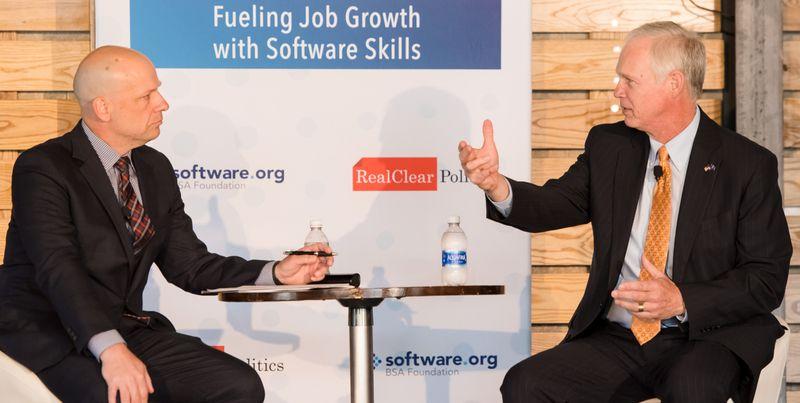
“When people say the word ‘software,’ they might not think of the Midwest. But … this is the place where software is booming,” Chris Hopfensperger, executive director of Software.org, told those gathered Thursday at a RealClearPolitics-sponsored event in Milwaukee. “The places where software is growing fastest? Indiana, Kansas … places like Wisconsin.” This flies in the face of conventional wisdom, which says that the digital economy thrives only on the coasts, with few exceptions, and associates “middle America” with rusted out factories and warehouses — emblems of yesterday’s economy.
The event, titled “Transforming the Wisconsin Economy: Fueling Job Growth With Software Skills,” challenged these notions by spotlighting technological and economic changes already taking place in the Badger State and looking toward what’s to come.
Part of the problem is the tendency to pit “traditional” sectors of the economy, such as manufacturing, against “new” ones, such as software. (Leave aside the fact that software is no longer “new”; Microsoft was founded almost half a century ago.) The reality is that, from construction and manufacturing to energy and transportation, “increasingly, software skills are a part of jobs in every sector,” as Hopfensperger put it. The digital economy isn’t leaving behind the old economy; the former is integrating into the latter, creating something new.
The Empty Promises of Trump and Sanders
Good News for Discouraged Workers
A Vote for Trump Is a Vote Against American Consumers
First Lady Honors Pioneering Female Air Force Officer
Still, there are challenges. “There’s no doubt there’s a certain level of skills gap in Wisconsin,” said home state Sen. Ron Johnson in a discussion with RCP founder and Executive Editor Tom Bevan. But “I think our biggest gap is a worker gap. We don’t have enough workers” with the technical skills to fill jobs in both “old” and “new” sectors of the economy.
The problem goes well beyond Wisconsin. The Republican lawmaker attributes this to “two primary causes.” The first is that
we tell all of our kids, for decades now, that you have to get a four-year degree, which is great if you know what you want to do with that four-year degree, fine. But you have two-year degrees, you have technical college, you have just going into the workforce — into manufacturing, where so many manufactures will actually pay for your education. So, I think we’ve done our children a huge disservice, pretty well saying “You’ve got to get a four-year degree.” What does that imply about going into manufacturing?
The result is that these careers are given “second-class status.” The second cause, Johnson continued, is that “we pay people not to work.” The growing dependence of able-bodied adults on welfare programs, he asserted, is one reason why “we have seen a decline in the labor-force participation rate,” resulting in fewer potential workers to fill the worker gap. To address these problems, we must emphasize that “all work has value.” As he put it:
The way you actually pursue happiness, which is one of our God-given rights — the pursuit of happiness — is through the dignity of earning your own success, and that generally is working. And it doesn’t necessarily have to be in the profit-making private sector; it can be nonprofit, it can be in public service. But people need to have that sense of personal value, of contributing to … their families and their communities.
America also has a demographics problem. “An economy is two things,” said the two-term senator, “human capital combined with financial capital.” There’s plenty of the latter; what’s lacking is the former. “Our birthrates are not where they need to be to grow an economy the way we want to.” So part of the solution will have to be immigration: “We have to welcome in immigrants, but we have to have a much more rational immigration system,” one that is more skills-based.
Another part of the solution, he noted, is education. “We need our education system to be more adaptive,” he said. That means not only encouraging two-year and technical degrees, but also leveraging technology in creative ways. “We are still on a 19th-century model of education,” especially when it comes to K-12 education. At the college level, Johnson thinks that the overemphasis on four-year degrees, fueled by federal financial assistance, has resulted in unsustainable levels of student debt.
The participants in two expert panels that followed his comments concurred that America is facing a skills gap and that our education system has to catch up. But some of the panelists disagreed with the senator’s characterization of that system.
Ray Cross, president of the University of Wisconsin system, conceded that we’ve made “mistakes” in the way we discuss higher education, especially by overemphasizing the importance of four-year degrees. He pointed to a recent Georgetown study showing that “since the recession … 95-plus percent of the jobs that have been created since then or that have been open since then have required some college … and that’s an incredibly important difference than before.” Those without degrees were particularly hard hit by the recession, and their recovery has lagged behind others. It seems worth noting that voters from this demographic played a key role in Donald Trump’s success in 2016.
But Cross also pointed out that student debt may not be as big of a problem as is often suggested. In Wisconsin, at least, the “average debt for college students,” including those who attend private colleges, “is roughly $30,000” — less than what “most people” will “pay for a car.” What’s more, the “default rate is very very low for Wisconsin students.” This suggests, he said, that four-year college remains “an incredibly good buy for the return on investment.”
Lastly, Cross pushed back against the idea that the only reason people go to college is to get a job. If that’s the only reason, he said, “then we’re failing in a number of ways.” College should of course prepare students to participate in the economy, but it’s also a process of self-discovery, one that helps students “figure out how to fit into” a given community and to “function as part of team.” Cross thinks it’s important not to reduce education to training: “We train animals; we educate people.”

The Danger Before the Attack
Leslie J. Sullivan • RealClearPolitics
Jon Finer’s Old and Dangerous ‘New Approach’ to Israel
Peter Berkowitz • RealClearPolitics
The President Deserves Better
John Ullyot • RealClearPolitics
Congress Doesn’t Need Another Blame Game. It Needs To Find What’s Broken
Jarrod Bernstein • RealClearPolitics
Democrats Won the Midterms. Common Sense Won, Too
Jordanne Kemper • RealClearPolitics
The 120th Congress Shapes Up
Carolina Lumetta • RealClearPolitics
RCP Today
Top stories on RealClearPolitics
The Takeaway
Polling intelligence and analysis delivered to your inbox
World News
Featuring the latest world news
Policy
Featuring the latest policy news
Support Our Mission
As part of RealClearPolitics, authors aim to provide balanced, non-partisan analysis by presenting top reporting and commentary from all sides of the political spectrum.
Trusted by policymakers and citizens alike since 2000