
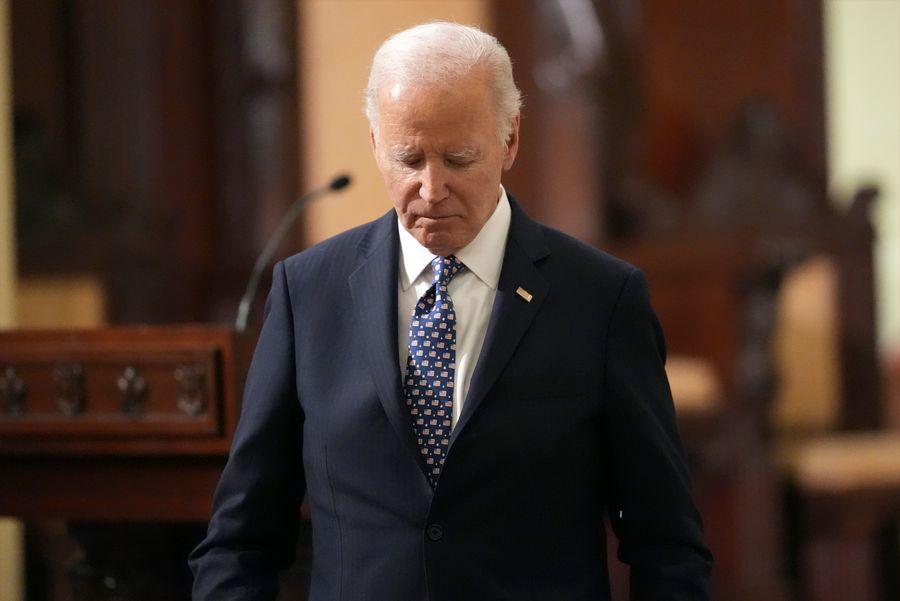
New Orleans Car Into Crowd Biden
President Biden Promised a Bridge but Left a Gulf
COMMENTARY
Published Jan. 15, 2025 • Read time: 5m
When historians look back at Joe Biden’s presidency, they will see failure wrapped in good intentions, marked most poignantly by the absence of a succession plan. Getting old is not a crime – it happens to every mortal. But Biden’s unwillingness to face that fact of life, and to choose a vice president accordingly, was a blunder that undermined his inability to lead effectively and will impair his legacy.
Elected in 2020 as a bridge to the next generation, Biden will instead be remembered as a leader who failed to prepare for the future, leaving his party and the nation in a precarious position despite his legislative achievements.
Biden’s presidency began with high expectations. Americans hoped for a seasoned operator to navigate the turbulence of COVID-19 amid debilitating political divisions and global uncertainty. Biden promised to heal the country’s wounds and lay the groundwork for a new generation, declaring, “This is a time to heal in America” during his inauguration. Yet, as his term ends, his missing succession plan stands as the most glaring indictment of his presidency.
Succession planning is a hallmark of effective leadership, and history offers examples of its importance. As Joe Biden has mentioned publicly, Franklin D. Roosevelt was president when he was born. Biden is proud of his birth president and has made no secret of his attempts to emulate him in various areas of domestic policy. But Biden ignored an essential element of Roosevelt’s example. In 1944, FDR realized that Vice President Henry Wallace was an unsuitable successor and turned to party elders to help find a running mate. That man, Harry Truman, was an exceptional commander-in-chief who brought World War II to a victorious conclusion and launched the Marshall Plan to win the peace.
BART Is Not a Homeless Shelter
Thank Gridlock for Economic Turnaround
Infrastructure Is Not the Problem
Take the Public-Private Road to Efficiency
Joe Biden, in contrast, selected Kamala Harris, a junior senator with limited national experience, who had failed to inspire voters when she ran in 2020 – a campaign in which she portrayed Biden himself as a racist. Yes, campaigns can be tough, but after she was installed as Biden’s vice president, he neglected to cultivate her as a viable successor.
Biden’s reluctance to step aside well ahead of the 2024 election further compounded this failure. Facing a potential rematch with Donald Trump, he could have elevated his stature by allowing the Democratic Party – through democratic means, i.e., primary elections – to pass the torch to a younger, more dynamic leader. The Democratic bench was strong, boasting talents like Gretchen Whitmer, Gavin Newsom, Pete Buttigieg, and Josh Shapiro.
This failure reflects a broader issue in American politics: the absence of institutionalized succession planning. In business, future CEOs are groomed. Even in monarchies, heirs are prepared. In professional sports, rising talent is cultivated. Yet political transitions often lack strategic foresight. Biden’s presidency exemplifies the dangers of an ad hoc approach that is too dependent on personal ego and ambition – and focuses too heavily on winning the next election.
After his disastrous June 27 debate performance, Biden was felled by friendly fire: Democrats worried about holding onto the White House – and their own offices – invoked flattery to induce him to leave. They invoked President Lyndon Johnson, who, buffeted by the unpopular Vietnam War, announced he wouldn’t run again. But this analogy wasn’t quite right. Johnson stepped aside in time for a terrific field to form: Eugene McCarthy, Bobby Kennedy, Hubert Humphrey.
Because of his failure to do the same in a timely way, generational renewal, a cornerstone of Biden’s 2020 campaign promises, remained unrealized. Despite early signals of his intent to serve as a transitional figure, Biden clung to power, alienating younger voters and deepening the disconnect between government and the next generation.
In the annals of history, Biden’s tenure will likely be framed as the baloney in the Trump sandwich, wedged between the two tumultuous terms of Donald Trump. While Biden achieved some legislative wins, including a sorely needed infrastructure bill, these accomplishments are overshadowed by his failure to prepare the nation for what comes next. Instead of building a bridge to the future, Biden’s leadership left a chasm of uncertainty.
The consequences extend beyond the Democratic Party. Biden’s inability to usher in a generational shift turned off younger voters and contributed to a broader disenchantment with traditional political leadership. This disengagement threatens to widen the divide between established parties and the electorate, creating fertile ground for fringe movements and anti-establishment candidates.
Biden’s place in history will be further diminished by comparisons to other one-term presidents who either recognized their limitations or rose to meet the moment. Biden’s tenure will be remembered as a missed opportunity – a presidency defined by promises unfulfilled and potential unrealized.
Even his most ardent supporters may struggle to articulate the Biden doctrine or identify a unifying theme of his presidency. Was he the president who brought the country together? The leader who tackled systemic issues? Or merely a placeholder in a turbulent era? The lack of clarity around his legacy is a testament to the country’s final memory of Biden’s debate performance when his leadership could only be described as confused.
Leadership is not merely about managing the present; it is about preparing for the future. By failing to do so, Biden has left his party vulnerable and the nation at a crossroads.
Ultimately, Joe Biden will be remembered as a president who promised a bridge but left a chasm. His presidency stands as a cautionary tale about the perils of clinging to power, the importance of succession planning, and the need for visionary leadership in times of crisis. The history books will document a presidency of unfulfilled promise and a legacy defined by what could have been.

Democrats Won the Midterms. Common Sense Won, Too
Jordanne Kemper • RealClearPolitics
The 120th Congress Shapes Up
Carolina Lumetta • RealClearPolitics
Flooding GOP Primaries With Democrats
Robert Natelson • RealClearPolitics
Washington Keeps Rewarding Oracle—Veterans Keep Paying the Price
Darin Gaub • RealClearPolitics
The Seeds of Unrestricted Warfare
John Teichert • RealClearPolitics
The Primary System Is Losing the Next Generation
Sean Trende • RealClearPolitics
RCP Today
Top stories on RealClearPolitics
The Takeaway
Polling intelligence and analysis delivered to your inbox
World News
Featuring the latest world news
Policy
Featuring the latest policy news
Support Our Mission
As part of RealClearPolitics, authors aim to provide balanced, non-partisan analysis by presenting top reporting and commentary from all sides of the political spectrum.
Trusted by policymakers and citizens alike since 2000