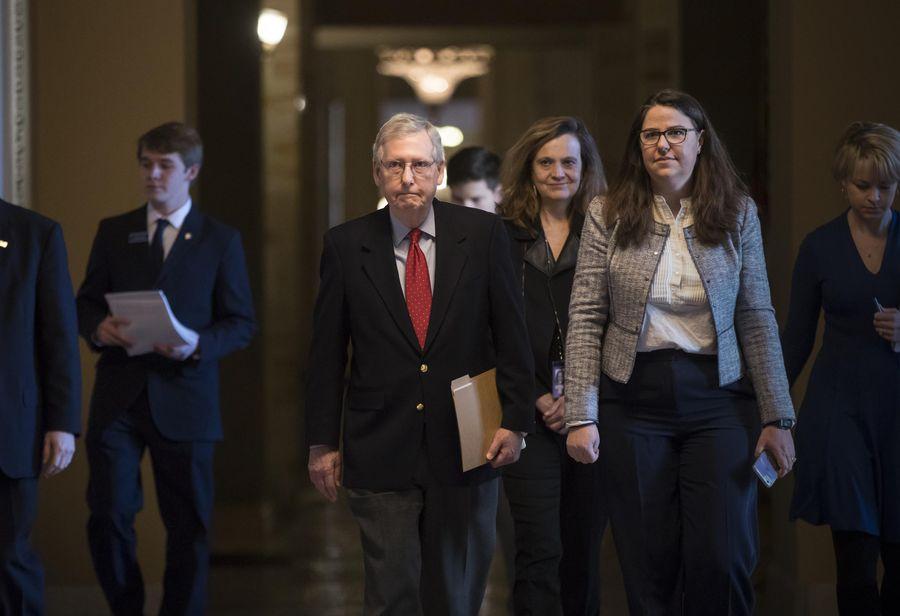
Senate Majority Leader Mitch McConnell, R-Ky., walks to the chamber on the first morning of a government shutdown after a divided Senate rejected a funding measure last night, at the Capitol in Washington, Saturday, Jan. 20, 2018. (AP Photo/J. Scott Applewhite)
Four Resolutions for 2018
COMMENTARY
Published Jan. 21, 2018 • Read time: 4m
Closing 2017, Republicans were breathing a sigh of relief: Tax reform had been signed, the federal government remained open, and the stock market was soaring.
That’s not an impressive list.
Washington is a one-party town and while tax reform is essential, alone it won’t uncork the American economy. In 2018, Congress must resolve to boost infrastructure spending, advance immigration reform, create an education system that fits our new world, and pass a visionary jobs bill.
Poor infrastructure harms U.S. competitiveness—the United States ranks ninth in the World Economic Forum Global Competitiveness Index—and it keeps growing companies away from places hungry for jobs. Amazon isn’t going to build their new headquarters in a decaying city.
NAIOP, the Commercial Real Estate Development Association, has offered some solutions, including using public-private partnerships (P3s). President Trump has abandoned P3s. That’s shortsighted. With $20 trillion in debt, the federal government alone can’t fund this priority and states are in trouble too. We need greater private sector involvement in infrastructure.
On immigration, Congress must focus on addressing the U.S. labor shortage, not on building a wall. That means giving hard-working DACA recipients a shot at citizenship and then moving on to comprehensive reform.
Major U.S. industries, including construction, face devastating worker shortages, which impede everything from disaster recovery to growth. The U.S. government should welcome any individual who has the skills or work ethic to fill one of our nation’s nearly 6 million unfilled jobs. Last August, Canada launched a matching program that ranks foreign-born applicants against positions employers have open. The U.S. government, and every state, needs something similar.
BART Is Not a Homeless Shelter
Thank Gridlock for Economic Turnaround
Infrastructure Is Not the Problem
Take the Public-Private Road to Efficiency
The lack of construction workers drives up U.S. housing prices, putting homeownership out of reach for some. Immigration reform will help more families achieve the American Dream.
We also need to rethink K-12 education. Our economy is undergoing a revolution, but our schools are built for the last one.
The IMD World Competitiveness Center’s global ranking examines how effective countries are at attracting, developing, and retaining talent. We’re 16th. IMD said the United States “risks losing some of its global competitiveness” if we don’t increase education investment. While more taxpayer money isn’t the only solution, starving the U.S. Education Department without a reform plan also won’t work. Lack of opportunity drives decay. It’s partly responsible for our devastating opioid epidemic. Hope begins at the schoolhouse doors, and so does a plan to rebuild our middle class.
We also need a visionary jobs bill focused on training and relocation. The GOP’s tax bill ended the program that allows Americans to deduct job-related moving expenses. We have a labor mobility problem in this country and, while I supported this legislation, that provision takes us backward. It must be fixed. Congress must make it easier, not harder, for individuals take a job in another state.
Policymakers also must provide better incentives for retraining. Today, new opportunities in core industries like manufacturing and construction are highly technological. To bring Americans back into these sectors, we need to give them the ability to participate in our digital transformation. Industry leaders also need to better communicate our opportunities to students and parents. Construction isn’t just about brawn anymore—we need programmers and engineers, and we’ll pay for them.
Given that 2018 is a midterm year, I doubt Republicans will get all this done. There is precedent for action, however. As the Bipartisan Policy Center noted, Bill Clinton signed welfare reform in August 1996 and was easily re-elected 10 weeks later; Ronald Reagan signed tax reform in a midterm cycle; and LBJ signed the Civil Rights Act in July 1964 and won in a landslide that November.
If election year inertia does take hold, it’s not an excuse. After Democrats’ disastrous 1984 and 1988 elections, where their presidential nominees suffered humiliating losses, moderates in that party advanced a more centrist agenda that carried Clinton into office in 1992.
Ideas work, and they get people to the polls.
The tax bill isn’t perfect, and it won’t uncork the economy on its own. Whichever party pushes for creative solutions to address infrastructure, immigration, education, and labor mobility and retraining deserves to win next November.

A RealClear Thanksgiving: Investing in a Better Future
David DesRosiers • RealClearPolitics
Trump’s Newsom Problem: Antagonist-in-Chief
Carolina Lumetta • RealClearPolitics
America’s Free Spirit
John Maxwell Hamilton • RealClearPolitics
The GOP Majority Should Go Out in Glory
Daniel McCarthy • RealClearPolitics
Republican Majorities Could Return Sooner Than Expected
J.T. Young • RealClearPolitics
The Danger Before the Attack
Leslie J. Sullivan • RealClearPolitics
RCP Today
Top stories on RealClearPolitics
The Takeaway
Polling intelligence and analysis delivered to your inbox
World News
Featuring the latest world news
Policy
Featuring the latest policy news
Support Our Mission
As part of RealClearPolitics, authors aim to provide balanced, non-partisan analysis by presenting top reporting and commentary from all sides of the political spectrum.
Trusted by policymakers and citizens alike since 2000