
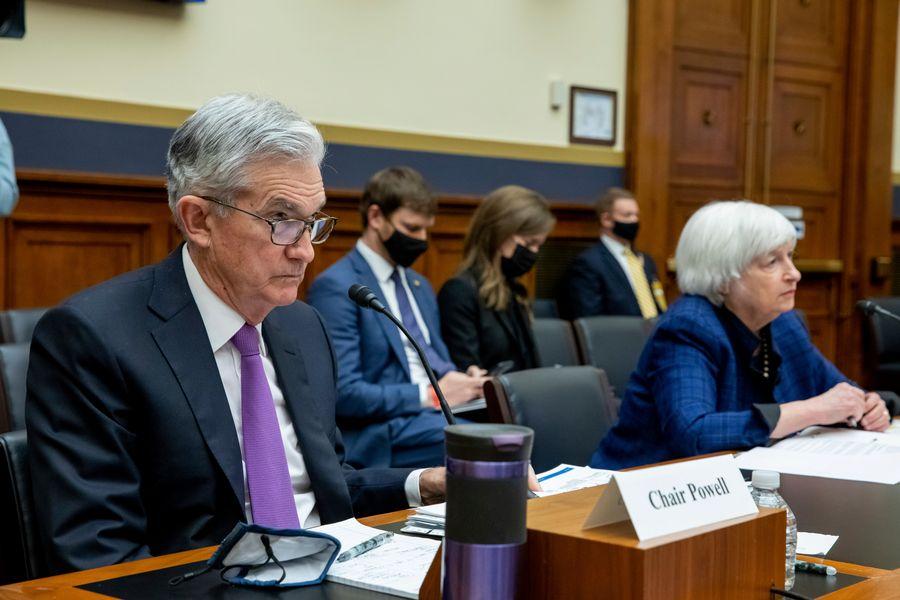
Congress Powell Yellen
The Fed Can't Control Inflation Without Massive Debt Relief
COMMENTARY
Published Jan. 2, 2022 • Read time: 4m
In the second week of December, the Bureau of Labor Statistics reported that the price of almost everything (except plane tickets) went up dramatically since 2020. This price inflation has hit food, housing, gas and other essentials at a clip not seen since “stagflation” in the 1970s and early ’80s.
The difference now is that we’re fighting with our hands tied behind our back, because meaningful interest rate increases – which are kryptonite for inflation – are currently impossible.
How Did We Get Here?
In times of high inflation, the Federal Reserve usually raises interest rates. This limits the money supply, meaning fewer dollars are available to chase up the price of goods and services, and prices tend to stabilize or fall. In this sense, the economy is like an auction, and dollars are the bidders. Fewer bids, lower prices.
This kind of belt-tightening can lead to unemployment and recessions, as occurred in 1980-82, but letting inflation run amok can have far worse consequences. Perhaps the worst case took place in Weimar Germany, where hyperinflation contributed to political extremism and peaked shortly before Hitler’s attempted coup, the Beer Hall Putsch. Then there is present-day Turkey, where massive inflation has led to widespread protests and a thriving black market for other currencies. It has even screwed up the supply chain for Nutella.
So, interest rates can be an important policy tool, but raising them becomes dangerous and untenable when there is too much debt in the system. And this is exactly where we are now.
Debt Explosion
In 2007, the federal government had borrowed a total of $9 trillion and paid about 5% interest on it, with an annual interest total of $450 billion. Today, it owes $29 trillion at 1.6%. Annual interest: $464 billion. It’s a neat trick racking up debt without paying more for it, but it leaves us vulnerable. For every one-percentage-point increase in rates, the interest payment will go up by $290 billion or more per year. That’s nearly half of the annual U.S. military budget – unless we start reducing the debt.
This risk is multiplied by other forms of debt, including mortgages, car loans, student loans, municipal and corporate debt, and financial leverage. Altogether, the total is in the ballpark of $100 trillion, much of which needs to be rolled over or refinanced on a regular basis, just like the federal debt. At least $2 trillion of this belongs to "zombie companies" that cannot make ends meet without borrowing more at ultra-low rates, and there are many near-zombie companies yet to come out of the woodwork.
As a result, the Fed has largely lost control of its most powerful tool against inflation. Yes, it plans to raise rates in 2022, but given the size of our collective debt, each minuscule bump is like trying to fix an electrical outlet with the power turned on.
What We Can Do
The Fed will try to thread the needle, but there is no room for error. If rates remain too low, it will further fuel inflation and asset bubbles, punishing already-beleaguered savers. On the other hand, raising rates too much could trigger a recession and a tidal wave of insolvency.
Unfortunately, these straits may be too narrow to navigate. In 2019, the then-interest rate of 2.5% helped spark a global dollar shortage, prompting bank bailouts and several rate decreases. That’s a far cry from the U.S. historical average of 5%, and worlds away from the Fed’s response last time inflation was this high (1977-1982), which saw rates ranging from 10% to 20%. For context, the Fed’s targeted range today is 0% to 0.25%.
Our current inflation is also related to global supply chain disruptions, which could abate and provide some relief, but experts warn that could take up to two more years. Or longer, depending on the severity of the pandemic and U.S.-China trade relations.
In the meantime, we as a society should look for ways to reduce debt, such as ending corporate tax breaks on interest, which incentivize ever-larger borrowing. And we must channel spending – such as the Build Back Better plan – toward productive projects such as genuine infrastructure improvements that would reduce the costs of transportation and energy. This would pay huge dividends, both financially and socially, and it may be the only way to resolve the interest rate dilemma and prevent runaway inflation.


RCP Today
Top stories on RealClearPolitics
The Takeaway
Polling intelligence and analysis delivered to your inbox
World News
Featuring the latest world news
Policy
Featuring the latest policy news
Support Our Mission
As part of RealClearPolitics, authors aim to provide balanced, non-partisan analysis by presenting top reporting and commentary from all sides of the political spectrum.
Trusted by policymakers and citizens alike since 2000