
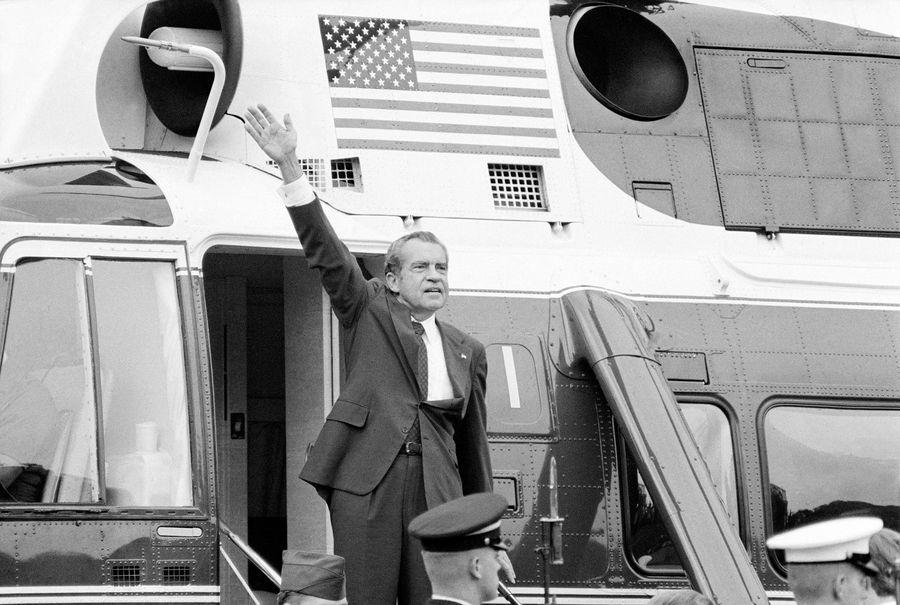
Nixon Waving Farewell
Memories From 50 Years Ago: Nixon Leaves Town
PURPLE NATION
Published Aug. 9, 2024 • Read time: 9m
“Look, kids…there’s no one here.”
I am sitting in a small library room in the grand Daughters of the American Revolution Constitution Hall, not too far from the White House. As I later learned, this room was chosen to look like the small White House library, which is located on the ground floor of the main residence where the president and the first lady live.
It was January or February 2002.
I had been seated in front of a camera, with microphones hanging over my head and a half-dozen production staff surrounding me and the cameras. I was about to be interviewed for a special documentary episode of the popular TV show, “The West Wing,” created and produced by the brilliant Aaron Sorkin.
The idea of the documentary was to interview prior U.S. presidents and their White House aides, interspersed with episodes from Sorkin’s hit show, which ran in prime time on NBC from September 1999 to May 2006. Mixing reality with fiction, using inspirational moments, was the concept of conveying the magic of working in the White House.
I was invited to be interviewed for a “special” episode of the show with this mixture of fiction and reality. The invitation was thanks to Dee Dee Myers, who had served as President Clinton’s first press secretary in his first term. After her White House service, Dee Dee had become one of several political consultants to Sorkin on scripts and story ideas for West Wing episodes.
Sometime in the autumn of 2001, Dee Dee called to ask if I would be willing to be interviewed for this special segment of the West Wing. She said that Aaron Sorkin was interested in some of my stories about “crisis management” in the White House when I worked for President Clinton as his special counsel from 1996 to 1998. They wanted me to think of uplifting, inspirational stories, the overall theme of the West Wing special about working in the White House.
Rethinking the Pledge; Trump and Women; One Last Egg Roll; Eulogizing Ike
2016: A Repeat of the 1960s
An Apology, Fashioned for Nancy Reagan
Nancy Reagan, Guardian of a Legacy
Of course I said yes. So there I was in front of the cameras, trying my best to tell stories that would interest the audience, hoping to impress Sorkin and his producers enough that they would include one of my tales in the final version that would air on NBC.
I picked a few I thought were most entertaining. For example, I told the story about my leak to the Associated Press about President Clinton allowing big donors to stay overnight in the Lincoln Bedroom to reward them for large financial donations to the Democratic Party during his 1996 reelection campaign. Preempting a media-feeding frenzy by getting out ahead of the story, I explained, was our strategy to deflate the revelations by congressional Republicans, who planned summer nationally televised hearings on their claims of fund-raising abuses.
When I was done with my behind-the-curtain reveal about White House crisis management, I looked around to try to assess the reaction. There was silence in the room.
“Well,” I asked, “how did I do?”
More silence.
Finally, the producer of my interview said something like: “Honestly, we can’t use any of this, Lanny. You see, Mr. Sorkin wants this special West Wing segment to be uplifting, inspirational. But all your stories are … well … depressing.”
I don’t think we can use any of it. It felt like a gut punch. I panicked. I had already called family and friends and told them I might be part of a West Wing special episode. Everyone was excited. Now I realized I had struck out. Minutes passed. I sat and watched the camera crew production staff packing up.
But then I had an idea. I remembered one inspirational moment involving the White House, although it was more than two decades before I served there for President Clinton. I decided to pitch it anyway.
I turned to the producer and told him I did have a story about the White House, but it occurred more than 20 years before I worked there for Clinton. But I found it very inspirational and memorable, to me at least. I started to tell him without asking his permission. It occurred on Aug. 9, 1974, the night Richard Nixon resigned from the presidency and left Washington shortly after noon, famously waving goodbye as he boarded Marine One.
This was the first president of the United States forced to resign because he was told by Republican leaders he had no chance to avoid impeachment by the House and conviction and removal by the Senate. The producer sat listening to me while others continued packing up.
So, I told the producer sitting in front of me that on that night, Aug. 9, I got home at about 10 p.m. and told my then-wife, Elaine, my idea: I wanted to wake the kids (daughter, 6; son, 4) and take them to the White House to be there for this memorable moment in U.S. history. And I asked her to come with me.
Naturally, she thought I was crazy and said, don’t wake the kids – you can go if you want to. Naturally, I ignored her advice. I picked up both children sound asleep in their beds, as they moaned and groaned, and carried them to the back seat of the car, where they immediately fell back to sleep.
Thirty minutes or so later, I turned the corner on 17th Street onto Pennsylvania Ave. and stopped in front of 1600 – the beautiful, brightly lit, white-columned North Portico of the White House. In those days, there were no barriers, so you could drive in front and sit in a car at the curb. I was astounded by what I saw. Actually, by what I did not see. I looked around in amazement. I was the only car at the curb. Suddenly, it hit me.
There’s no one here! And this is what I told the producer:
On the day Richard Nixon resigned… At 10 o’clock at night, I drove [my daughter and son] downtown and parked in front of the White House. And I said to them, “Look, there’s no one here. There isn’t a soldier, there isn’t a policeman, there isn’t a gun anywhere to be seen. The most powerful person on the planet left this place on his own…because of the rule of law.”
Now that may be corny, but I said to myself, “God bless America that made a system like this where there is no military that I can find.” And I turned around, proud of my eloquence, and they were both sound asleep!
I looked at the producer to see what he thought of my story. I hoped that if he found it as inspirational as I had remembered it, he would let me repeat it on camera before everyone unplugged everything and went home.
The producer stared at me. Then I noticed, for the first time, everyone in the room, who had been packing up, had stopped to listen.
Then the producer said: “That’s a take.”
“What?” I asked. “What do you mean, ‘a take?’ I can repeat it on camera if you want.”
For the first time in our session, he smiled. Then he said something like: “The camera was running, Lanny. You were looking at me, but the camera was running. You didn’t know. The microphone was kept live above you. Your story is amazing. You don’t need to repeat it. It will never be as good the second time as what you just did without knowing we were taping. In fact, you were better because you didn’t know. I think Aaron will love it.”
I was delighted. And hopeful.
Several months later, on April 23, 2002, my then-wife Elaine and I were watching the special documentary “West Wing” episode. (Season 3, Episode 19). By then, I had been told that my story about my 1974 visit to the White House with my sleeping young children might make the cut.
The entire segment, another Aaron Sorkin brilliant concept and execution, was widely watched (and re-watched over the years) and won an Emmy award. It included interviews of three presidents (Jimmy Carter, Jerry Ford, and Bill Clinton) and others who served as senior staff in the White House, such as Dee Dee Myers; Paul Begala, former Clinton political counselor; Leon Panetta, former Clinton chief of staff; and David Gergen, who had advised Presidents Nixon, Ford, and Clinton. Interspersed with these interviews were segments from the fictional West Wing TV show, brilliantly relating to the comments made before and after by the former presidents and White House officials.
I checked my watch. The hour for the segment was almost over. It seemed my story about my crazy trip to the White House with my two young children hadn’t made the cut. My heart sank. Then, as the background music grew towards what seemed to be an inspirational ending of the episode, suddenly, there I was, a full-faced close-up shot, telling my story, with the final line: “The most powerful person on the planet left this place on his own…because of the rule of law….”
For weeks, months, and years, even into this year, I still receive calls from people who have seen the segment – now available streaming online. I received a thank you letter from Aaron Sorkin himself, which I placed on the wall of our home office. I also got a call from my son Seth, now all grown up, who had watched the segment. Did you like it? I asked. He said something like: Dad, you were great. Just so you know. You completely made that story up.
I laughed, a little bit painfully.
“How would you know – you were fast asleep!”
He laughed and admitted I had a point.
Little could I ever imagine on that night when I made my speech to my sleeping kids that, about 50 years later, a president of the United States would deny the results of an election without evidence and ignore our Constitution and the rule of law. And not leave the office quietly or peacefully. And the same now-former president would be running again and still refuses to concede he lost the 2020 election and is still coy when asked if he’ll accept the will of the voters to abide by the U.S. Constitution – and the bedrock principle of the rule of law.
Democrats Won the Midterms. Common Sense Won, Too
Jordanne Kemper • RealClearPolitics
The 120th Congress Shapes Up
Carolina Lumetta • RealClearPolitics
Flooding GOP Primaries With Democrats
Robert Natelson • RealClearPolitics
Washington Keeps Rewarding Oracle—Veterans Keep Paying the Price
Darin Gaub • RealClearPolitics
The Seeds of Unrestricted Warfare
John Teichert • RealClearPolitics
The Primary System Is Losing the Next Generation
Sean Trende • RealClearPolitics
RCP Today
Top stories on RealClearPolitics
The Takeaway
Polling intelligence and analysis delivered to your inbox
World News
Featuring the latest world news
Policy
Featuring the latest policy news
Support Our Mission
As part of RealClearPolitics, authors aim to provide balanced, non-partisan analysis by presenting top reporting and commentary from all sides of the political spectrum.
Trusted by policymakers and citizens alike since 2000