
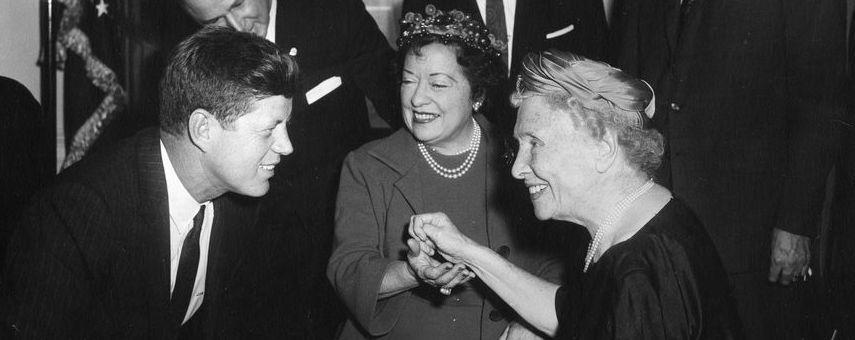
Helen Keller's Powerful Pitch for Braille Books
Published March 27, 2020 • Read time: 3m
The 20th in a series of articles commemorating Women's History Month by spotlighting a significant speech or testimony delivered by a woman in the U.S. on this date.
Helen Keller had spoken to many state legislatures, but this was her first appearance in Congress. She was there to support a federally financed program to create Braille books for blind adults. “Books are the eyes of the blind,” she told the nation’s lawmakers. And she asked them to close their eyes and, for a few moments, imagine the world of the blind.
It would take another year of congressional wrangling before President Herbert Hoover signed the Pratt-Smoot Act authorizing the Library of Congress to create and circulate Braille books to adults with vision loss — later known as the National Library Service for the Blind and Print Disabled.
Books Are the Eyes of the Blind
By Helen Keller
March 27, 1930 — Committee on the Library, U.S. House of Representatives, Washington, D.C.
Mr. Chairman, and friends, the bill which you have under consideration today asks for an appropriation to supply Braille books to a class of persons who, through no fault of their own, are unable to read regular print. I hope the bill passes. Giving the blind worthwhile books is a practical way of helping them to overcome their handicap. Indeed, it is far more than a practical measure; it partakes of the nature of a boon.
Books are the eyes of the blind. They reveal to us the glories of the light-filled world, they keep us in touch with what people are thinking and doing, they help us to forget our limitations. With our hands plunged into an interesting book, we feel independent and happy.
Have you ever tried to imagine what it would be like not to see? Close your eyes for a moment. This room, the faces you have been looking at — where are they? Go to the window keeping your eyes shut. Everything out there is a blank — the street, the sky, the sun itself! Try to find your way back to your seat. Can you picture who is sitting in that chair, day in and day out, always in the dark gazing back of you? What you would not give to be able to read again! Wouldn’t you give anything in the world for something to make you forget your misfortune for one hour? This bill affords you an opportunity to bestow this consolation upon thousands of blind men and women in the United States.
Rethinking the Pledge; Trump and Women; One Last Egg Roll; Eulogizing Ike
2016: A Repeat of the 1960s
An Apology, Fashioned for Nancy Reagan
Nancy Reagan, Guardian of a Legacy
When you closed your eyes just now you were assuming the sable livery of the blind, knowing all the time how quickly you could fling it aside. You felt no heavier burden than a grateful sigh that your blindness was a mummery. We who face the reality know we cannot escape the shadow while life lasts. I ask you to show your gratitude to God for your sight by voting for this bill.
I thank you.
Source: Books for the Adult Blind: Hearing Before the Committee on the Library, House of Representatives, 71st Congress, 2d Session, on H.R. 9042, March 27, 1930 (Washington DC: US Government Printing Office), 1930, pp. 21-22.

The Danger Before the Attack
Leslie J. Sullivan • RealClearPolitics
Jon Finer’s Old and Dangerous ‘New Approach’ to Israel
Peter Berkowitz • RealClearPolitics
The President Deserves Better
John Ullyot • RealClearPolitics
Congress Doesn’t Need Another Blame Game. It Needs To Find What’s Broken
Jarrod Bernstein • RealClearPolitics
Democrats Won the Midterms. Common Sense Won, Too
Jordanne Kemper • RealClearPolitics
The 120th Congress Shapes Up
Carolina Lumetta • RealClearPolitics
RCP Today
Top stories on RealClearPolitics
The Takeaway
Polling intelligence and analysis delivered to your inbox
World News
Featuring the latest world news
Policy
Featuring the latest policy news
Support Our Mission
As part of RealClearPolitics, authors aim to provide balanced, non-partisan analysis by presenting top reporting and commentary from all sides of the political spectrum.
Trusted by policymakers and citizens alike since 2000