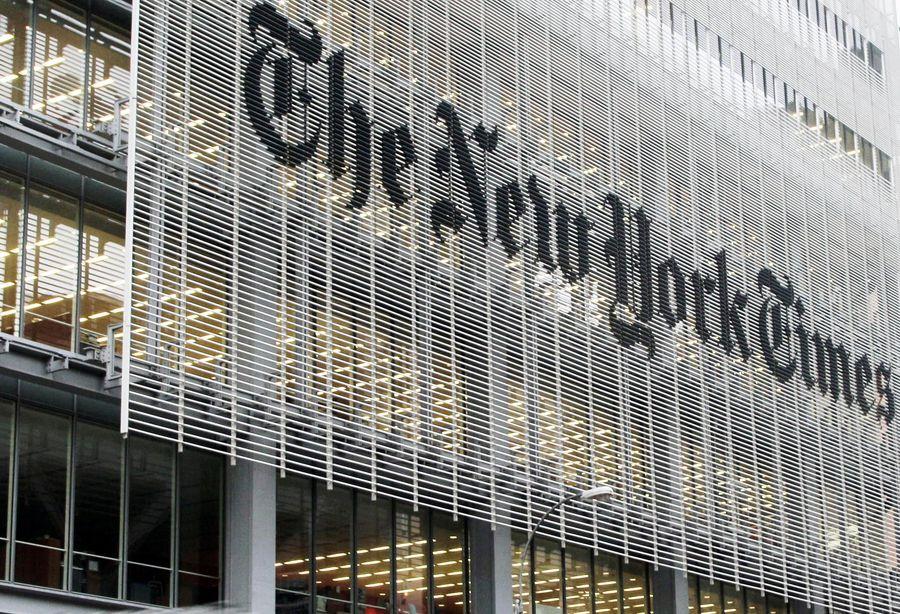
FILE- This Oct. 10, 2012, file photo shows the New York Times building in New York. The New York Times Co. reports earnings Thursday, Feb. 8, 2018. (AP Photo/Richard Drew, File)
Give Thanks for America's Increasing Fairness
Published Nov. 29, 2019 • Read time: 4m
It's Thanksgiving week in a country whose warring political tribes are not much inclined to giving thanks. But any American with a reasonable historic perspective can easily find reasons to do so.
For one thing, it's clear that we are a much fairer nation than we were in the past. Women, black Americans, immigrants and minorities of any perceptible kind are treated more fairly and in a more friendly manner than was the case within the memory of many of us now living.
Evidence of this comes from the strained attempts of those who criticize the country and desperately insist that things are just as bad as they ever were. The New York Times' The 1619 Project, for example, insists that anti-black racism is the central theme of American history. Author Ta-Nehisi Coates seems to argue that American racism is as strong today as ever -- and always will be.
A more sensible estimate comes via an interview by World Socialist Web Site's Tom Mackaman of Princeton historian James McPherson, the nation's premier Civil War historian. The Times, surprisingly, did not interview McPherson for its 1619 Project articles, which he called "a very unbalanced, one-sided account."
Slavery and racism were part of the American story, he argued, but so are anti-slavery and civil rights movements. And "the idea that racism is a permanent condition, well that's just not true," he said. You don't have to match McPherson's mastery of the subject -- few do -- to know that's true.
Most black Americans, the group with the most firsthand exposure to examples of anti-black racism -- agree with him. Political polling shows that any increase in those believing that racism is an impenetrable barrier to black Americans comes not from blacks but from liberal white college graduates.
Rethinking the Pledge; Trump and Women; One Last Egg Roll; Eulogizing Ike
2016: A Repeat of the 1960s
An Apology, Fashioned for Nancy Reagan
Nancy Reagan, Guardian of a Legacy
In his New York Times blog, Thomas Edsall cites research showing many black voters have shifted from blaming racial discrimination for blacks' statistical disadvantages to blaming individual-based behavior.
Since Donald Trump's election, affluent white college graduates have increasingly blamed racism. As evidence they often cite 1930s New Deal housing programs' "redlining" and the 1955 murder of Emmett Till. This desperate hunt for unfairness in the distant past and the insistence that nothing has changed are pure virtue signaling, untethered to observations of contemporary American life.
Actual contemporary evidence indicates blacks are doing better in a fairer society. Crime rates, incarceration rates and teen pregnancy rates are way down from the 1990s, as Columbia undergraduate Coleman Hughes writes in Quillette. And bachelor's degrees and life expectancies are way up. Not entirely unconnected with this is the perhaps politically awkward fact that lower-income and minority Americans have been experiencing record-low unemployment and higher-than-average wage gains during the last three years.
Complaints still come in saying that social mobility is decreasing, and that various elite educational and economic categories do not contain the same percentages of blacks and some other minorities as the larger society. But it is an illusion of social engineers that a free society can be arranged with identical percentages of every identifiable group in every identifiable category. And it is a fact -- a melancholy fact, perhaps, but a fact -- that an increasingly fair society will have a decreasing degree of social mobility.
That's because in a fair society, people tend to end up in places where they started off. In a society like ours, with increasing assortative mating (people marrying those with similar interests and abilities), both nature and nurture -- hereditary traits and child-rearing practices -- tend to produce a generation of relatively few people with the capacity and inclination to climb, or fall down from, the socioeconomic ladder.
The good news is that our advanced and increasingly fair society has many such ladders and many fewer barriers. And as a recent academic study published by the National Academy of Sciences finds: "Americans overestimate the intergenerational persistence in income ranks. They overestimate economic prospects for children from rich families and underestimate economic prospects for those from poor families."
Many academics and journalists seem fixated on income inequality and the gap between billionaires and others. Ordinary Americans seem more concerned about fairness -- they embrace equal treatment and reject racial quotas and preferences -- and about showing equal respect to fellow citizens regardless of income or wealth. This is all reason for thanks, in my view, in an increasingly fair nation -- one that can get fairer still if social engineers stay out of the way.
COPYRIGHT 2019 CREATORS.COM

A RealClear Thanksgiving: Investing in a Better Future
David DesRosiers • RealClearPolitics
Trump’s Newsom Problem: Antagonist-in-Chief
Carolina Lumetta • RealClearPolitics
America’s Free Spirit
John Maxwell Hamilton • RealClearPolitics
The GOP Majority Should Go Out in Glory
Daniel McCarthy • RealClearPolitics
Republican Majorities Could Return Sooner Than Expected
J.T. Young • RealClearPolitics
The Danger Before the Attack
Leslie J. Sullivan • RealClearPolitics
RCP Today
Top stories on RealClearPolitics
The Takeaway
Polling intelligence and analysis delivered to your inbox
World News
Featuring the latest world news
Policy
Featuring the latest policy news
Support Our Mission
As part of RealClearPolitics, authors aim to provide balanced, non-partisan analysis by presenting top reporting and commentary from all sides of the political spectrum.
Trusted by policymakers and citizens alike since 2000