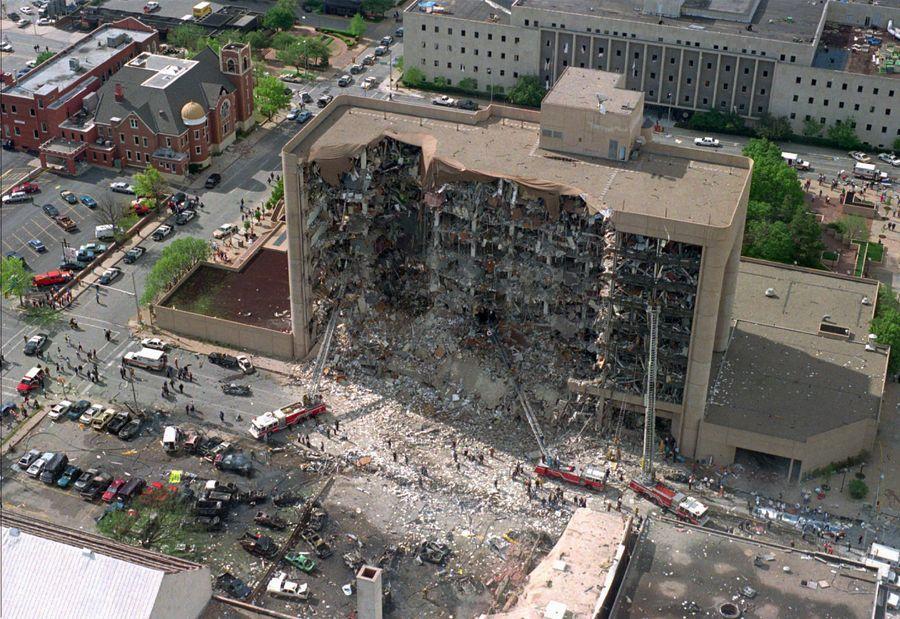
9:02 A.M., April 19, 1995
COMMENTARY
Published April 20, 2020 • Read time: 7m
Join the Conversation
0For every generation, there’s a first “do you remember where you were when” moment. My grandparents all remembered where they were when they found out that the Japanese had bombed Pearl Harbor. My parents remember where they were when they learned that President Kennedy had been shot. For Generation-Xers it would likely be the Challenger explosion. I suspect for older Millennials it would be 9/11 or when Barack Obama won the presidency. My children will probably remember learning that school would be canceled because of a pandemic.
These moments become cumulative over the course of a lifetime; I remember exactly where I was on 9/11, as do, I suspect, most Boomers. But some moments are only universal among a smaller subsection of the population. One such moment occurred 25 years ago yesterday, in Oklahoma City. On that morning, Timothy McVeigh pulled a Ryder truck filled with explosives in front of the Alfred P. Murrah Federal Building, lit the fuse in a drop-off zone, and walked away. At 9:02 a.m., the bomb detonated, smashing the front of the building and killing 168 people. The blast was powerful enough that my mother felt it in the classroom where she worked as a teacher’s aide, 15 miles away.
I remember vividly walking through my college’s common room that morning. I was a senior, and probably very much not thinking about making my classes that day. As I turned to the big screen television, I saw images of a city with a plume of smoke rising over it, with police, ambulance and fire sirens blaring. I initially thought that it must be some dust-up in the Middle East, but quickly recognized the skyline as my adopted hometown.
Rethinking the Pledge; Trump and Women; One Last Egg Roll; Eulogizing Ike
2016: A Repeat of the 1960s
An Apology, Fashioned for Nancy Reagan
Nancy Reagan, Guardian of a Legacy
It’s hard to convey how differently public tragedies were experienced in the pre-internet era. On the one hand, we were badly limited in the information we could obtain; if the news program you were watching didn’t carry a given news item, you missed it. If you went to class, you were detached from the world. At the same time, there were fewer options with which to distract oneself; we still lived in a world of broadcast network television, and the networks were dedicated to this story and only this story.
Most importantly for my purposes, there were no cellphones. This sent me sprinting up the steps to my dorm room to call home. At the time, the limited reports were that a federal installation in Oklahoma City had been bombed; the news footage didn’t look like Tinker Air Force Base, where my dad was stationed, but I couldn’t be sure. Unfortunately, the phone lines to Oklahoma were jammed, and so, in the absence of texts or e-mail, it was several hours before I could learn that my parents were fine.
After I graduated a month later I returned home and learned, as we would be reminded six years later, that Six Degrees of Kevin Bacon is not just a parlor game; it’s an eerily accurate descriptor of the world amid tragedy. Even if you weren’t affected directly by the bombing, if you lived in Oklahoma City you were almost certainly only one or two steps from someone who was.
One of my mother’s students lost a father. One of my father’s airmen lost a wife. I served on the alumni board for the Oklahoma Foundation for Excellence. The office was directly across from the Murrah Building, and a shard of glass from an exploding window struck the director in the neck, severing her jugular vein; she miraculously survived (with help from a fast-thinking co-worker).
When I returned home, I got a job as a bartender at a local family restaurant (this was decidedly not what my parents had in mind for me). My co-bartender had actually narrowly escaped death himself. He drove past the Murrah Building every morning around 9 on his way to open up the restaurant. On that day he realized he had forgotten the baseball hat that he wore daily and turned around to retrieve it; he saw the explosion in the rear-view mirror of his car.
I probably learned more useful life lessons in that job (and the similar job I worked once I arrived in Washington, D.C., a few months later) than in any other, but one life lesson in particular is relevant here. Most of the people I encountered in my job were pleasant – that in itself was an important life lesson – but one couple in particular was just awful. They would come in, take a seat, sit and stare at each other, and rarely order any food. Unlike other patrons, they didn’t engage with the staff, responding to questions only with monosyllables or even hand gestures. After a while, they would leave.
At one point, I approached the owner to complain about the family. I went on for some time about them until he politely interrupted me and said, “Sean, those are Baylee Almon’s parents.”
Every defining memory also has its defining image, and for the Oklahoma City bombing it is definitely the image of a firefighter carrying the lifeless body of a toddler out of the wreckage. McVeigh had pulled into the drop-off zone under the daycare center at the Murrah Building. Of the 168 people he killed, 19 were children. The child in that image was one of those children, Baylee Almon.
One of my favorite book quotes is from “To Kill a Mockingbird,” which many students read in middle or high school. For some reason, I always found Scout’s paraphrase of Atticus Finch to be particularly meaningful: “You never really know a man until you stand in his shoes and walk around in them.” This was a confirmatory moment. The Almons were my Boo Radley, two people who looked and behaved like caricatures of an unhappy couple determined to bring the world down to their level. It wasn’t until I actually learned something about them and could see the world somewhat from their point of view that I could understand they were just normal people struggling with an extraordinarily horrific life event, and probably doing so in the exact same way that I would if, God forbid, I were ever placed in a similar situation.
I’ve thought about this experience throughout my life and I think about it a lot today. Genuine monsters are real, but in my experience they are few and far between. Broken people struggling to hold themselves together are far more common.
And yet, so many of our interactions today are online, where you don’t even have the benefit of matching an actual name to a seemingly unpleasant person. In large part because of this, it’s easy to blow up at someone and bring yourself down to their level without even pausing to think about who you are lashing out at. I’ve watched people “drag” strangers when even a moment of reflection might reveal that this was unjust; I’ve seen longstanding friendships and even families ripped apart over a Facebook post or a tweet that would barely cause a ripple in an interpersonal interaction.
We’re obviously living in a nerve-wracking time in our nation’s history. The effects of a corrosive presidential election are being compounded by a virus that has us largely confined to our houses, adding familial and financial strains to an already vicious environment.
So just remember when you encounter a person saying something thoughtless, insensitive, or outright stupid on social media: The odds are that you know nothing about them. They could be fighting through a family loss; they could be staring down bankruptcy; they could be struggling with mental health issues. I’m far from perfect in this regard, but if we could resist dunking on someone unless we’ve walked in their shoes and know them well enough that we really can ascertain their point of view, we’d probably all be better off. It’s quite easy to be a positive force in someone’s life, even inadvertently. It’s much easier to be toxic, and the consequences of the latter can be far more devastating than the former, regardless of how righteous your intent might be.

A RealClear Thanksgiving: Investing in a Better Future
David DesRosiers • RealClearPolitics
Trump’s Newsom Problem: Antagonist-in-Chief
Carolina Lumetta • RealClearPolitics
America’s Free Spirit
John Maxwell Hamilton • RealClearPolitics
The GOP Majority Should Go Out in Glory
Daniel McCarthy • RealClearPolitics
Republican Majorities Could Return Sooner Than Expected
J.T. Young • RealClearPolitics
The Danger Before the Attack
Leslie J. Sullivan • RealClearPolitics
RCP Today
Top stories on RealClearPolitics
The Takeaway
Polling intelligence and analysis delivered to your inbox
World News
Featuring the latest world news
Policy
Featuring the latest policy news
Support Our Mission
As part of RealClearPolitics, authors aim to provide balanced, non-partisan analysis by presenting top reporting and commentary from all sides of the political spectrum.
Trusted by policymakers and citizens alike since 2000