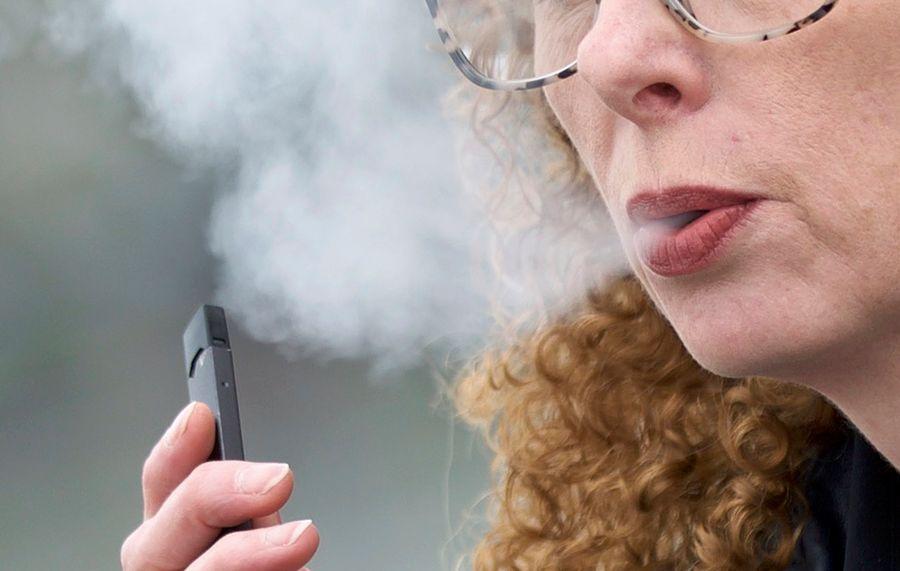
FILE - In this April 16, 2019 file photo, a woman exhales while vaping from a Juul pen e-cigarette in Vancouver, Wash. Schools have been wrestling with how to balance discipline with treatment in their response to the soaring numbers of vaping students. Using e-cigarettes, often called vaping, has now overtaken smoking traditional cigarettes in popularity among students, says the Centers for Disease Control and Prevention. Last year, one in five U.S. high school students reported vaping the previous month, according to a CDC survey. (AP Photo/Craig Mitchelldyer)
Vaping Scare: Unhealthy Actions From Health Officials
COMMENTARY
Published Sept. 13, 2019 • Read time: 4m
A recent spate of “vaping-related” illnesses and a handful of deaths have grabbed headlines and sounded alarms. While it’s understandable the public is concerned about young people falling seriously ill after vaping, government officials at the Food and Drug Administration, the Centers for Disease Control and Prevention, and now the White House have amplified anxieties and undermined public health by failing to report the facts and spreading “unnecessarily vague” information.
The several hundred cases of severe respiratory illnesses were not triggered by legal, regulated e-cigarettes. New York University public health professor Ray Niaura points out that those products “have been on the market for a long time,” making it highly unlikely that traditional e-cigarettes are suddenly causing lung problems.
And he’s right. Health officials have now determined that most of the acute lung problems involve a contaminant, derived from vitamin E, which is found in illicit tetrahydrocannabinol or THC, the psychoactive chemical in marijuana. Those liquids were bought from unregulated street vendors.
CDC officials were “unnecessarily vague” in describing the lung incidents, as Boston University Professor Michael Siegel put it. Rather than blaming illicit THC oil, they continue to ambiguously describe these incidents as if they were caused by legal products, leading the public to believe that all e-cigarettes and vape products are killers. But this opaqueness serves another federal government purpose: to kill the e-cigarette industry.
President Calls Drug Addiction a Health Problem
Lawmakers Hail New Opioid Rules -- But Call for More
No Opiates for the Masses?
Obamacare's Tax-Time Torment
In August, while acknowledging the first lung disease death, CDC Director Dr. Robert Redfield said that “this tragic death in Illinois reinforces the serious risks associated with e-cigarette products.” The CDC’s Dr. Brian King echoed the same theme in a briefing, noting, “There’s a variety of harmful ingredients identified” in e-cigarettes. “We haven’t specifically linked any of those specific ingredients to the current cases but we know that e-cigarette aerosol is not harmless.” Vague, generalized warnings do nothing to help the public make informed decisions. Rather, they give media outlets free rein to fuel the fire by using terms like “epidemic” and “outbreak.”
And physician and advocacy groups like the American Medical Association have only exacerbated the mystery around these products. When asked in a recent NPR interview about the link between the lung illnesses and vaping, AMA President Dr. Patrice Harris said, “Well, unfortunately, we just don’t know. … That’s why the AMA recommended that everyone avoid e-cigarettes at this time.”
Even adults who have already used vaping to quit smoking? Dr. Harris, that is deadly advice. The CDC – and physician groups – should be telling the public that nearly a half million Americans die each year from cigarette smoking. That’s over 1,300 … Every. Single. Day. For the past 30-plus years.
Smokers burn tobacco to release and inhale nicotine laced with a toxic tar containing 7,000 chemicals. After 20 or 30 years, they have high risks for heart diseases, many cancers, asthma, emphysema and more. Vaping is a form of harm reduction, and it’s considered 95% safer than cigarettes. Not perfectly safe, but a big improvement over smoking. Not sharing this information – and instead letting a frenzy develop over vaping – is harm escalation.
Dr. Siegel correctly noted that the government should provide useful information to Americans. When he excoriated the CDC for its misguided language, Siegel pointed out that “responsible public warnings need to be as specific as possible about the risk. In an outbreak of E. coli caused by a contaminated batch of lettuce, we don’t tell the public that the disease is associated with eating, or even that it is associated with eating lettuce.” And Siegel is right. Health officials have an obligation to provide clear and useful guidance on how best to avoid or reduce risks. Americans deserve this, whether they are smoking cigarettes, using e-cigarettes, or vaping illicit THC products.
The downside to scaremongering about vaping is huge. Millions of former smokers who transitioned to far less harmful vaping may assume they made a mistake and return to cigarettes. Millions more will never consider making the switch to vaping. Cigarettes are the real killer. But anti-nicotine extremists want to eliminate cigarettes’ biggest competitor, which makes them the real threat to public health.

Newsom Defies Voters, Juries and Lawmakers To Spare Murderers While Defending Abortion
Curtis Hill • RealClearPolitics
The Algorithmic Tilt
Frank Filingeri • RealClearPolitics
A RealClear Thanksgiving: Investing in a Better Future
David DesRosiers • RealClearPolitics
Trump’s Newsom Problem: Antagonist-in-Chief
Carolina Lumetta • RealClearPolitics
America’s Free Spirit
John Maxwell Hamilton • RealClearPolitics
The GOP Majority Should Go Out in Glory
Daniel McCarthy • RealClearPolitics
RCP Today
Top stories on RealClearPolitics
The Takeaway
Polling intelligence and analysis delivered to your inbox
World News
Featuring the latest world news
Policy
Featuring the latest policy news
Support Our Mission
As part of RealClearPolitics, authors aim to provide balanced, non-partisan analysis by presenting top reporting and commentary from all sides of the political spectrum.
Trusted by policymakers and citizens alike since 2000