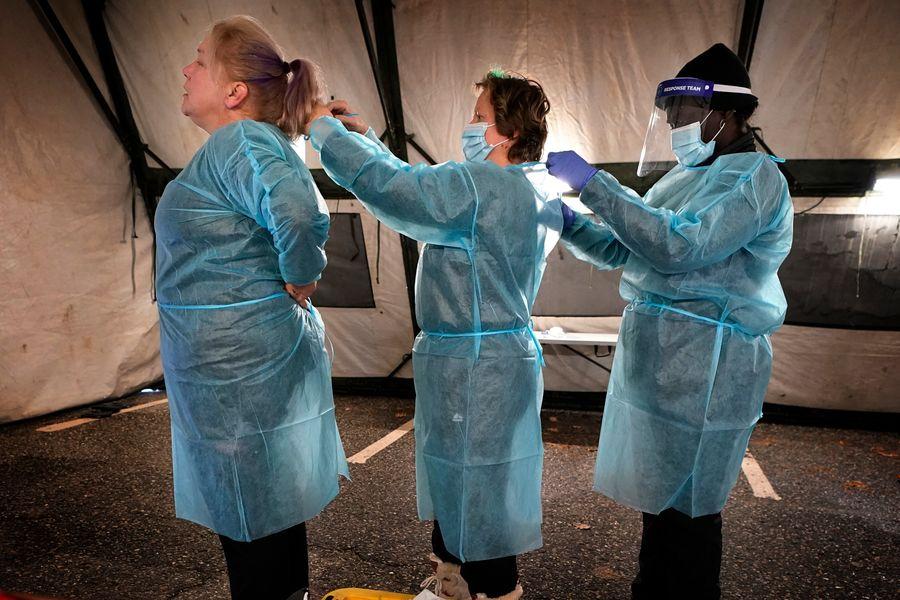
Virus Outbreak Maine
Déjà Flu: How To Avoid Another Lockdown
COMMENTARY
Published Jan. 25, 2025 • Read time: 4m
President Donald Trump withdrew America from the World Health Organization on the first day of the second presidency. Trump cited the WHO’s mishandling of the COVID-19 pandemic, a sentiment many Americans share, especially toward its ineffective lockdowns that shuttered our nation for years.
Yet, as different sicknesses emerge, partial mask mandates are coming back, and hospital visitation limits for loved ones are also returning. With the bird flu, there are already mass shortages of eggs in supermarkets, and scientists are rushing to develop an mRNA vaccine to prevent further deaths.
As an ex-FDA chief already declared, a lousy rerun of the 2020 pandemic response could happen if health organizations or the federal government can’t control these illnesses. Their reliance on lockdowns would cost us our economy, children’s education, and fundamental freedoms.
Americans must resist federal lockdowns, letting the states take charge to champion a balanced, pro-liberty pandemic response.
With forced isolations, the federal government let the national economy and its workers slip into freefall. In 2022, the National Bureau of Economic Research (NBER) published a working paper determining that lockdowns hurt the general and state economies. Other business studies showed lockdowns reducing GDP by 5.4% and decreasing consumer spending by 7.5% after three months. Air travel, dining, and social services sectors shrunk by at least 27%.
The toll of this negligence cost taxpayers $14 trillion – two times the impact of the Great Recession.
Shockingly, the NBER paper also found that districts with locked-down economies didn’t even have better health outcomes. Consequently, one-third of America’s small businesses and 22 million nonfarm jobs were sacrificed for nothing.
In the small chance of another pandemic, we must advocate for federal officials to minimize their intervention and preserve economic freedom. Local governments should tailor public health responses based on community conditions instead of national mandates, as they are more apt to deal with backyard issues. Thus, instead of quarantining everyone, they can introduce relevant measures that protect the most vulnerable demographics so they can work uninterrupted. It’s a creative and fiscally responsible way to boost public health infrastructure, lessen the risk of transmission, and avoid job closures.
Learning from COVID’s errors, flexibility is the key to navigating turbulence. Relaxing regulations will help worksites adapt to new developments and let us choose whether to adhere to suggested health measures. We’ve seen how nationwide protests occur when big government curtails our right to assemble and the intensified lack of trust that follows.
States must inform the entire population of a sickness’s risks not as a fearmongering tactic but to empower us to make our own decisions. It reinforces the fundamental principle that government exists to serve, not control, their economic needs. Indeed, economic vitality should be common ground between the governors and the governed, and this respect for autonomy is the trust that will prepare us for the next pandemic.
We shouldn’t take up this cause solely for our workers; we must also fight for our kids’ education.
Last pandemic’s school shutdowns saw a nationwide decrease in standardized testing scores, reading performances, and language learning in children. Further, children from disadvantaged backgrounds experienced a skill loss comparable to dropping from a B to a C in about half of their school subjects. As higher rates of remote instruction were linked to larger learning losses, parents now won’t enroll their kids in public education, including kindergarten programs. Education experts believe there is “a real possibility” that these effects are permanent.
The solution is simple: Keep the schools open. A balanced response values mental health and social development as essential as “slowing the spread.” Allow families to decide the best course of action for their children, especially with the anxiety of remote-only learning. For low-income families, quality education is upward mobilization. Schools must be open to reduce dependency on the same government programs and closures that caused educational deficits.
Look no further than Gov. Ron DeSantis’ approach to COVID-19 in Florida as a role model. DeSantis implemented an early and phased reopening strategy that prioritized face-to-face learning while offering learning options to families. Florida emphasized closing achievement gaps and linked school reopenings to economic recovery. While pro-shutdown officials slammed DeSantis, Florida reported low school-related COVID-19 case rates, with fewer than 1% of registered students identified as having school-related cases.
If Americans remember and enact a similarly bold battle plan, a flu or virus will be no match for our people, industries, and schools.
In a nation founded on liberty, autonomy is a moral imperative and a practical strategy for achieving public health goals. Whether bird flu or norovirus is next doesn’t matter; it matters that America rejects the lockdown mentality and embraces a balanced pandemic response of medical and personal freedom.


RCP Today
Top stories on RealClearPolitics
The Takeaway
Polling intelligence and analysis delivered to your inbox
World News
Featuring the latest world news
Policy
Featuring the latest policy news
Support Our Mission
As part of RealClearPolitics, authors aim to provide balanced, non-partisan analysis by presenting top reporting and commentary from all sides of the political spectrum.
Trusted by policymakers and citizens alike since 2000