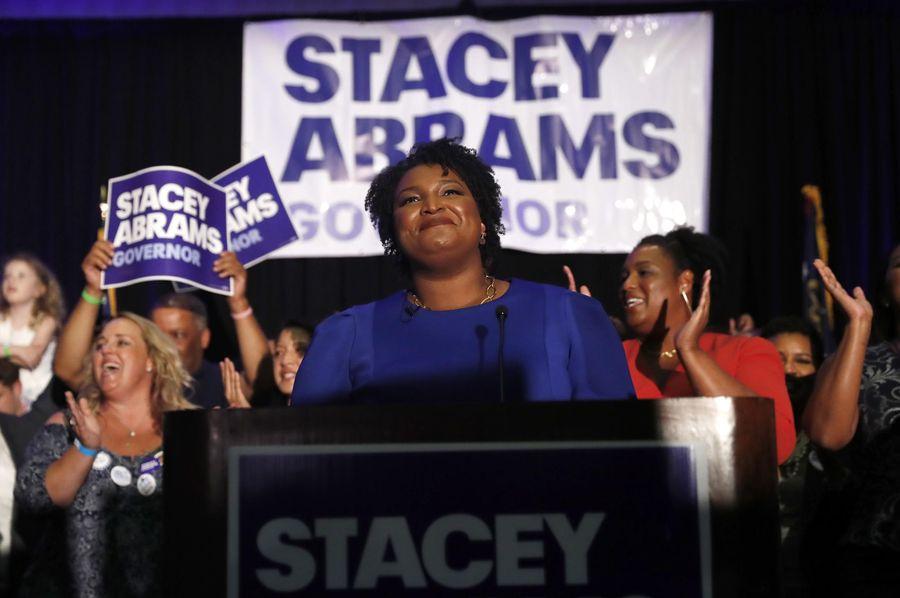
FILE - In this May 22, 2018, file photo, Georgia Democratic gubernatorial candidate Stacey Abrams smiles before speaking to supporters during an election-night watch party in Atlanta. More women than ever before have won their primaries for governor, U.S. Senate and House this year. Thatâs setting a record and paving the way for battles in November that could significantly increase the number of women in elected office. (AP Photo/John Bazemore, File)
Will Toxic Politics Stem the Surge in Women Candidates?
COMMENTARY
Published Aug. 30, 2018 • Read time: 4m
When Hillary Clinton lost the 2016 presidential election, it sparked a surge of female candidates. According to Rutgers Center for American Women and Politics, nearly 500 women initially filed to run for the U.S. House of Representatives, 54 filed for the Senate, and 77 for governor – a record number of women running for office. While some are clearly running against President Trump, others saw Clinton’s loss as a rallying cry that women still have a long way to go to reach parity in politics. But is this year’s uptick in women running for office the start of a long-term trend, or a one-time reaction? Will the increasingly poisonous political atmosphere that is causing too many voters to tune out, ultimately dissuade more women from entering the political field in the future?
We often talk about the impact women will have on our political systems – their potential to get more accomplished, tackle issues men may avoid, and simply bring fresh perspectives to our governing bodies. But we don’t often consider how our political system – and today’s political climate, in particular – may impact the supply of female candidates.
The good news is that sexism doesn’t seem to be as big a barrier to women succeeding in politics as in the past. Certainly there are still too many conversations about female candidates’ appearance and family life. But Jennifer Lawless and Danny Hayes at American University have found that candidates’ gender “does not affect journalists’ coverage of, or voters’ attitudes toward, the women and men running for office in their districts.” Jody Newman of the National Women’s Political Caucus discovered back in 1994 that “when women run for office, they win as often as men do.”
Defending Boys in a "Girl Power" Age
Dress Codes and Female Dignity
The Monsterization of Men
Genderfication of Adolescence
The disparity seems to be driven instead by women choosing not to run in the first place. Research suggests simply asking women to run can have a big impact on increasing their participation – but still there may be a bigger obstacle keeping women from leaning into the political sphere. The character of the modern campaign makes many women recoil from politics (not to mention many men). In 2013, Kristin Kanthak and Jonathan Woon from the University of Pittsburgh conducted a randomized controlled experiment, which concluded, “[E]lections themselves – rather than differences in ability or relative confidence – dissuade women from entering the fray.”
The “noisiness” of a modern political campaign simply makes communicating seem too arduous and unpleasant. It’s not that women candidates don’t have a thick skin or can’t hold their own in a debate – they certainly do. Rather, it’s the perception that any individual in politics can’t make their perspectives heard or significantly impact the conversation. And when there are so many other ways in which women believe they can be influential, well, politics too often falls off the to-do list.
It’s exciting to see so many women actively engaging in the political sphere this year. But it’s hard not to wonder how the intensified toxicity of our political culture – exacerbated by a 24-hour news cycle and social media – may affect women’s participation over the long term. It’s worrisome to think that there may be a backlash as women witness the challenge of female candidates trying to break through the noise and have their viewpoints heard.
The intense political heat, which may be driving more women to launch campaigns this year, has the potential to keep women after them from following suit. We should all want to improve our political climate so that we can have a more productive conversation about policy solutions to problems in health care, energy, education, foreign policy, and other areas. And the fever pitch of political divisiveness may keep qualified female candidates from participating in fixing our collective problems – just when we need them most.
Programs like Running Start dismantle barriers to power by reaching women earlier in life with a message of political agency. Perhaps even more important, Running Start brings together young women of varying political viewpoints to engage in civics and civil disagreement so that when they arrive in public office – or any other positions of leadership – they’re prepared to practice healthy forms of debate. Isn’t it time we all start doing the same?

A RealClear Thanksgiving: Investing in a Better Future
David DesRosiers • RealClearPolitics
Trump’s Newsom Problem: Antagonist-in-Chief
Carolina Lumetta • RealClearPolitics
America’s Free Spirit
John Maxwell Hamilton • RealClearPolitics
The GOP Majority Should Go Out in Glory
Daniel McCarthy • RealClearPolitics
Republican Majorities Could Return Sooner Than Expected
J.T. Young • RealClearPolitics
The Danger Before the Attack
Leslie J. Sullivan • RealClearPolitics
RCP Today
Top stories on RealClearPolitics
The Takeaway
Polling intelligence and analysis delivered to your inbox
World News
Featuring the latest world news
Policy
Featuring the latest policy news
Support Our Mission
As part of RealClearPolitics, authors aim to provide balanced, non-partisan analysis by presenting top reporting and commentary from all sides of the political spectrum.
Trusted by policymakers and citizens alike since 2000