SCOTUS Decision on Coach's Prayer May Determine Extent of Diversity
COMMENTARY
Published May 3, 2022 • Read time: 4m
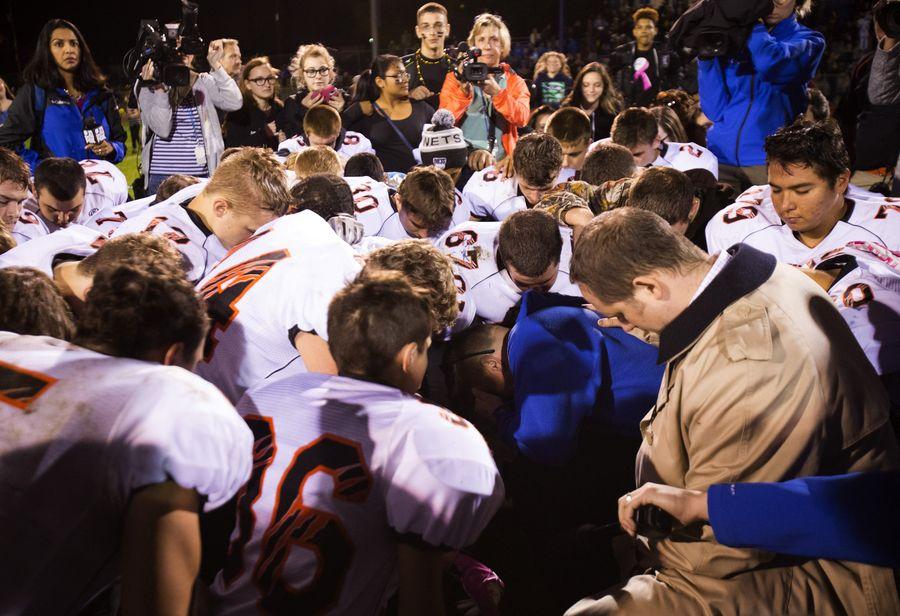
The Supreme Court just heard a case deciding whether a football coach could be fired for praying at the 50-yard line. At stake in this case is not just the job of one football coach, but the future of religious expression in public schools. The arguments seemed to go very well for Coach Joe Kennedy, a former public high school coach who had to leave his job because the Bremerton, Washington school district couldn’t stand his quiet, visible prayer after games.
It’s no secret that students, teachers, and coaches have diverse religious beliefs, and that sometimes they might express those beliefs on school grounds. The school district said it was right to penalize Coach Kennedy because his prayer was visible to football players as young as 14. The school has it backwards. Religion is a natural part of human life, one we shouldn’t be afraid of letting 14-year-olds see (and if we’re being honest, one they’ve probably already seen elsewhere). For too long, our law has treated religious expression like asbestos – a relic of a bygone era, toxic to students and best left hidden in old walls.
The source of this approach is a series of Supreme Court decisions running back to the 1970s, decisions which aged about as well as asbestos insulation. The Lemon and endorsement tests, as they are known, prohibit schools from advancing religion or appearing to endorse religion. Advancement and endorsement are in the eye of the beholder, and school boards (not to mention their lawyers) are quick to see religious endorsement at every turn. That’s how we get a world where Coach Kennedy can lose his job for quiet prayers, or leaders in Maine decide that it’s ok to fund private schools but not private schools that teach religion, since lack of religious teaching is a “defining characteristic of a public education.” That last quote is the subject of another Supreme Court case this term, and time will tell whether Maine or common sense prevails.
An Easter Lesson in Judging Not
Is ISIS Faithful to Islam?
Press Club Welcomes Rezaian Back Home
Hostility to Tradition
Taking these doctrines to their (il)logical endpoint, the school district’s lawyers claimed that, if teenagers saw Coach Kennedy pray in public, they might feel uncomfortable. But what about the effect on students of faith – any faith – who watch a coach be fired for praying in public? What message does this send to a Muslim student who is looking for a place to pray during the school day, or a Jewish student deciding whether to wear a kippah under his baseball cap? If allowing quiet religious expression is deemed to send the wrong message, what message is sent by actual penalties on religious expression? If religious expression is punished and religious adults are banished, students of all faiths and none lose an important opportunity to learn about deep diversity – and hear an unmistakable message about how their own faith expression will be treated in school.
The district’s lawyer accused Coach Kennedy of “divid[ing]” school staff and sparking “vitriol” against school officials by praying after football games. But what sparked the controversy was not prayer. It was the district’s decision to suppress it. Indeed, the students who initially joined Coach Kennedy in prayer on the field did so in solidarity with him, after he was reprimanded. This should come as no surprise: In the international context, research has shown that countries that allow more freedom of religion have far lower levels of social violence than those that do not. The district tried valiantly to blame Coach Kennedy’s peaceful prayers for creating a post-game “zoo,” but the “zoo” was a reaction to the district’s own aggressive moves to silence Coach Kennedy and prevent students who shared his faith from exercising their own.
At the Becket Fund for Religious liberty, we defend people of all faiths, and we urged the Court in a friend-of-the-court brief to ensure that religious expression by teachers and students is protected. If Coach Kennedy can be fired for praying, then students lose out – not only on a football coach they respect, but on the opportunity to express their own faith, or to see the diverse faith expressions of coaches, teachers, and students in their own community. If Bremerton wants better diversity education in public schools, perhaps school officials will find that our Constitution provides just the diversity education they need.

A RealClear Thanksgiving: Investing in a Better Future
David DesRosiers • RealClearPolitics
Trump’s Newsom Problem: Antagonist-in-Chief
Carolina Lumetta • RealClearPolitics
America’s Free Spirit
John Maxwell Hamilton • RealClearPolitics
The GOP Majority Should Go Out in Glory
Daniel McCarthy • RealClearPolitics
Republican Majorities Could Return Sooner Than Expected
J.T. Young • RealClearPolitics
The Danger Before the Attack
Leslie J. Sullivan • RealClearPolitics
RCP Today
Top stories on RealClearPolitics
The Takeaway
Polling intelligence and analysis delivered to your inbox
World News
Featuring the latest world news
Policy
Featuring the latest policy news
Support Our Mission
As part of RealClearPolitics, authors aim to provide balanced, non-partisan analysis by presenting top reporting and commentary from all sides of the political spectrum.
Trusted by policymakers and citizens alike since 2000